Needham committee clears key wording in draft tree-protection rules, keeps arborist requirement
February 03, 2026 | Town of Needham, Norfolk County, Massachusetts
This article was created by AI summarizing key points discussed. AI makes mistakes, so for full details and context, please refer to the video of the full meeting. Please report any errors so we can fix them. Report an error »
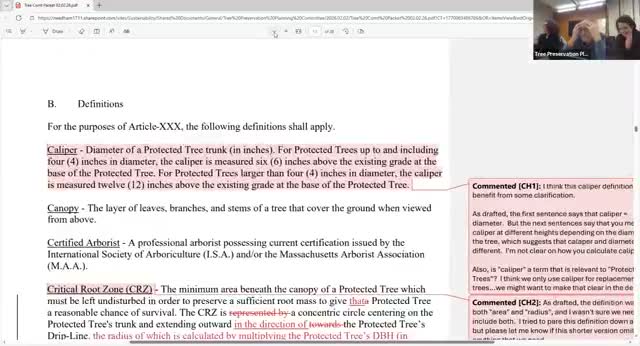
The Tree Preservation Planning Committee of the Town of Needham spent its Feb. 2 meeting reviewing town-council comments on a draft tree-protection bylaw and related regulations, agreeing on several drafting changes and next steps.
Committee members agreed to remove repeated references to “protected” from several definitions and to clarify measurement language for tree size: caliper (used for younger trees) and diameter at breast height (DBH, measured 4.5 feet above grade) should be stated consistently and left to staff/arborist review for exact wording. On the critical root zone, members favored Chris’s suggested rewrite that defines the zone as a concentric circle centered on the trunk with a radius calculated by multiplying DBH (in inches) by 18.
“We’re removing protected tree,” an attending committee member said during the discussion, reflecting a move to simplify definitions and avoid circular phrasing. The committee asked staff member Ed to review the proposed technical measurements.
A central operational decision involved the tree protection and mitigation plan itself: the group agreed the regulations should streamline the plan title (e.g., “tree protection plan” or “tree protection and mitigation plan”) and clarify submission timing (file prior to commencement of permitted work) and the appropriate permitting authority rather than naming the building department exclusively.
On professional standards, members debated whether certified arborist input should be required for all plans. After discussion the committee agreed to retain a certified-arborist requirement for mitigation plans affecting significant or legacy trees while seeking thresholds or provisions to reduce cost burden on small homeowners. “So so we’re okay with keeping the arborist then?” a member asked; others answered affirmatively while asking staff and Chris to draft threshold language.
The committee also reorganized the regulations into clearer subsections for tree retention, replanting, and removal; it favored moving numeric mitigation ratios and incentive details (for example, higher credit for overstory species) into the mitigation-fee schedule so the bylaw text remains readable while the fee schedule contains the calculations and tables.
Several practical conflicts were flagged for the consultant’s (Chris’s) review: where trunks sit on lot lines, whether a tree with 50% of its trunk inside the protected zone should count, and how the tree bylaw will interact with the town’s zoning bylaw when existing encroachments or rebuilding permits are involved. Committee members agreed to put those conflicts on a short list for Chris to resolve at the next meeting.
On enforcement, members debated bond provisions versus tying compliance to permit closeout or certificate-of-occupancy inspections. Several members favored relying on permit closeout as primary verification and to revisit bond language for larger projects only.
The committee set next steps: staff will ask Ed to review the technical definitions and Chris to attend an upcoming meeting; mitigation-fee scenario homework was assigned and the committee scheduled a mitigation-fee-focused discussion for March 9. The meeting ended after a standard motion and roll-call vote to adjourn.
Votes at a glance
- Motion to approve the Jan. 12 minutes — approved (remote roll-call recorded during meeting).
- Motion to adjourn — approved (roll-call vote recorded).
Committee members agreed to remove repeated references to “protected” from several definitions and to clarify measurement language for tree size: caliper (used for younger trees) and diameter at breast height (DBH, measured 4.5 feet above grade) should be stated consistently and left to staff/arborist review for exact wording. On the critical root zone, members favored Chris’s suggested rewrite that defines the zone as a concentric circle centered on the trunk with a radius calculated by multiplying DBH (in inches) by 18.
“We’re removing protected tree,” an attending committee member said during the discussion, reflecting a move to simplify definitions and avoid circular phrasing. The committee asked staff member Ed to review the proposed technical measurements.
A central operational decision involved the tree protection and mitigation plan itself: the group agreed the regulations should streamline the plan title (e.g., “tree protection plan” or “tree protection and mitigation plan”) and clarify submission timing (file prior to commencement of permitted work) and the appropriate permitting authority rather than naming the building department exclusively.
On professional standards, members debated whether certified arborist input should be required for all plans. After discussion the committee agreed to retain a certified-arborist requirement for mitigation plans affecting significant or legacy trees while seeking thresholds or provisions to reduce cost burden on small homeowners. “So so we’re okay with keeping the arborist then?” a member asked; others answered affirmatively while asking staff and Chris to draft threshold language.
The committee also reorganized the regulations into clearer subsections for tree retention, replanting, and removal; it favored moving numeric mitigation ratios and incentive details (for example, higher credit for overstory species) into the mitigation-fee schedule so the bylaw text remains readable while the fee schedule contains the calculations and tables.
Several practical conflicts were flagged for the consultant’s (Chris’s) review: where trunks sit on lot lines, whether a tree with 50% of its trunk inside the protected zone should count, and how the tree bylaw will interact with the town’s zoning bylaw when existing encroachments or rebuilding permits are involved. Committee members agreed to put those conflicts on a short list for Chris to resolve at the next meeting.
On enforcement, members debated bond provisions versus tying compliance to permit closeout or certificate-of-occupancy inspections. Several members favored relying on permit closeout as primary verification and to revisit bond language for larger projects only.
The committee set next steps: staff will ask Ed to review the technical definitions and Chris to attend an upcoming meeting; mitigation-fee scenario homework was assigned and the committee scheduled a mitigation-fee-focused discussion for March 9. The meeting ended after a standard motion and roll-call vote to adjourn.
Votes at a glance
- Motion to approve the Jan. 12 minutes — approved (remote roll-call recorded during meeting).
- Motion to adjourn — approved (roll-call vote recorded).
View the Full Meeting & All Its Details
This article offers just a summary. Unlock complete video, transcripts, and insights as a Founder Member.
✓
Watch full, unedited meeting videos
✓
Search every word spoken in unlimited transcripts
✓
AI summaries & real-time alerts (all government levels)
✓
Permanent access to expanding government content
30-day money-back guarantee
