Committee hears testimony on Senate Bill 6,086 to expand protections for judicial officers and court staff
January 22, 2026 | Legislative Sessions, Washington
This article was created by AI summarizing key points discussed. AI makes mistakes, so for full details and context, please refer to the video of the full meeting. Please report any errors so we can fix them. Report an error »
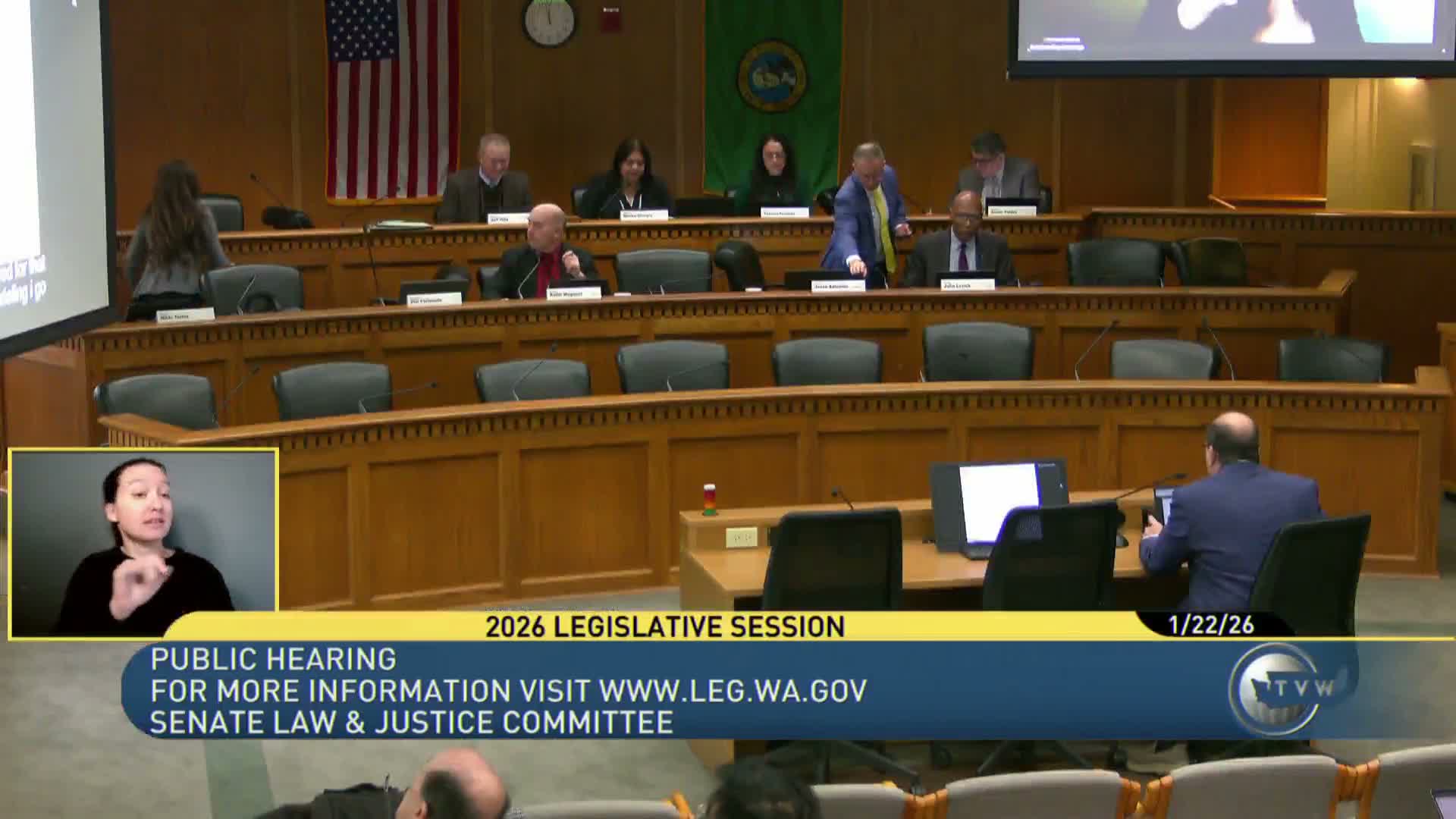
The Law and Justice Committee heard testimony on Senate Bill 6,086 during its Jan. 22 public hearing. The bill would broaden the circumstances under which the unlawful online disclosure of personal information about judicial officers and court staff is prohibited and would expand eligibility for removal and civil remedies.
Staff briefing: Tim Ford told the committee the bill would remove the current requirement that a threat be “imminent and serious” to qualify unlawful publication of personal information, expand the list of covered individuals (including judicial officers and court clerks), and allow the administrative office of the courts to use security consultants to carry out threat assessments and receive certain non-conviction criminal-history information.
Supporters’ case: Jaylee (Administrative Office of the Courts) said the bill responds to a sustained rise in threats and would provide a clear, enforceable path to protect personal information; she said threat assessments by AOC security consultants would provide backup when local capacity is overstretched. “When safety is compromised, the independence of our courts is at risk,” she said. Judge Sean O’Donnell described the tone of threats judges are receiving and urged protections. Catherine Cornwall, clerk for King County Superior Court, told the committee clerks’ names appear on many court documents and that clerks have been targeted; she said a county clerk previously had to relocate for more than a month after a threat was judged credible.
Implementation concerns: County and records officials supported the policy goal but raised operational hurdles. Timothy Grisham (Washington Association of County Officials) and Michael Shaw (County Auditors Association) noted costs and technical constraints to redact records already in digital archives and asked for clarification of the bill’s “good-faith” language. Heather Hirataka (state archivist) said the state archive holds hundreds of millions of records, many with the fields in question, and asked to work with sponsors to clarify archives’ role.
Constitutional and legal concerns: Russell Brown (Washington Association of Prosecuting Attorneys) cautioned about language that uses the term “threat,” pointing to longstanding constitutional doctrine on true threats, and noted tension between prompt removal and First Amendment protections for certain publicly provided materials.
Next steps: Committee members thanked proponents and opponents for detailed input and indicated an intent to continue negotiating technical fixes before executive consideration. No final committee vote on the underlying bill was recorded at the hearing’s close.
Why it matters: The bill addresses personal safety for members of the judiciary and court staff and touches on privacy, records management and constitutional free-speech issues; county auditors and archivists warned the committee that implementation could carry unbudgeted costs for redaction and digital-archive management.
Staff briefing: Tim Ford told the committee the bill would remove the current requirement that a threat be “imminent and serious” to qualify unlawful publication of personal information, expand the list of covered individuals (including judicial officers and court clerks), and allow the administrative office of the courts to use security consultants to carry out threat assessments and receive certain non-conviction criminal-history information.
Supporters’ case: Jaylee (Administrative Office of the Courts) said the bill responds to a sustained rise in threats and would provide a clear, enforceable path to protect personal information; she said threat assessments by AOC security consultants would provide backup when local capacity is overstretched. “When safety is compromised, the independence of our courts is at risk,” she said. Judge Sean O’Donnell described the tone of threats judges are receiving and urged protections. Catherine Cornwall, clerk for King County Superior Court, told the committee clerks’ names appear on many court documents and that clerks have been targeted; she said a county clerk previously had to relocate for more than a month after a threat was judged credible.
Implementation concerns: County and records officials supported the policy goal but raised operational hurdles. Timothy Grisham (Washington Association of County Officials) and Michael Shaw (County Auditors Association) noted costs and technical constraints to redact records already in digital archives and asked for clarification of the bill’s “good-faith” language. Heather Hirataka (state archivist) said the state archive holds hundreds of millions of records, many with the fields in question, and asked to work with sponsors to clarify archives’ role.
Constitutional and legal concerns: Russell Brown (Washington Association of Prosecuting Attorneys) cautioned about language that uses the term “threat,” pointing to longstanding constitutional doctrine on true threats, and noted tension between prompt removal and First Amendment protections for certain publicly provided materials.
Next steps: Committee members thanked proponents and opponents for detailed input and indicated an intent to continue negotiating technical fixes before executive consideration. No final committee vote on the underlying bill was recorded at the hearing’s close.
Why it matters: The bill addresses personal safety for members of the judiciary and court staff and touches on privacy, records management and constitutional free-speech issues; county auditors and archivists warned the committee that implementation could carry unbudgeted costs for redaction and digital-archive management.
View the Full Meeting & All Its Details
This article offers just a summary. Unlock complete video, transcripts, and insights as a Founder Member.
✓
Watch full, unedited meeting videos
✓
Search every word spoken in unlimited transcripts
✓
AI summaries & real-time alerts (all government levels)
✓
Permanent access to expanding government content
30-day money-back guarantee
