Budget committee certifies $577.1M surplus as commissioner outlines ‘standstill’ executive budget and five‑year gaps
January 23, 2026 | 2026 Legislature LA, Louisiana
This article was created by AI summarizing key points discussed. AI makes mistakes, so for full details and context, please refer to the video of the full meeting. Please report any errors so we can fix them. Report an error »
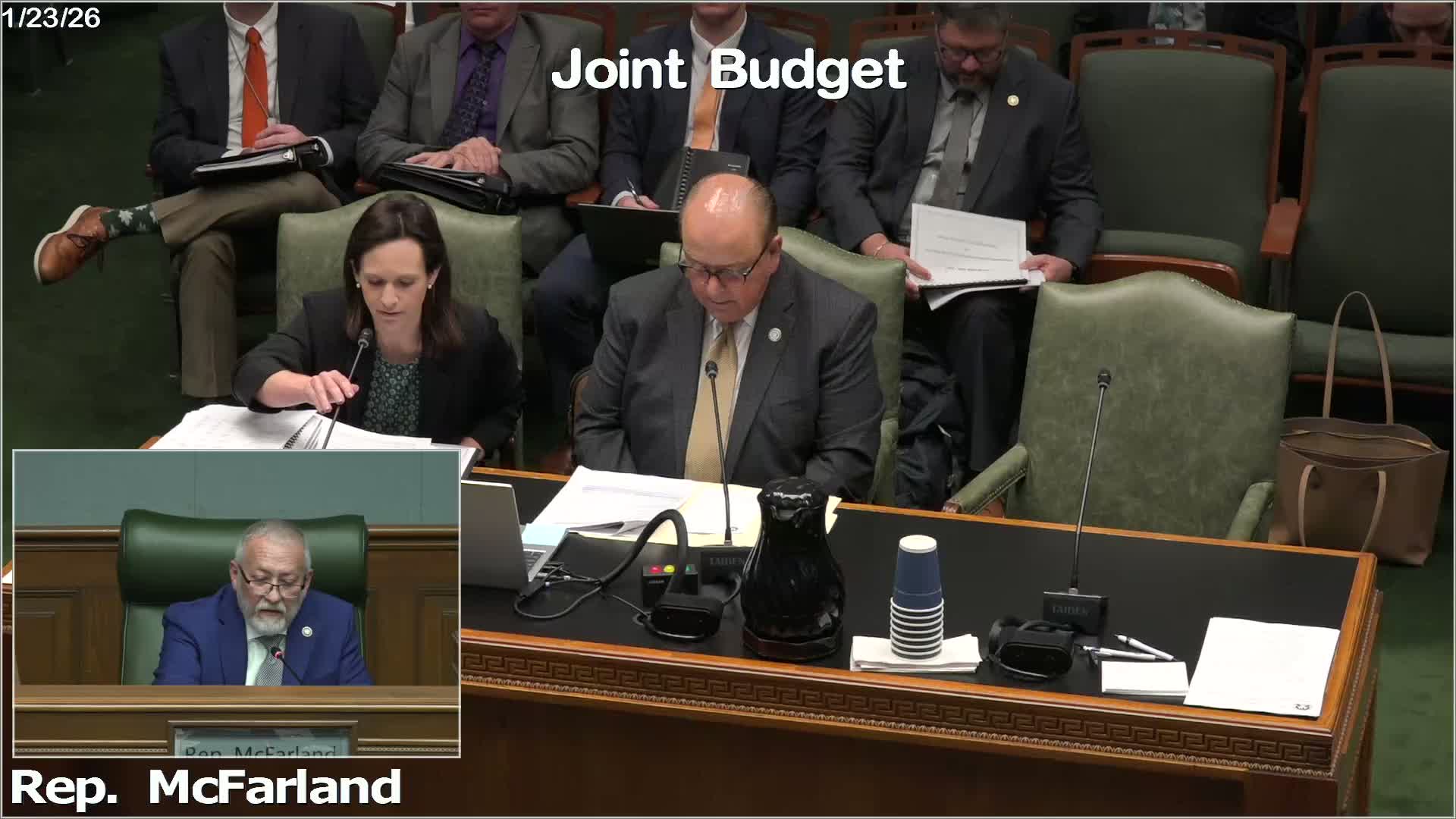
The Joint Budget Committee certified a state surplus of $577,073,871 and received a detailed presentation of the governor’s FY‑27 executive budget and five‑year baseline on Feb. 3.
Colleen Gill of the Office of Planning and Budget presented the January fiscal status statement and the surplus total, saying the figure has been unchanged since October. Taylor Barra, the commissioner of administration, formally certified the surplus under Title 39, section 75 and the committee approved the fiscal status statement by voice vote after Speaker de VA moved approval.
Gill and Barra told members the five‑year baseline shows balanced results in FY‑26 and FY‑27 but increasing structural shortfalls thereafter: about a $379 million deficit in FY‑28, roughly $614 million in FY‑29 and close to $977 million in FY‑30. Barra attributed the shortfalls mainly to a revenue decline tied to rededication of motor vehicle sales tax to the Transportation Trust Fund and to rising statewide costs such as Medicaid utilization and medical inflation.
“This will be a three‑year step,” Barra said of the administration’s approach to incorporating efficiency savings identified through the LA DOGE optimization exercise. He described a roughly $250–$300 million efficiency estimate being incorporated into the standstill budget rather than relying on one‑time revenue to fund recurring costs.
Budget highlights the administration included in the package:
- LA Gator vouchers: $44.2 million in new funding to expand the voucher program in addition to roughly $42.43 million that continues to fund the traditional voucher cohort. Barra said the additional $44.2 million aims to open eligibility to more families (including some kindergarten and multi‑child households) and to fund a second priority tranche of applicants. “If you’re using the $50 million number, this would give it a $90 million availability, for applications for LA Gator,” Barra said.
- Louisiana Economic Development: $75 million for a ‘‘High Impact Jobs’’ program to support site development and recruitment.
- DCFS modernization: $12 million to begin improvements to the Department of Children and Family Services’ information systems and a possible later funds‑bill request to digitize records.
- Corrections: funding to add capacity and staffing at Louisiana State Penitentiary (Angola), including funding for an increase in offenders and approximately 150 positions; local housing per‑diem was also increased.
Gill and Barra also outlined means‑of‑finance substitutions that increase State General Fund obligations by $86.5 million — including swaps in state police funding — and noted a SNAP administrative cost‑share change that raises the state share from 50% to 75% effective Oct. 1, 2026.
On surplus uses, Barra reminded members that statute requires 25% to be deposited to the Budget Stabilization Fund and 25% to repay the unfunded accrued liability; the remainder (about $288 million) is typically allocated across capital outlay, coastal protection, debt defeasance or highway projects. Barra said the administration would likely recommend highway priority investments and proposed a $10 million deposit to the voting technology fund, though final decisions will come with the funds bill.
Committee members asked for details about modernization and DCFS funding priorities, the interplay between federal and state money in the totals presented, and how long‑term savings will be sustained. Representative Amadeh questioned rising Medicaid payments shown in the baseline; Gill explained the increases reflect managed care organization adjustments, nursing‑home rebases and anticipated utilization changes.
There was no recorded roll‑call vote for the fiscal status statement; the committee approved the certification and moved on to subsequent agenda matters.
What’s next: the committee will continue hearings on the executive budget and related BA (budget amendment) requests; the administration noted some figures may be adjusted after the May 16 constitutional amendment election.
Colleen Gill of the Office of Planning and Budget presented the January fiscal status statement and the surplus total, saying the figure has been unchanged since October. Taylor Barra, the commissioner of administration, formally certified the surplus under Title 39, section 75 and the committee approved the fiscal status statement by voice vote after Speaker de VA moved approval.
Gill and Barra told members the five‑year baseline shows balanced results in FY‑26 and FY‑27 but increasing structural shortfalls thereafter: about a $379 million deficit in FY‑28, roughly $614 million in FY‑29 and close to $977 million in FY‑30. Barra attributed the shortfalls mainly to a revenue decline tied to rededication of motor vehicle sales tax to the Transportation Trust Fund and to rising statewide costs such as Medicaid utilization and medical inflation.
“This will be a three‑year step,” Barra said of the administration’s approach to incorporating efficiency savings identified through the LA DOGE optimization exercise. He described a roughly $250–$300 million efficiency estimate being incorporated into the standstill budget rather than relying on one‑time revenue to fund recurring costs.
Budget highlights the administration included in the package:
- LA Gator vouchers: $44.2 million in new funding to expand the voucher program in addition to roughly $42.43 million that continues to fund the traditional voucher cohort. Barra said the additional $44.2 million aims to open eligibility to more families (including some kindergarten and multi‑child households) and to fund a second priority tranche of applicants. “If you’re using the $50 million number, this would give it a $90 million availability, for applications for LA Gator,” Barra said.
- Louisiana Economic Development: $75 million for a ‘‘High Impact Jobs’’ program to support site development and recruitment.
- DCFS modernization: $12 million to begin improvements to the Department of Children and Family Services’ information systems and a possible later funds‑bill request to digitize records.
- Corrections: funding to add capacity and staffing at Louisiana State Penitentiary (Angola), including funding for an increase in offenders and approximately 150 positions; local housing per‑diem was also increased.
Gill and Barra also outlined means‑of‑finance substitutions that increase State General Fund obligations by $86.5 million — including swaps in state police funding — and noted a SNAP administrative cost‑share change that raises the state share from 50% to 75% effective Oct. 1, 2026.
On surplus uses, Barra reminded members that statute requires 25% to be deposited to the Budget Stabilization Fund and 25% to repay the unfunded accrued liability; the remainder (about $288 million) is typically allocated across capital outlay, coastal protection, debt defeasance or highway projects. Barra said the administration would likely recommend highway priority investments and proposed a $10 million deposit to the voting technology fund, though final decisions will come with the funds bill.
Committee members asked for details about modernization and DCFS funding priorities, the interplay between federal and state money in the totals presented, and how long‑term savings will be sustained. Representative Amadeh questioned rising Medicaid payments shown in the baseline; Gill explained the increases reflect managed care organization adjustments, nursing‑home rebases and anticipated utilization changes.
There was no recorded roll‑call vote for the fiscal status statement; the committee approved the certification and moved on to subsequent agenda matters.
What’s next: the committee will continue hearings on the executive budget and related BA (budget amendment) requests; the administration noted some figures may be adjusted after the May 16 constitutional amendment election.
View the Full Meeting & All Its Details
This article offers just a summary. Unlock complete video, transcripts, and insights as a Founder Member.
✓
Watch full, unedited meeting videos
✓
Search every word spoken in unlimited transcripts
✓
AI summaries & real-time alerts (all government levels)
✓
Permanent access to expanding government content
30-day money-back guarantee
