State study recommends phased Utah Lake recovery with $6–11M pilot, long-term program outlined
January 09, 2026 | 2026 Utah Legislature, Utah Legislature, Utah Legislative Branch, Utah
This article was created by AI summarizing key points discussed. AI makes mistakes, so for full details and context, please refer to the video of the full meeting. Please report any errors so we can fix them. Report an error »
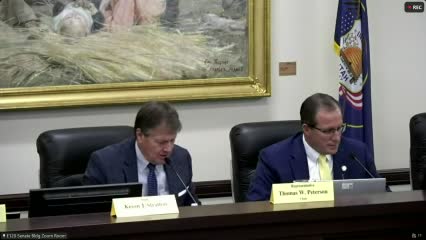
The Division of Forestry, Fire and State Lands presented the Utah Lake Study to the commission on Jan. 9, which synthesizes past research and recommends a phased, adaptive approach to restoring lake health.
Ben Steierman (Deputy Director, FFSL) told commissioners that the lake faces four compounding stressors—large numbers of invasive carp (the study cites roughly 750,000 carp counted in 2025), sediment resuspension and unstable sediments, excess nutrients, and abnormal water-level swings (seasonal fluctuations up to several feet). The study concludes passive recovery is unlikely and recommends coordinated, phased action across four management tracks: invasive carp control, habitat and sediment management, nutrient reduction and management, and increasing human-access and benefits.
The recommended first phase is a pilot covering roughly 100 acres with estimated spending of $6 million (minimum) to $11 million (preferred) over the 2026–2030 window to test approaches and measure ecological responses. The study stresses adaptive management to avoid unintended consequences—for example, removal of carp could increase water clarity in ways that affect submerged vegetation and native fish (June sucker) unless habitat is restored concurrently.
Commissioners asked for metrics and next steps; presenters said the study includes metrics and that dedicated staffing, sustained funding and interagency coordination will be necessary. The commission asked staff to work with the division on an appropriation request for phase‑1 funding and to provide an infographic and metric dashboard to summarize expected outcomes and indicators.
What happens next: study authors will provide staff materials and work with the commission and appropriations staff on a possible phase‑1 funding request and implementation roadmap.
Ben Steierman (Deputy Director, FFSL) told commissioners that the lake faces four compounding stressors—large numbers of invasive carp (the study cites roughly 750,000 carp counted in 2025), sediment resuspension and unstable sediments, excess nutrients, and abnormal water-level swings (seasonal fluctuations up to several feet). The study concludes passive recovery is unlikely and recommends coordinated, phased action across four management tracks: invasive carp control, habitat and sediment management, nutrient reduction and management, and increasing human-access and benefits.
The recommended first phase is a pilot covering roughly 100 acres with estimated spending of $6 million (minimum) to $11 million (preferred) over the 2026–2030 window to test approaches and measure ecological responses. The study stresses adaptive management to avoid unintended consequences—for example, removal of carp could increase water clarity in ways that affect submerged vegetation and native fish (June sucker) unless habitat is restored concurrently.
Commissioners asked for metrics and next steps; presenters said the study includes metrics and that dedicated staffing, sustained funding and interagency coordination will be necessary. The commission asked staff to work with the division on an appropriation request for phase‑1 funding and to provide an infographic and metric dashboard to summarize expected outcomes and indicators.
What happens next: study authors will provide staff materials and work with the commission and appropriations staff on a possible phase‑1 funding request and implementation roadmap.
Don't Miss a Word: See the Full Meeting!
Go beyond summaries. Unlock every video, transcript, and key insight with a Founder Membership.
✓
Get instant access to full meeting videos
✓
Search and clip any phrase from complete transcripts
✓
Receive AI-powered summaries & custom alerts
✓
Enjoy lifetime, unrestricted access to government data
30-day money-back guarantee
