Portland council frames 2026 priorities around Vision 0, housing and homelessness; staff to map next steps
January 12, 2026 | Portland, Cumberland County, Maine
This article was created by AI summarizing key points discussed. AI makes mistakes, so for full details and context, please refer to the video of the full meeting. Please report any errors so we can fix them. Report an error »
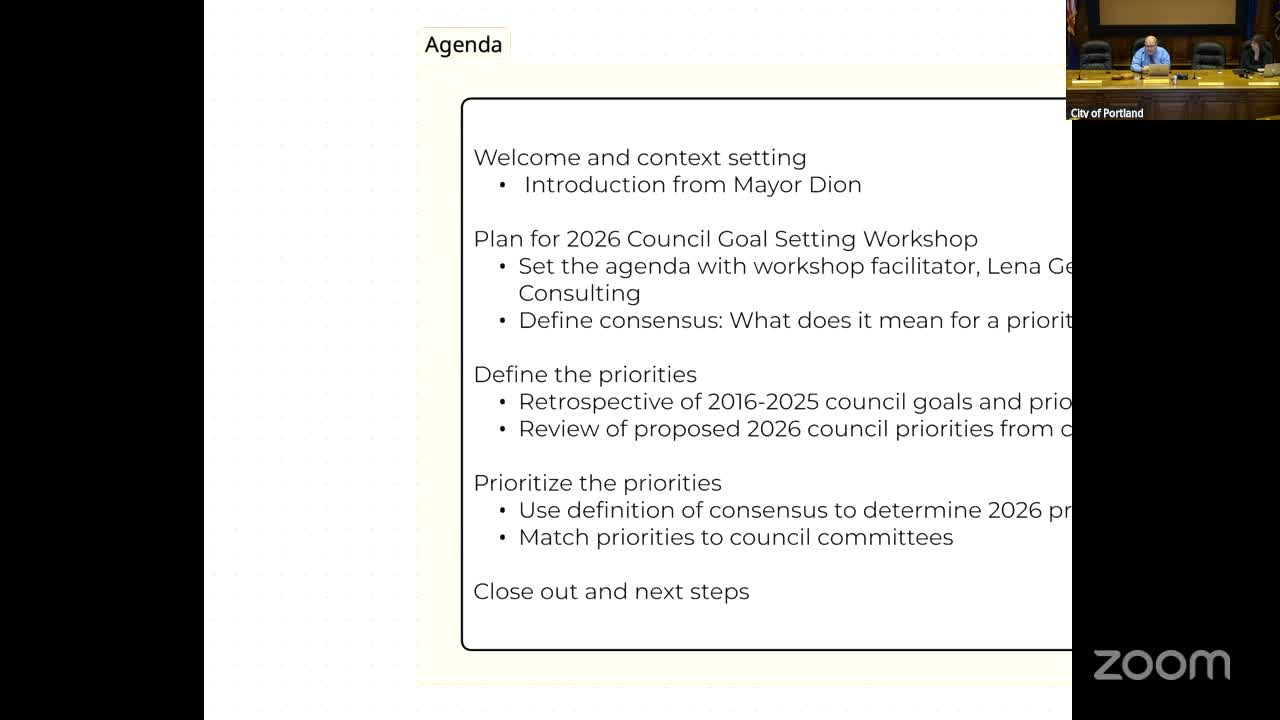
Mayor Mark Dion convened Portland’s goal-setting workshop and told councilors the session was intended to turn pre-work into a focused set of priorities for 2026. "This evening, we're convening the councils…for a workshop on goal setting for the upcoming calendar year," Dion said at the start of the meeting.
Facilitator Lena Garrity, who led the session, asked the council to define what ‘consensus’ should mean for including items as formal priorities and walked through a decade-long retrospective of past council priorities to frame tonight’s discussion. "We’re gonna start by defining consensus…Is it a strong majority? Is it your standard simple majority?" Garrity asked as the council debated whether inclusion would require a simple majority, seven votes for emergency measures, or the presence of active champions to move items forward.
Transportation — and the council’s role supporting the Vision 0 safety plan — emerged as the clearest area of agreement. Councilor Sykes urged improved interdepartmental coordination and creation of a "complete streets" committee, along with targeted changes to city speed limits and enforcement. Councilor Bullitt emphasized budgeting and community engagement as necessary to make Vision 0 visible in neighborhoods. Several councilors also raised the Franklin Street Arterial project as an item that will need council support when the initial design report arrives.
Housing and affordability dominated the next portion of discussion. Councilor Grant asked that the future of the Federated Midtown parcel be decided within a year and called for action on inclusionary zoning pending staff recommendations. Councilor Sykes noted the ongoing social-housing task force work and referenced a possible $50 million housing bond that has been under discussion, saying it could be one financing route for permanently affordable housing. On rent-control implementation, multiple councilors pressed for better data collection (leases and verified rent records) and improved enforcement processes rather than immediate policy changes.
Homelessness and service coordination drew extensive debate. Councilor McDevitt and others urged a time-limited task force or other mechanism to produce concrete recommendations and to clarify how existing bodies such as the Emergency Shelter Assessment Committee (ESAC/ESART) feed policy decisions. Councilor Grant proposed a measurable goal — reducing the staff-estimated chronic homelessness cohort (about 120 people, according to staff) by half over a year — which prompted discussion about whether a task force or better use of existing data and coordinated entry reporting would be the most effective next step.
Councilors also discussed municipal priorities on climate and sustainability, including assessing cruise-ship impacts and integrating climate resilience with development of the Federated Midtown parcel; public-health topics such as a senior center and workforce pipelines for fire/EMS; planning and permitting reforms to accelerate housing production; and economic-development items including resolving the Live Nation venue proposal and re-evaluating public support for the arts. On fiscal policy, options to diversify revenue and expand the senior tax equity program were raised.
No formal motions or votes were taken during the workshop; instead the council agreed to carry items into committee work plans. Garrity closed by saying she would return in the second half of the next workshop with a mapped set of priorities that show where council consensus exists and what will move to committee for implementation. Mayor Dion then adjourned the workshop.
What happens next: staff will map items the facilitator flags as having the most agreement to relevant committees for work-plan inclusion and return with a workshop update. The council did not adopt any ordinance, bond or binding commitment at the session.
Quotes (selected)
"This evening, we're convening the councils…for a workshop on goal setting for the upcoming calendar year," Mayor Mark Dion said at the opening.
"We're gonna start by defining consensus…Is it a strong majority? Is it your standard simple majority?" facilitator Lena Garrity asked as the council debated thresholds.
"I see there's a $50,000,000 housing bond referendum for vote here. That I've in a perfect world I would love that," Councilor Sykes said when discussing housing finance options.
"My impression after a year of seeing the data…is that the chronic homeless population is about 120 people. If we could reduce that by half, that would be a major victory," Councilor Grant said when proposing a quantifiable homelessness goal.
Ending note: the council left the workshop without binding decisions but with clear guidance to move transportation, housing and homelessness priorities into committee work plans for further study and possible action.
Facilitator Lena Garrity, who led the session, asked the council to define what ‘consensus’ should mean for including items as formal priorities and walked through a decade-long retrospective of past council priorities to frame tonight’s discussion. "We’re gonna start by defining consensus…Is it a strong majority? Is it your standard simple majority?" Garrity asked as the council debated whether inclusion would require a simple majority, seven votes for emergency measures, or the presence of active champions to move items forward.
Transportation — and the council’s role supporting the Vision 0 safety plan — emerged as the clearest area of agreement. Councilor Sykes urged improved interdepartmental coordination and creation of a "complete streets" committee, along with targeted changes to city speed limits and enforcement. Councilor Bullitt emphasized budgeting and community engagement as necessary to make Vision 0 visible in neighborhoods. Several councilors also raised the Franklin Street Arterial project as an item that will need council support when the initial design report arrives.
Housing and affordability dominated the next portion of discussion. Councilor Grant asked that the future of the Federated Midtown parcel be decided within a year and called for action on inclusionary zoning pending staff recommendations. Councilor Sykes noted the ongoing social-housing task force work and referenced a possible $50 million housing bond that has been under discussion, saying it could be one financing route for permanently affordable housing. On rent-control implementation, multiple councilors pressed for better data collection (leases and verified rent records) and improved enforcement processes rather than immediate policy changes.
Homelessness and service coordination drew extensive debate. Councilor McDevitt and others urged a time-limited task force or other mechanism to produce concrete recommendations and to clarify how existing bodies such as the Emergency Shelter Assessment Committee (ESAC/ESART) feed policy decisions. Councilor Grant proposed a measurable goal — reducing the staff-estimated chronic homelessness cohort (about 120 people, according to staff) by half over a year — which prompted discussion about whether a task force or better use of existing data and coordinated entry reporting would be the most effective next step.
Councilors also discussed municipal priorities on climate and sustainability, including assessing cruise-ship impacts and integrating climate resilience with development of the Federated Midtown parcel; public-health topics such as a senior center and workforce pipelines for fire/EMS; planning and permitting reforms to accelerate housing production; and economic-development items including resolving the Live Nation venue proposal and re-evaluating public support for the arts. On fiscal policy, options to diversify revenue and expand the senior tax equity program were raised.
No formal motions or votes were taken during the workshop; instead the council agreed to carry items into committee work plans. Garrity closed by saying she would return in the second half of the next workshop with a mapped set of priorities that show where council consensus exists and what will move to committee for implementation. Mayor Dion then adjourned the workshop.
What happens next: staff will map items the facilitator flags as having the most agreement to relevant committees for work-plan inclusion and return with a workshop update. The council did not adopt any ordinance, bond or binding commitment at the session.
Quotes (selected)
"This evening, we're convening the councils…for a workshop on goal setting for the upcoming calendar year," Mayor Mark Dion said at the opening.
"We're gonna start by defining consensus…Is it a strong majority? Is it your standard simple majority?" facilitator Lena Garrity asked as the council debated thresholds.
"I see there's a $50,000,000 housing bond referendum for vote here. That I've in a perfect world I would love that," Councilor Sykes said when discussing housing finance options.
"My impression after a year of seeing the data…is that the chronic homeless population is about 120 people. If we could reduce that by half, that would be a major victory," Councilor Grant said when proposing a quantifiable homelessness goal.
Ending note: the council left the workshop without binding decisions but with clear guidance to move transportation, housing and homelessness priorities into committee work plans for further study and possible action.
View the Full Meeting & All Its Details
This article offers just a summary. Unlock complete video, transcripts, and insights as a Founder Member.
✓
Watch full, unedited meeting videos
✓
Search every word spoken in unlimited transcripts
✓
AI summaries & real-time alerts (all government levels)
✓
Permanent access to expanding government content
30-day money-back guarantee
