Dallas reports 12.9% drop in NIBRS violent crime; council presses police on random gunfire response
January 12, 2026 | Dallas, Dallas County, Texas
This article was created by AI summarizing key points discussed. AI makes mistakes, so for full details and context, please refer to the video of the full meeting. Please report any errors so we can fix them. Report an error »
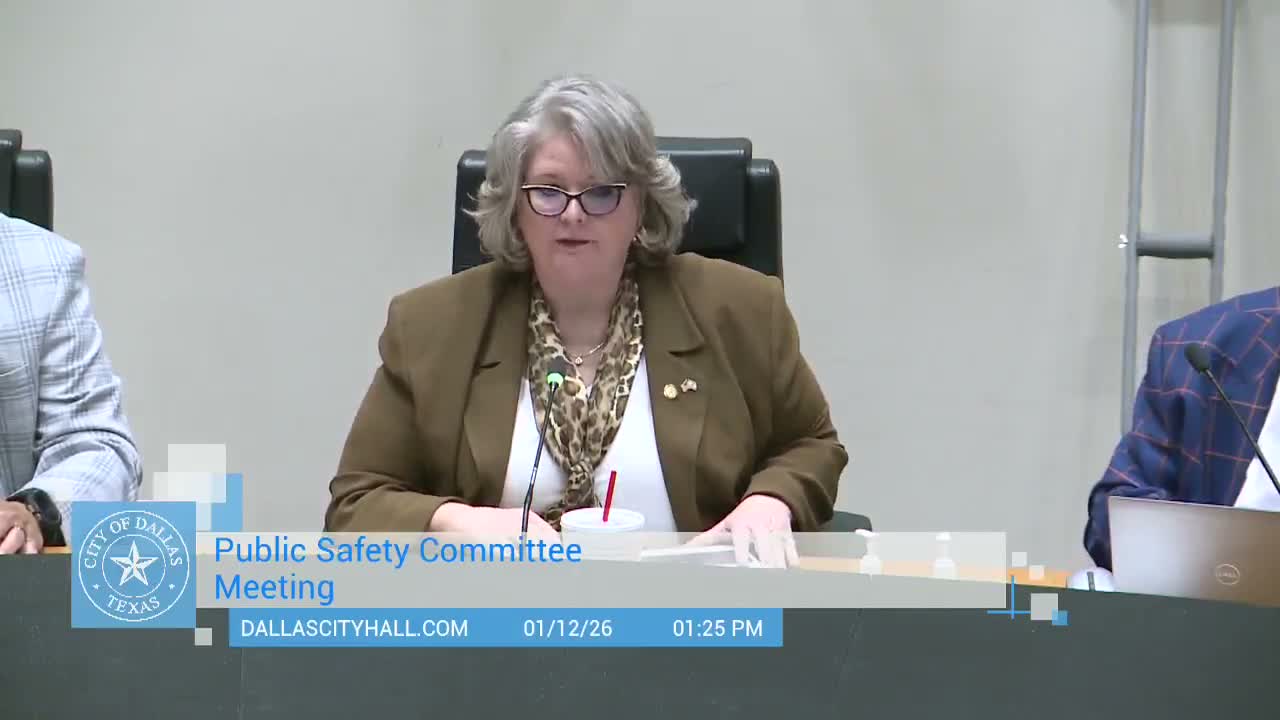
Major Andre Taylor opened the violent-crime briefing by noting the committee's update uses NIBRS (National Incident Based Reporting System) definitions and that "Slide 3 shows that violent crime is down 12.9% year to date." He said the decline reflects evidence-based strategies, technology and focused enforcement, including the winter initiative "Operation Holiday Heat" and continued work in PNI locations.
Taylor summarized focal efforts: micro-grid PNI locations (five city sites), the use of focus-deterrence outreach that yields voluntary engagement and support services for repeat-involved people, and increased victim contacts. "Random gunfire is some of the hardest crimes and the most dangerous crimes for us to solve," he said, and described New Year's Eve arrests that followed officers pursuing people discharging weapons in the air.
Multiple council members pressed DPD on the gap between citywide metrics and neighborhood experience. One council member representing District 4 said her office receives "2 to 3 calls daily" about random gunfire and reported community-collected shell casings; she urged a specific local resolve beyond citywide percentage declines. Another council member noted a Fox 4 story where a bullet entered a home and landed near a baby's crib and asked how the city can "get ahead of this." The Chair asked DPD to identify specific hot-spot locations (ten per district would be an example) and bring possible targeted interventions back next month.
Council also discussed proposed technology to detect random gunfire and a previously mentioned drone response. Supporters said new sensors and drones could help locate shooters quickly and tie detection to rapid officer dispatch; DPD said drones and detection technology will be integrated with existing systems from briefings and will be part of continued efforts.
The committee acknowledged a broader challenge: response priority levels impact how quickly officers arrive. A clarification was made in the meeting that random gunfire was a priority 3 (one speaker corrected an earlier reference), and staff noted actual dispatch priorities and presence in PNI grids are part of the operational tradeoffs when officers prioritize immediate-victim calls.
The committee praised year-over-year crime reductions but directed staff to return with neighborhood-specific proposals and prioritized locations to better align metrics with resident experience.
Taylor summarized focal efforts: micro-grid PNI locations (five city sites), the use of focus-deterrence outreach that yields voluntary engagement and support services for repeat-involved people, and increased victim contacts. "Random gunfire is some of the hardest crimes and the most dangerous crimes for us to solve," he said, and described New Year's Eve arrests that followed officers pursuing people discharging weapons in the air.
Multiple council members pressed DPD on the gap between citywide metrics and neighborhood experience. One council member representing District 4 said her office receives "2 to 3 calls daily" about random gunfire and reported community-collected shell casings; she urged a specific local resolve beyond citywide percentage declines. Another council member noted a Fox 4 story where a bullet entered a home and landed near a baby's crib and asked how the city can "get ahead of this." The Chair asked DPD to identify specific hot-spot locations (ten per district would be an example) and bring possible targeted interventions back next month.
Council also discussed proposed technology to detect random gunfire and a previously mentioned drone response. Supporters said new sensors and drones could help locate shooters quickly and tie detection to rapid officer dispatch; DPD said drones and detection technology will be integrated with existing systems from briefings and will be part of continued efforts.
The committee acknowledged a broader challenge: response priority levels impact how quickly officers arrive. A clarification was made in the meeting that random gunfire was a priority 3 (one speaker corrected an earlier reference), and staff noted actual dispatch priorities and presence in PNI grids are part of the operational tradeoffs when officers prioritize immediate-victim calls.
The committee praised year-over-year crime reductions but directed staff to return with neighborhood-specific proposals and prioritized locations to better align metrics with resident experience.
View the Full Meeting & All Its Details
This article offers just a summary. Unlock complete video, transcripts, and insights as a Founder Member.
✓
Watch full, unedited meeting videos
✓
Search every word spoken in unlimited transcripts
✓
AI summaries & real-time alerts (all government levels)
✓
Permanent access to expanding government content
30-day money-back guarantee
