DPD shifts to victim-centered approach, reports increased recoveries of trafficking victims
January 12, 2026 | Dallas, Dallas County, Texas
This article was created by AI summarizing key points discussed. AI makes mistakes, so for full details and context, please refer to the video of the full meeting. Please report any errors so we can fix them. Report an error »
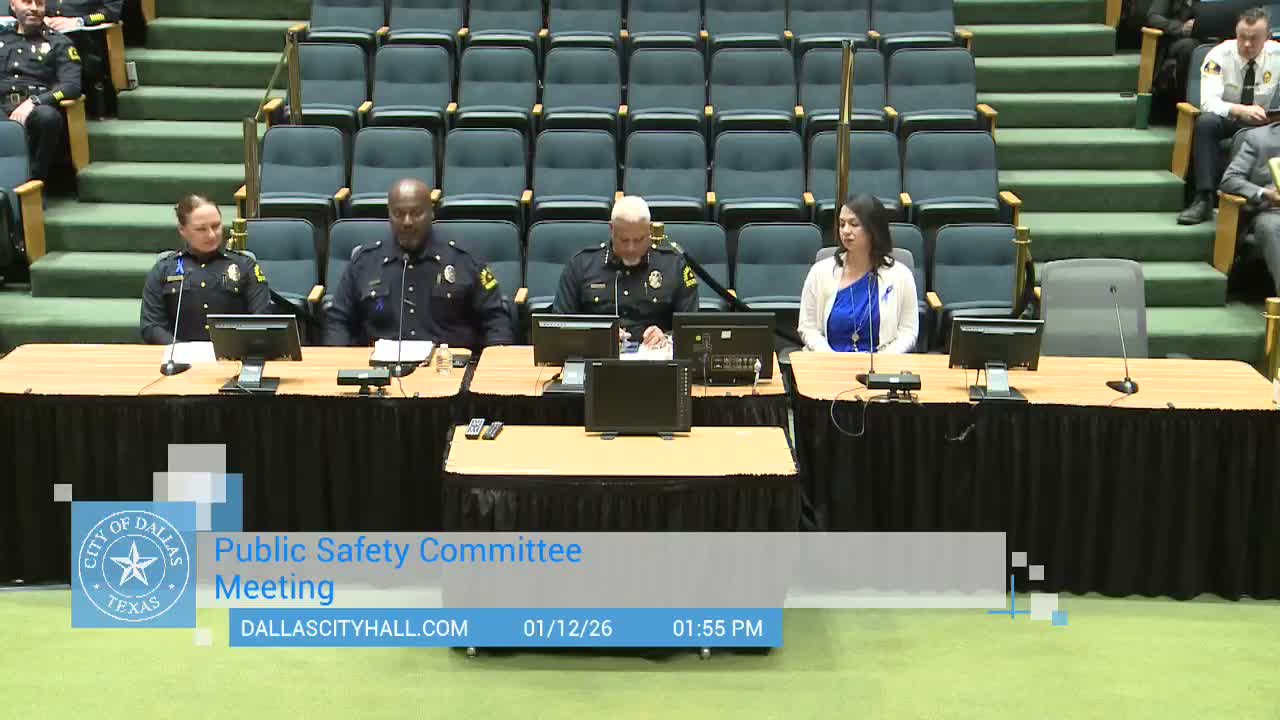
Major Aaron Harrell, commander of the Special Investigations Division, told the Public Safety Committee that DPD's human trafficking work is organized around three priorities: support and protection for victims, holding defendants accountable through investigation and prosecution, and shifting enforcement toward buyers and traffickers.
Harrell said the unit's change to a victim-centered approach drove a data pattern showing fewer reported cases overall while increasing arrests, victim contacts and services. He reported "63 victims free from exploitation and [who] receive services from our NGO partners." He added the division is emphasizing buyer-focused enforcement to disrupt networks driving demand.
Lieutenant Brianna Valentine described a new dashboard developed with the city's data analytics and business intelligence center that compiles four markers to identify high-risk youth (runaway younger than 12, runaway more than four times in 12 months, prior exploitation history, or runaway longer than 30 days). She said detectives use the dashboard daily; "Many times they'll see a kid that they've seen before. They have immediately gone right back out that same day and tried to find that child." Valentine reported the high-risk victims unit made 193 recoveries in 2025, a more than 65% increase from the previous year.
Council members and the Chair praised the data-driven approach and interagency partnerships. One member noted missing-juvenile reports dropped from roughly 85 per month to the low 40s after the dashboard went online and credited the coordinated response and NGO partners.
Harrell said the unit's change to a victim-centered approach drove a data pattern showing fewer reported cases overall while increasing arrests, victim contacts and services. He reported "63 victims free from exploitation and [who] receive services from our NGO partners." He added the division is emphasizing buyer-focused enforcement to disrupt networks driving demand.
Lieutenant Brianna Valentine described a new dashboard developed with the city's data analytics and business intelligence center that compiles four markers to identify high-risk youth (runaway younger than 12, runaway more than four times in 12 months, prior exploitation history, or runaway longer than 30 days). She said detectives use the dashboard daily; "Many times they'll see a kid that they've seen before. They have immediately gone right back out that same day and tried to find that child." Valentine reported the high-risk victims unit made 193 recoveries in 2025, a more than 65% increase from the previous year.
Council members and the Chair praised the data-driven approach and interagency partnerships. One member noted missing-juvenile reports dropped from roughly 85 per month to the low 40s after the dashboard went online and credited the coordinated response and NGO partners.
View the Full Meeting & All Its Details
This article offers just a summary. Unlock complete video, transcripts, and insights as a Founder Member.
✓
Watch full, unedited meeting videos
✓
Search every word spoken in unlimited transcripts
✓
AI summaries & real-time alerts (all government levels)
✓
Permanent access to expanding government content
30-day money-back guarantee
