Dallas committee reviews city‑run WIC program and asks auditor for a cost‑benefit study
January 12, 2026 | Dallas, Dallas County, Texas
This article was created by AI summarizing key points discussed. AI makes mistakes, so for full details and context, please refer to the video of the full meeting. Please report any errors so we can fix them. Report an error »
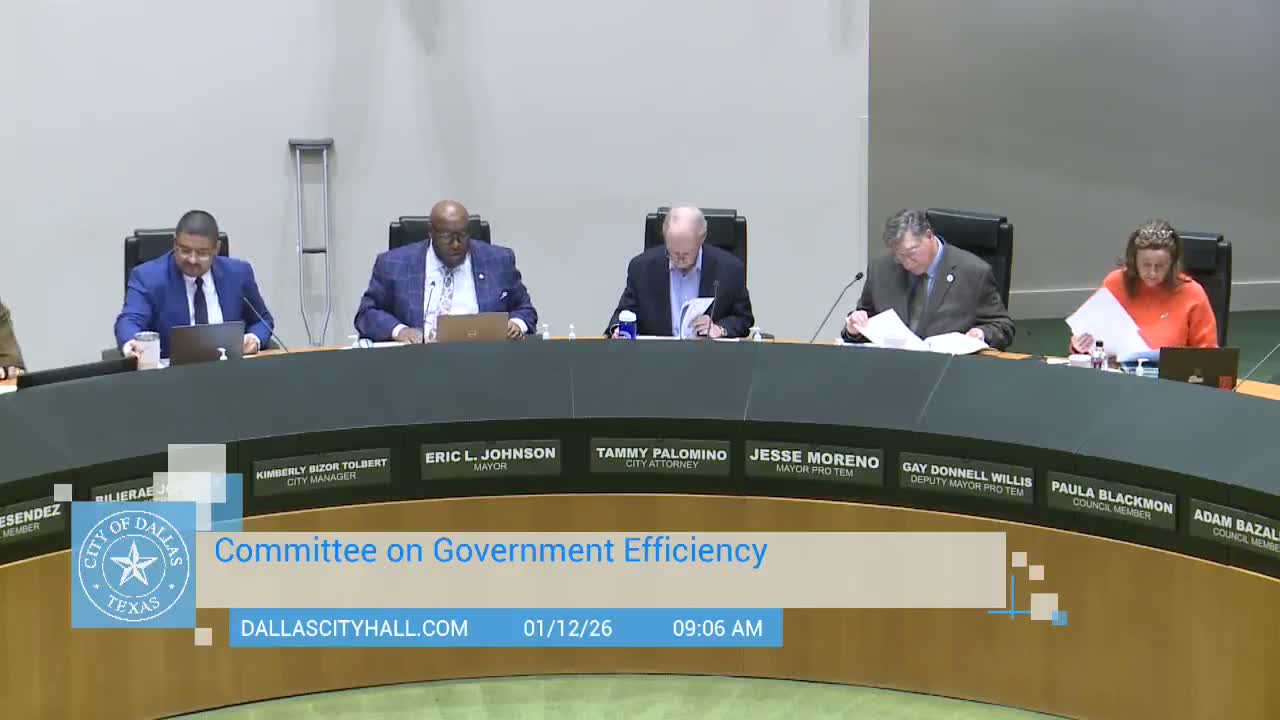
The Committee on Government Efficiency heard a detailed briefing on the city‑administered Women, Infants and Children (WIC) program and asked the internal auditor to analyze whether administration should remain with the City of Dallas.
Deputy Director Jessica Gallichaud and WIC program staff told the committee the city serves eligible pregnant women, infants and children through clinic‑based nutrition education, breastfeeding support and electronic benefits (EBT) for approved groceries. Staff said the program is federally funded and operated under a grant contract with the Texas Health and Human Services Commission (HHSC), and that local operations are paid from the grant rather than from local tax dollars.
Why it matters: Councilmembers expressed strong support for WIC’s mission but raised questions about the program’s administration, given that the city serves clients who live across multiple jurisdictions. Several members pressed for a clearer breakdown of administrative costs, indirect revenue, and the program’s net fiscal impact on city finances.
Program details and funding: Presenters described a clinic network that includes high‑volume hub sites and smaller neighborhood access points and noted the statewide Texan (TXIN) system allows participants to be served at any authorized clinic. Staff reported roughly $17 million in grant revenue for FY25 and projected about $18 million for FY26, explaining that the state’s budgeted grant award typically exceeds the amount the city actually collects because reimbursement follows allowable, documented expenses. Staff identified an earned‑income component of about $14.25 per client per month that funds local administration and reported about $600,000 in indirect cost revenue collected by the city in FY25.
Participation and operations: WIC staff said Dallas averages roughly 77,000 individuals served per month (counting individual benefit packages) and that participation dipped during the 2019 IT rollout and pandemic years but has recovered after standardizing clinic processes and expanding outreach. The program said it returned to a two‑staff certification model in 2025 after temporarily using a USDA waiver during the pandemic.
Questions from councilmembers: Committee members repeatedly asked why a large share of the local grant appears as an "administration" line, what that category includes, and whether the city effectively benefits when indirect costs are allocated internally. Several members suggested county administration could be explored; staff replied that the state (HHSC) holds authority over who serves as a local agency and that any transition would be complex (leases, staff benefits, and state approval).
Requested follow up: The committee asked staff to provide a clear administrative cost breakdown, participation metrics (enrollment rates, wait times), and comparisons to alternate local agency models. The committee chair formally recommended that the internal auditor perform a holistic cost‑benefit and transition analysis and return findings to the committee (timing dependent on the auditor’s work queue).
The meeting record: Staff noted recent state WIC audits that identified corrective actions and said all items had been addressed with corrective action plans and monitoring tools. The committee voted to request additional data and an audit but did not take any action to change program operations during the meeting.
What’s next: The committee asked the auditor to report back to the committee with the requested cost‑benefit and transition analysis (committee recommended March, pending auditor availability).
Deputy Director Jessica Gallichaud and WIC program staff told the committee the city serves eligible pregnant women, infants and children through clinic‑based nutrition education, breastfeeding support and electronic benefits (EBT) for approved groceries. Staff said the program is federally funded and operated under a grant contract with the Texas Health and Human Services Commission (HHSC), and that local operations are paid from the grant rather than from local tax dollars.
Why it matters: Councilmembers expressed strong support for WIC’s mission but raised questions about the program’s administration, given that the city serves clients who live across multiple jurisdictions. Several members pressed for a clearer breakdown of administrative costs, indirect revenue, and the program’s net fiscal impact on city finances.
Program details and funding: Presenters described a clinic network that includes high‑volume hub sites and smaller neighborhood access points and noted the statewide Texan (TXIN) system allows participants to be served at any authorized clinic. Staff reported roughly $17 million in grant revenue for FY25 and projected about $18 million for FY26, explaining that the state’s budgeted grant award typically exceeds the amount the city actually collects because reimbursement follows allowable, documented expenses. Staff identified an earned‑income component of about $14.25 per client per month that funds local administration and reported about $600,000 in indirect cost revenue collected by the city in FY25.
Participation and operations: WIC staff said Dallas averages roughly 77,000 individuals served per month (counting individual benefit packages) and that participation dipped during the 2019 IT rollout and pandemic years but has recovered after standardizing clinic processes and expanding outreach. The program said it returned to a two‑staff certification model in 2025 after temporarily using a USDA waiver during the pandemic.
Questions from councilmembers: Committee members repeatedly asked why a large share of the local grant appears as an "administration" line, what that category includes, and whether the city effectively benefits when indirect costs are allocated internally. Several members suggested county administration could be explored; staff replied that the state (HHSC) holds authority over who serves as a local agency and that any transition would be complex (leases, staff benefits, and state approval).
Requested follow up: The committee asked staff to provide a clear administrative cost breakdown, participation metrics (enrollment rates, wait times), and comparisons to alternate local agency models. The committee chair formally recommended that the internal auditor perform a holistic cost‑benefit and transition analysis and return findings to the committee (timing dependent on the auditor’s work queue).
The meeting record: Staff noted recent state WIC audits that identified corrective actions and said all items had been addressed with corrective action plans and monitoring tools. The committee voted to request additional data and an audit but did not take any action to change program operations during the meeting.
What’s next: The committee asked the auditor to report back to the committee with the requested cost‑benefit and transition analysis (committee recommended March, pending auditor availability).
View the Full Meeting & All Its Details
This article offers just a summary. Unlock complete video, transcripts, and insights as a Founder Member.
✓
Watch full, unedited meeting videos
✓
Search every word spoken in unlimited transcripts
✓
AI summaries & real-time alerts (all government levels)
✓
Permanent access to expanding government content
30-day money-back guarantee
