Fleet managers outline optimization plan; council presses for department‑level data on costs and utilization
January 12, 2026 | Dallas, Dallas County, Texas
This article was created by AI summarizing key points discussed. AI makes mistakes, so for full details and context, please refer to the video of the full meeting. Please report any errors so we can fix them. Report an error »
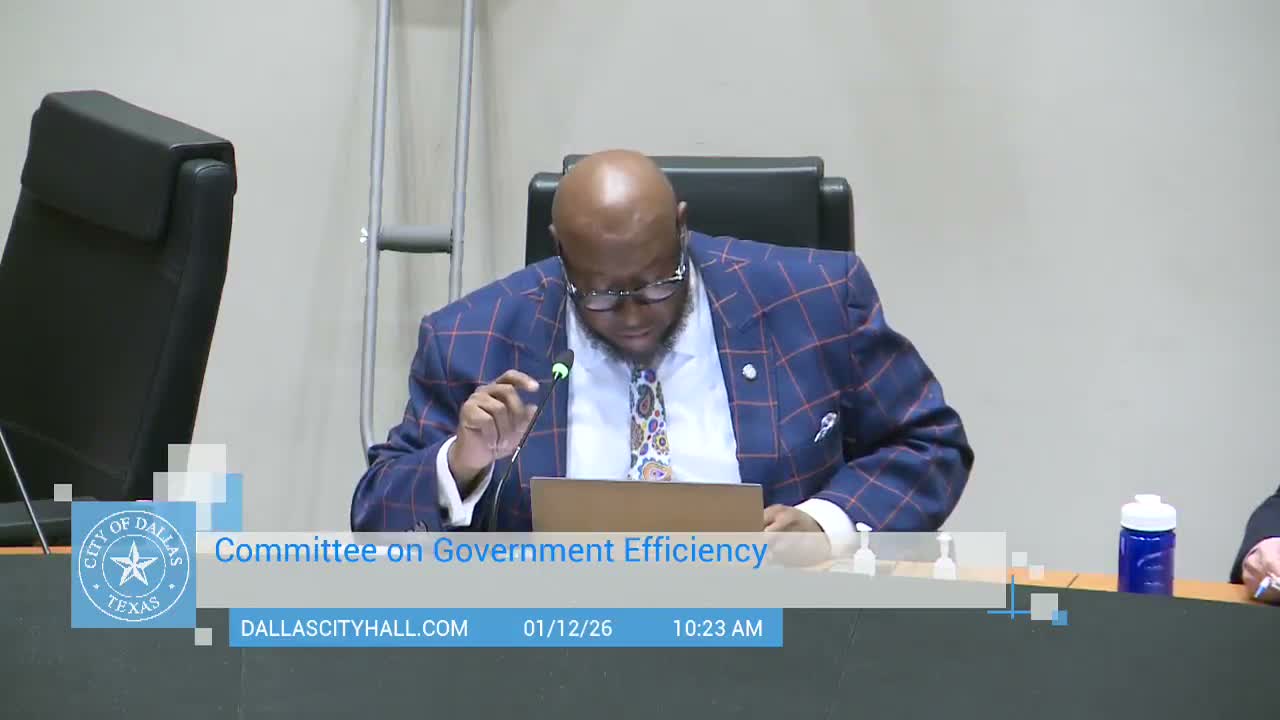
The Committee on Government Efficiency received a detailed update from fleet management on steps to 'right‑size' the city vehicle and equipment inventory and pressed staff for more department‑level data on utilization, replacement criteria and costs.
Fleet staff said the city catalogs roughly 5,557 assets (with additional decentralized assets managed by other departments), operates five service centers, and uses an AssetWorks (M5) system to track inventory and condition. Presenters said they removed 108 underused assets last year and reported a reported cost avoidance of just over $8 million from those removals. Staff emphasized a total‑cost‑of‑ownership approach to replacement decisions and described an 11‑criteria algorithm used to evaluate assets for replacement (age, utilization hours/miles, parts availability and other factors).
Telematics and data‑driven policing of utilization: Staff showed results from a GPS/telematics rollout that integrates with fleet software and supports geofencing, driver performance monitoring, and utilization reports by council district. They reported roughly 3,600 assets with GPS installed and said the technology has already exposed inefficiencies (for example, low DEF fluid events) and supported operational changes.
Costs, preventive maintenance and questions from council: Councilmembers asked for more granular figures (average vehicle age ~9.5 years was cited in answer, squad car mileage ~13,000 miles/year), breakdowns by department, and typical maintenance costs. Staff reported the fleet budgets about $23M for fuel (approximately 6.8M gallons annually at recent budgeting figures), uses multiple vendor contracts for fuel, and has a major software contract with an estimated base cost of about $1.8M over five years.
Rightsizing measures and billing changes: Presenters described enforcement and incentives they are implementing — a move to direct billing so departments see individual vehicle costs (labor, parts, overhead) and exploration of dynamic pricing for underused vehicles. Councilmembers suggested setting utilization review triggers (for example, start formal review at 25% utilization) and establishing a shared motor‑pool for emergency backup rather than each department holding low‑use vehicles.
Ongoing data and audit follow up: Committee members asked fleet staff to provide a memo with department‑level metrics (vehicle counts by type, average maintenance cost, mileage bands under 5,000 and under 10,000 miles, preventive maintenance compliance) and the status of AssetWorks (M5) capture for decentralized assets. Staff said EFM manages about 75% of assets and that adding decentralized assets into M5 remains a heavy lift but is underway.
The meeting: The briefing closed after further questioning about charging infrastructure and EV adoption. Fleet and city management emphasized they will not replace underutilized vehicles with EVs and that the most efficient outcome is eliminating unnecessary vehicles.
What’s next: Staff committed to follow up with requested memos and to return to the committee with deeper, department‑level reports and the specific preventive‑maintenance and utilization numbers requested by councilmembers.
Fleet staff said the city catalogs roughly 5,557 assets (with additional decentralized assets managed by other departments), operates five service centers, and uses an AssetWorks (M5) system to track inventory and condition. Presenters said they removed 108 underused assets last year and reported a reported cost avoidance of just over $8 million from those removals. Staff emphasized a total‑cost‑of‑ownership approach to replacement decisions and described an 11‑criteria algorithm used to evaluate assets for replacement (age, utilization hours/miles, parts availability and other factors).
Telematics and data‑driven policing of utilization: Staff showed results from a GPS/telematics rollout that integrates with fleet software and supports geofencing, driver performance monitoring, and utilization reports by council district. They reported roughly 3,600 assets with GPS installed and said the technology has already exposed inefficiencies (for example, low DEF fluid events) and supported operational changes.
Costs, preventive maintenance and questions from council: Councilmembers asked for more granular figures (average vehicle age ~9.5 years was cited in answer, squad car mileage ~13,000 miles/year), breakdowns by department, and typical maintenance costs. Staff reported the fleet budgets about $23M for fuel (approximately 6.8M gallons annually at recent budgeting figures), uses multiple vendor contracts for fuel, and has a major software contract with an estimated base cost of about $1.8M over five years.
Rightsizing measures and billing changes: Presenters described enforcement and incentives they are implementing — a move to direct billing so departments see individual vehicle costs (labor, parts, overhead) and exploration of dynamic pricing for underused vehicles. Councilmembers suggested setting utilization review triggers (for example, start formal review at 25% utilization) and establishing a shared motor‑pool for emergency backup rather than each department holding low‑use vehicles.
Ongoing data and audit follow up: Committee members asked fleet staff to provide a memo with department‑level metrics (vehicle counts by type, average maintenance cost, mileage bands under 5,000 and under 10,000 miles, preventive maintenance compliance) and the status of AssetWorks (M5) capture for decentralized assets. Staff said EFM manages about 75% of assets and that adding decentralized assets into M5 remains a heavy lift but is underway.
The meeting: The briefing closed after further questioning about charging infrastructure and EV adoption. Fleet and city management emphasized they will not replace underutilized vehicles with EVs and that the most efficient outcome is eliminating unnecessary vehicles.
What’s next: Staff committed to follow up with requested memos and to return to the committee with deeper, department‑level reports and the specific preventive‑maintenance and utilization numbers requested by councilmembers.
Don't Miss a Word: See the Full Meeting!
Go beyond summaries. Unlock every video, transcript, and key insight with a Founder Membership.
✓
Get instant access to full meeting videos
✓
Search and clip any phrase from complete transcripts
✓
Receive AI-powered summaries & custom alerts
✓
Enjoy lifetime, unrestricted access to government data
30-day money-back guarantee
