Orange Unified approves partnership with Bikendova & Associates to expand bullying‑prevention
January 23, 2026 | Orange Unified School District, School Districts, California
This article was created by AI summarizing key points discussed. AI makes mistakes, so for full details and context, please refer to the video of the full meeting. Please report any errors so we can fix them. Report an error »
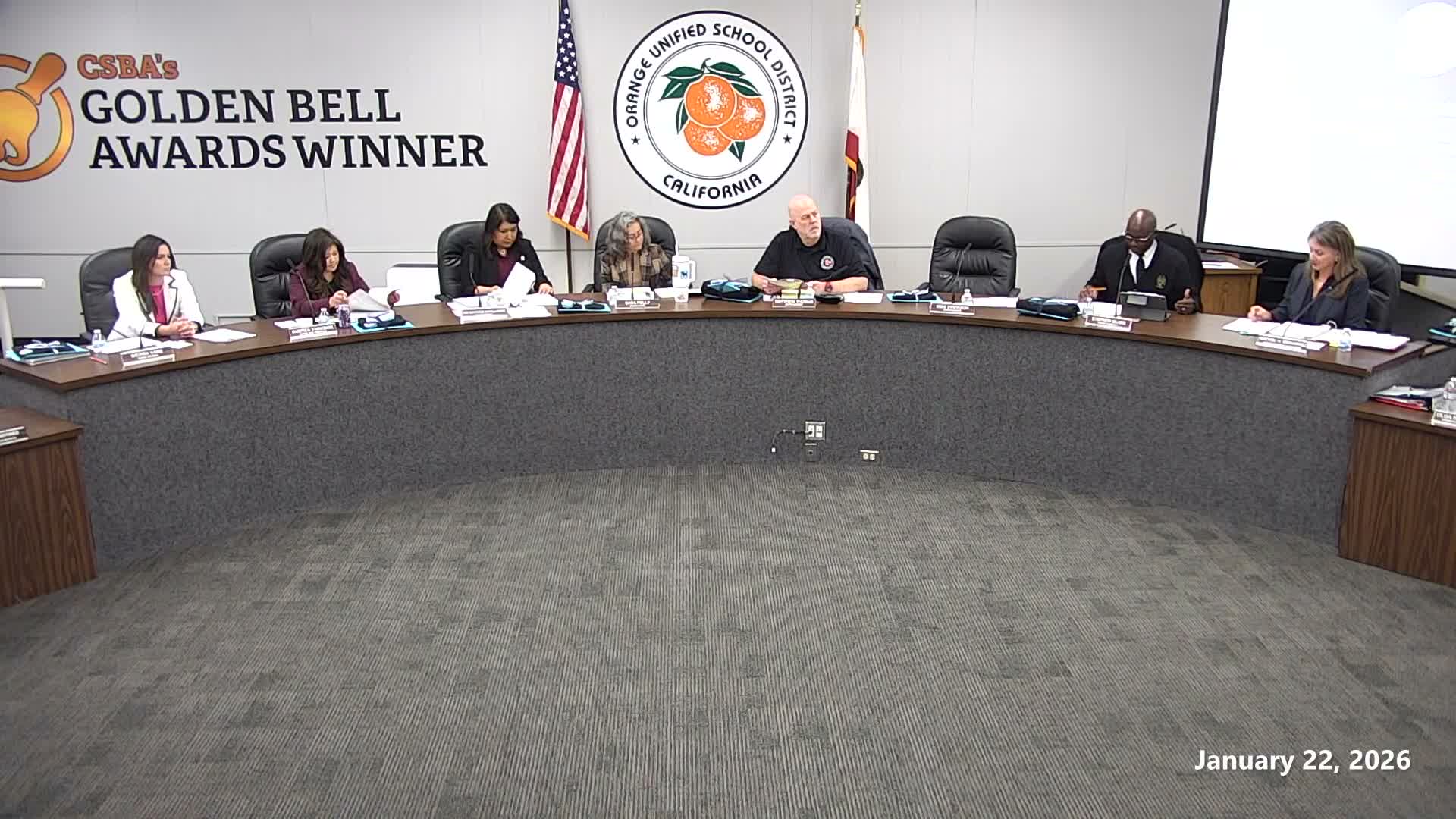
Orange Unified School District trustees on Jan. 22 voted to contract with Bikendova & Associates to expand the district’s bullying‑prevention and conflict‑resolution practices.
The board approved the recommended agreement after a presentation by Dr. Marlene Bikendova, who described an approach that brings influential student bystanders together—with parental consent—to build empathy and directly change peer behavior. The district intends to pilot the work in selected schools beginning with cohort training as soon as April and pursue a staged, district‑wide implementation over roughly 12–18 months.
District staff said the work will begin with a three‑day training series for counselors and intervention staff: an intro and foundation day, a focused day on undercover team formation, and a day on narrative mediation and leadership in systems. The vendor model pairs initial expert facilitation with ongoing coaching to transfer skills to site counselors and administrators.
Bikendova told trustees that her team’s method produced rapid improvements in individual cases at prior sites: in one account a student who rated the bullying problem a 10 on a 0–10 scale fell to 0 after several weeks of a student‑led intervention, with improvements in attendance and grades. She said the approach also includes weekly progress monitoring and documented parental opt‑in for student participants.
Trustees and parents asked for safeguards. Trustee Vane and members of the public raised questions about consent, how parents of the students selected as team members are notified, and whether the model applies at elementary through high‑school levels. Bikendova and district staff said teams include opt‑in permission letters to families, that the district has used the approach with kindergarten through 12th grade in other districts, and that coaches monitor weekly ratings and can re‑deploy or stop interventions if the rating does not decline.
Staff outlined implementation steps that include pilot schools, a coaching plan, communications to families and PTAs, and data collection to assess effectiveness. District implementation staff said they expect early adopters to begin using the method quickly after training, with ongoing coaching to bring at least 70% of counselors and interventionists to regular use.
The motion to approve implementation of the resource passed unanimously among trustees present with a 6‑0‑1 recorded outcome.
The board directed staff to include detailed pilot site communications and the vendor’s scope in the Friday information packet and to return with progress updates once the pilot phase is under way.
The board approved the recommended agreement after a presentation by Dr. Marlene Bikendova, who described an approach that brings influential student bystanders together—with parental consent—to build empathy and directly change peer behavior. The district intends to pilot the work in selected schools beginning with cohort training as soon as April and pursue a staged, district‑wide implementation over roughly 12–18 months.
District staff said the work will begin with a three‑day training series for counselors and intervention staff: an intro and foundation day, a focused day on undercover team formation, and a day on narrative mediation and leadership in systems. The vendor model pairs initial expert facilitation with ongoing coaching to transfer skills to site counselors and administrators.
Bikendova told trustees that her team’s method produced rapid improvements in individual cases at prior sites: in one account a student who rated the bullying problem a 10 on a 0–10 scale fell to 0 after several weeks of a student‑led intervention, with improvements in attendance and grades. She said the approach also includes weekly progress monitoring and documented parental opt‑in for student participants.
Trustees and parents asked for safeguards. Trustee Vane and members of the public raised questions about consent, how parents of the students selected as team members are notified, and whether the model applies at elementary through high‑school levels. Bikendova and district staff said teams include opt‑in permission letters to families, that the district has used the approach with kindergarten through 12th grade in other districts, and that coaches monitor weekly ratings and can re‑deploy or stop interventions if the rating does not decline.
Staff outlined implementation steps that include pilot schools, a coaching plan, communications to families and PTAs, and data collection to assess effectiveness. District implementation staff said they expect early adopters to begin using the method quickly after training, with ongoing coaching to bring at least 70% of counselors and interventionists to regular use.
The motion to approve implementation of the resource passed unanimously among trustees present with a 6‑0‑1 recorded outcome.
The board directed staff to include detailed pilot site communications and the vendor’s scope in the Friday information packet and to return with progress updates once the pilot phase is under way.
Don't Miss a Word: See the Full Meeting!
Go beyond summaries. Unlock every video, transcript, and key insight with a Founder Membership.
✓
Get instant access to full meeting videos
✓
Search and clip any phrase from complete transcripts
✓
Receive AI-powered summaries & custom alerts
✓
Enjoy lifetime, unrestricted access to government data
30-day money-back guarantee
