Arizona lab leaders outline practical steps to transition to ISO/IEC 17025:2017 accreditation
February 02, 2026 | Office of Justice Programs, Department of Justice (DOJ), Executive, Federal
This article was created by AI summarizing key points discussed. AI makes mistakes, so for full details and context, please refer to the video of the full meeting. Please report any errors so we can fix them. Report an error »
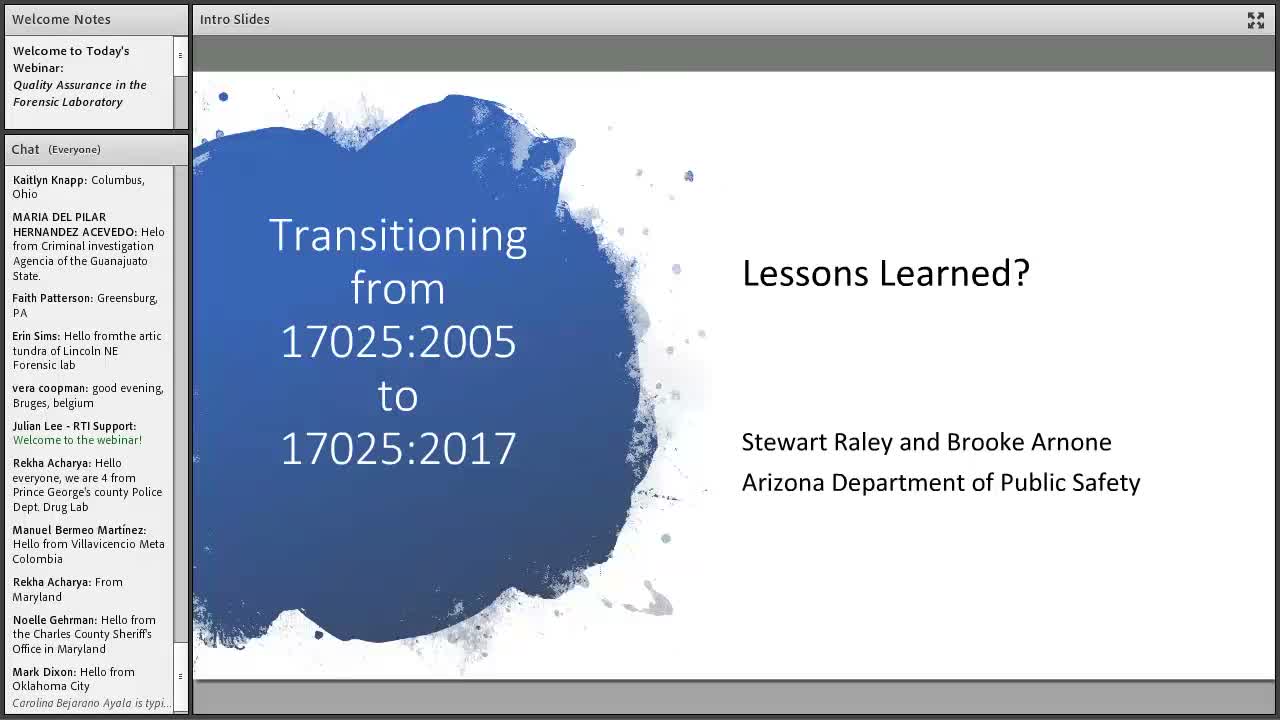
Brooke Arnone, quality assurance manager for the Arizona Department of Public Safety Crime Laboratory System, and Stuart Raley, supervising forensic scientist in the Scientific Analysis Bureau quality assurance unit, offered practical guidance for laboratories shifting from ISO/IEC 17025:2005 to the 2017 standard during an RTI International webinar.
Arnone and Raley said laboratories should begin with a gap analysis and prioritize the quality assurance manual before revising discipline-level procedures. "Your quality assurance manual is probably 95% ready for the transition," Arnone said, and advised teams to "take it one step at a time" rather than attempting sweeping changes in a short period.
The presenters emphasized a risk-based approach that distinguishes high- and low-risk activities and allocates control accordingly. Raley described Standard 8 as introducing "actions to address risks and opportunities," and urged labs to document how they identify and evaluate risks through internal audits, technical reviews and management assessments.
On personnel and competency, the presenters said Standard 6 requires that any staff who influence results be competency tested before performing evidence testing and that individuals who perform validations be formally authorized. Raley noted that competency testing can take several forms, including practical exercises, observational testing and supervised rotations.
Reporting and testimony review were also highlighted. The speakers said organizations must ensure issued reports are treated as technical records and that the new decision rule provisions require laboratories to account for measurement uncertainty in certain results. They warned that testimony reviews now require reviewers to demonstrate competency in the scope of the review, which has logistical implications for multi-site systems.
Arnone described operational steps the Arizona lab used in advance of reassessment: involving technical leads, preparing a crosswalk between old and new clauses, reorganizing the quality manual to avoid duplication with general procedures, and staging documents on ShareFile for assessors. She said the lab received five nonconformities during assessment, "appealed 3 of them, and we won all 3 appeals," and credited daily communication with the lead assessor in resolving issues.
In a question-and-answer session, the presenters said there is no single standard mandating a move to paperless records; labs must assess retention schedules and migration risks before altering formats. They confirmed that the Arizona state lab validated its LIMS (JusticeTrax) after upgrades and that training samples in drug disciplines often come from disposed case material when customer agreements permit.
The presenters recommended practical, incremental work: focus on one discipline if resources are limited, involve supervisors and tech leads early, document risk assessments and management-review outcomes, and maintain open communication with assessors and customers. The webinar slides and recording will be archived on ForensicCOE (www.forensiccoe.org) and ASCLAD (ascld.org).
The webinar recording and presenter materials are available for follow-up questions, and the presenters offered to share sample QA manuals and checklists by email.
Arnone and Raley said laboratories should begin with a gap analysis and prioritize the quality assurance manual before revising discipline-level procedures. "Your quality assurance manual is probably 95% ready for the transition," Arnone said, and advised teams to "take it one step at a time" rather than attempting sweeping changes in a short period.
The presenters emphasized a risk-based approach that distinguishes high- and low-risk activities and allocates control accordingly. Raley described Standard 8 as introducing "actions to address risks and opportunities," and urged labs to document how they identify and evaluate risks through internal audits, technical reviews and management assessments.
On personnel and competency, the presenters said Standard 6 requires that any staff who influence results be competency tested before performing evidence testing and that individuals who perform validations be formally authorized. Raley noted that competency testing can take several forms, including practical exercises, observational testing and supervised rotations.
Reporting and testimony review were also highlighted. The speakers said organizations must ensure issued reports are treated as technical records and that the new decision rule provisions require laboratories to account for measurement uncertainty in certain results. They warned that testimony reviews now require reviewers to demonstrate competency in the scope of the review, which has logistical implications for multi-site systems.
Arnone described operational steps the Arizona lab used in advance of reassessment: involving technical leads, preparing a crosswalk between old and new clauses, reorganizing the quality manual to avoid duplication with general procedures, and staging documents on ShareFile for assessors. She said the lab received five nonconformities during assessment, "appealed 3 of them, and we won all 3 appeals," and credited daily communication with the lead assessor in resolving issues.
In a question-and-answer session, the presenters said there is no single standard mandating a move to paperless records; labs must assess retention schedules and migration risks before altering formats. They confirmed that the Arizona state lab validated its LIMS (JusticeTrax) after upgrades and that training samples in drug disciplines often come from disposed case material when customer agreements permit.
The presenters recommended practical, incremental work: focus on one discipline if resources are limited, involve supervisors and tech leads early, document risk assessments and management-review outcomes, and maintain open communication with assessors and customers. The webinar slides and recording will be archived on ForensicCOE (www.forensiccoe.org) and ASCLAD (ascld.org).
The webinar recording and presenter materials are available for follow-up questions, and the presenters offered to share sample QA manuals and checklists by email.
Don't Miss a Word: See the Full Meeting!
Go beyond summaries. Unlock every video, transcript, and key insight with a Founder Membership.
✓
Get instant access to full meeting videos
✓
Search and clip any phrase from complete transcripts
✓
Receive AI-powered summaries & custom alerts
✓
Enjoy lifetime, unrestricted access to government data
30-day money-back guarantee
