UNM’s New Mexico Decedent Image Database opens researchers to anonymized CT scans with strict privacy rules
February 02, 2026 | Office of Justice Programs, Department of Justice (DOJ), Executive, Federal
This article was created by AI summarizing key points discussed. AI makes mistakes, so for full details and context, please refer to the video of the full meeting. Please report any errors so we can fix them. Report an error »
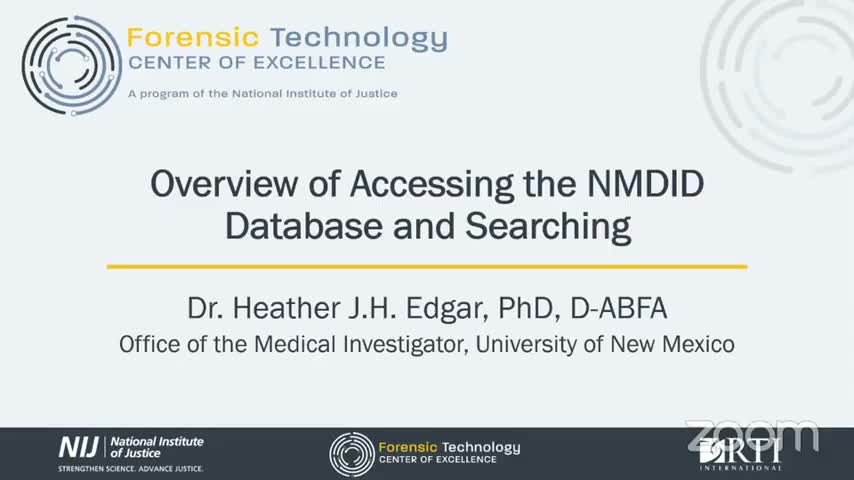
The University of New Mexico’s Office of the Medical Investigator and project lead Dr. Heather Egger on a webinar described the New Mexico Decedent Image Database (NMDID), an anonymized archive of whole-body CT scans and linked metadata intended for research.
Egger, the project’s principal investigator and a forensic anthropologist at UNM, said the database contains CT data derived from about 15,243 decedents with roughly 10,000 slices per scan — roughly 150 million images and just over 50 terabytes of data — and up to 69 searchable metadata fields per record. “The New Mexico attorney general has determined that decedents are not human subjects,” Egger said, adding that autopsy reports are public records and the team voluntarily followed a research protocol to protect privacy.
The site (nmdid.unm.edu) includes a data dictionary and resources that explain variable definitions, standards and how to read the metadata. Egger demonstrated searches that return demographic and cause-of-death fields, noting, for example, a query for males ages 18–65 with gunshot wounds returned 1,340 cases in the database.
Access process and restrictions
Egger said researchers request access by completing a short online form that requires an institutional email address and a brief (the team requests up to 750 words) description of intended research, inclusion/exclusion criteria and the number of individuals sought. “We require an institutional email address,” she said; requests submitted from generic personal email accounts such as Gmail or Yahoo have been rejected. Egger said most access requests are reviewed within about 24 hours.
Image requests are limited to 500 cases per request by default; teams can submit additional requests or justify larger samples if necessary. The project team reviews image requests (at least two reviewers) and will often ask for clarifications rather than deny proposals outright.
Privacy safeguards and data use
A required data-use agreement prohibits attempts to identify or contact families and bars publishing face reconstructions in recognizable formats. “You shall not attempt to identify or contact any individual's family whose data is included in the database,” Egger said. The agreement also asks researchers to cite the database in publications and to share citations with the project team.
Technical and ethical background
Egger said the project arose from National Institute of Justice (NIJ) funding that supported initial scanning and later funding for database and website development. The team worked with UNM’s Center for Advanced Research Computing to de-identify DICOM headers, reassign anonymized IDs, convert proprietary formats and host the data. Student teams conducted voluntary outreach to next of kin, collecting richer metadata for roughly 10,000 decedents and denser information for about 1,800.
Q&A highlights
In response to audience questions, Egger said NMDID includes no genetic data, so searches for genetic admixture are not possible; race and ethnicity fields use census-style categories and tribal membership fields list 23 tribes present in New Mexico. She noted CT acquisition protocols, scout images and other technical details are published on the site and that teaching uses are permitted with restrictions on broad distribution of raw CT files.
What happens next
The database is available for research and teaching uses according to the project’s data-use rules; prospective users should consult the data dictionary and the project’s IRB protocol posted on the site and include a concise research statement when requesting images. The project team said it will work with applicants to approve feasible, appropriate requests.
Provenance: transcript excerpts of the presentation and Q&A support the facts in this article; the primary presentation material runs from the speaker’s introduction through the webinar’s closing remarks.
Egger, the project’s principal investigator and a forensic anthropologist at UNM, said the database contains CT data derived from about 15,243 decedents with roughly 10,000 slices per scan — roughly 150 million images and just over 50 terabytes of data — and up to 69 searchable metadata fields per record. “The New Mexico attorney general has determined that decedents are not human subjects,” Egger said, adding that autopsy reports are public records and the team voluntarily followed a research protocol to protect privacy.
The site (nmdid.unm.edu) includes a data dictionary and resources that explain variable definitions, standards and how to read the metadata. Egger demonstrated searches that return demographic and cause-of-death fields, noting, for example, a query for males ages 18–65 with gunshot wounds returned 1,340 cases in the database.
Access process and restrictions
Egger said researchers request access by completing a short online form that requires an institutional email address and a brief (the team requests up to 750 words) description of intended research, inclusion/exclusion criteria and the number of individuals sought. “We require an institutional email address,” she said; requests submitted from generic personal email accounts such as Gmail or Yahoo have been rejected. Egger said most access requests are reviewed within about 24 hours.
Image requests are limited to 500 cases per request by default; teams can submit additional requests or justify larger samples if necessary. The project team reviews image requests (at least two reviewers) and will often ask for clarifications rather than deny proposals outright.
Privacy safeguards and data use
A required data-use agreement prohibits attempts to identify or contact families and bars publishing face reconstructions in recognizable formats. “You shall not attempt to identify or contact any individual's family whose data is included in the database,” Egger said. The agreement also asks researchers to cite the database in publications and to share citations with the project team.
Technical and ethical background
Egger said the project arose from National Institute of Justice (NIJ) funding that supported initial scanning and later funding for database and website development. The team worked with UNM’s Center for Advanced Research Computing to de-identify DICOM headers, reassign anonymized IDs, convert proprietary formats and host the data. Student teams conducted voluntary outreach to next of kin, collecting richer metadata for roughly 10,000 decedents and denser information for about 1,800.
Q&A highlights
In response to audience questions, Egger said NMDID includes no genetic data, so searches for genetic admixture are not possible; race and ethnicity fields use census-style categories and tribal membership fields list 23 tribes present in New Mexico. She noted CT acquisition protocols, scout images and other technical details are published on the site and that teaching uses are permitted with restrictions on broad distribution of raw CT files.
What happens next
The database is available for research and teaching uses according to the project’s data-use rules; prospective users should consult the data dictionary and the project’s IRB protocol posted on the site and include a concise research statement when requesting images. The project team said it will work with applicants to approve feasible, appropriate requests.
Provenance: transcript excerpts of the presentation and Q&A support the facts in this article; the primary presentation material runs from the speaker’s introduction through the webinar’s closing remarks.
Don't Miss a Word: See the Full Meeting!
Go beyond summaries. Unlock every video, transcript, and key insight with a Founder Membership.
✓
Get instant access to full meeting videos
✓
Search and clip any phrase from complete transcripts
✓
Receive AI-powered summaries & custom alerts
✓
Enjoy lifetime, unrestricted access to government data
30-day money-back guarantee
