Capitol staff unveil digital twin to monitor preservation, plumbing and portraits
February 02, 2026 | 2025-2026 House Legislature MI, Michigan
This article was created by AI summarizing key points discussed. AI makes mistakes, so for full details and context, please refer to the video of the full meeting. Please report any errors so we can fix them. Report an error »
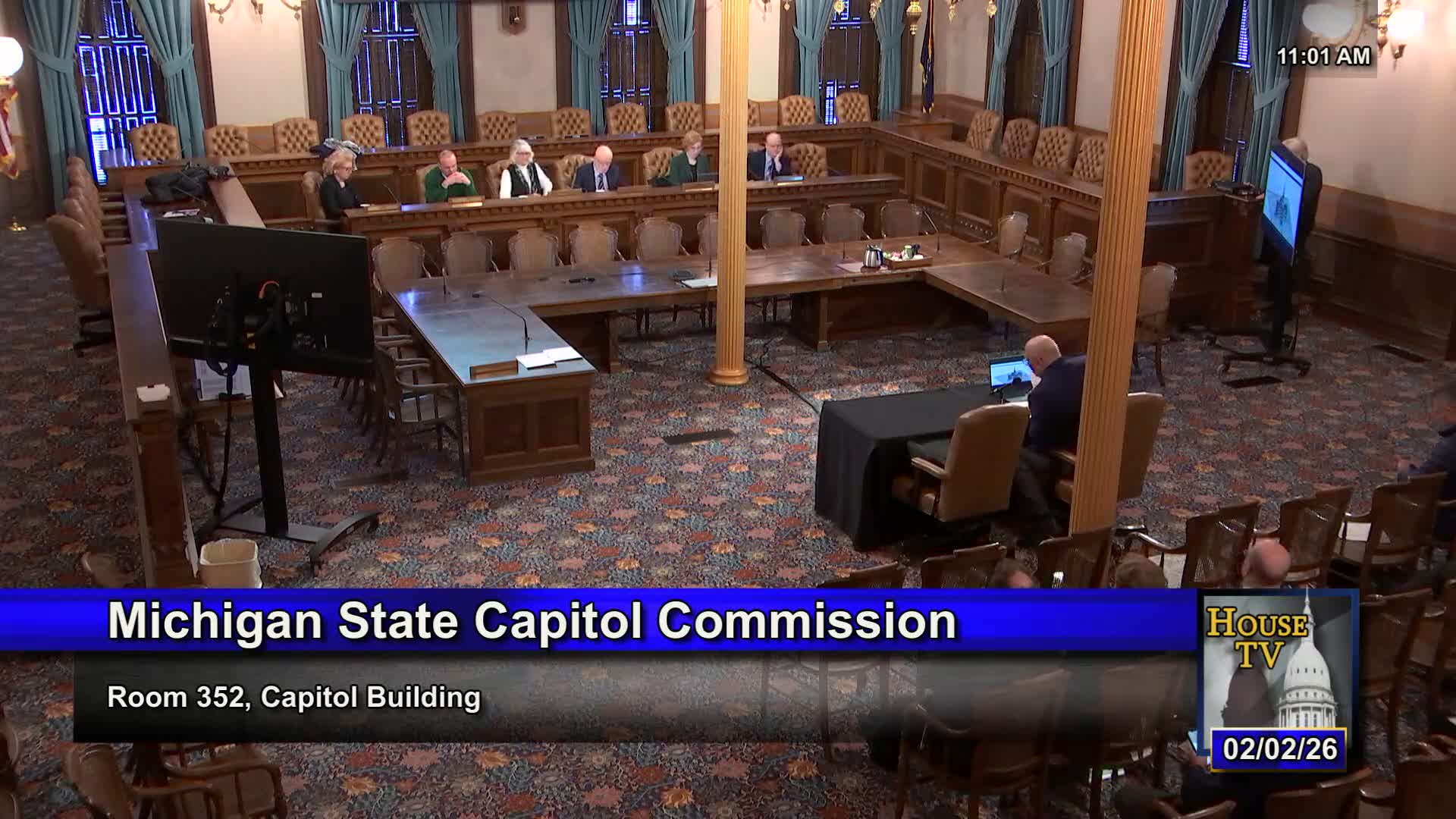
Rob, a Capitol facilities staff member, demonstrated the commission’s new HBIM — a three-dimensional “digital twin” of the Michigan Capitol that links high-resolution exterior and interior scans with building systems and records. The model, Rob said, can display live temperature and humidity readings for specific rooms and surface a history of past conservation work for features such as plaster, draperies and ceilings.
Rob said the tool will help staff spot problems earlier and reduce damage to the building’s “150 years” of historical fabric. “If we get an alarm, we can pretty much figure out where it is a lot quicker,” he said, and described how the system can reveal mechanical piping, show shutoff-valve locations, and trace water flow so an operator can isolate a leak rather than cutting large holes in walls.
The presentation included results from a recent exterior drone survey and high-resolution photos that Quinn Evans used to assign and label individual dome panels, enabling annual comparative analysis to detect paint or metal deterioration. Rob also showed lidar scans of a Michigan chandelier and said the 3‑D model will be replicated for each chandelier in the building.
Rob described the Governor’s Office as a pilot area for integrating a 2016 decorative-surfaces report into the HBIM so future conservators and contractors can see what repairs were done and when. He also demonstrated a color-coded map of the glass floor with identifiers for original 1879 tiles, later insertions (1931 and later) and pieces slated for 2025–26 work, so replacements can match historical specifications.
Rob credited a multi-disciplinary HBIM team of staff with mechanical, electrical, artwork and documentation expertise for assembling the model and said staff will continue loading photographs and reports and training additional users.
On governance, Rob introduced a “hundred-year portrait plan” included in the meeting folders and said staff will bring a motion at the March meeting to adopt a policy memorializing where and how governors’ portraits are placed in common areas so future stewards follow a consistent approach. Chair Candler asked commissioners to review the document and prepare for a vote.
The commission also received routine updates on the 4th Floor project (scaffolding removed) and tour metrics; Rob cautioned that visitor increases strain staffing and that January’s lower numbers were due to cold weather and school closings.
The commission did not take a formal vote on the HBIM presentation itself; the next procedural step is the portrait-placement policy scheduled for a March vote.
Rob said the tool will help staff spot problems earlier and reduce damage to the building’s “150 years” of historical fabric. “If we get an alarm, we can pretty much figure out where it is a lot quicker,” he said, and described how the system can reveal mechanical piping, show shutoff-valve locations, and trace water flow so an operator can isolate a leak rather than cutting large holes in walls.
The presentation included results from a recent exterior drone survey and high-resolution photos that Quinn Evans used to assign and label individual dome panels, enabling annual comparative analysis to detect paint or metal deterioration. Rob also showed lidar scans of a Michigan chandelier and said the 3‑D model will be replicated for each chandelier in the building.
Rob described the Governor’s Office as a pilot area for integrating a 2016 decorative-surfaces report into the HBIM so future conservators and contractors can see what repairs were done and when. He also demonstrated a color-coded map of the glass floor with identifiers for original 1879 tiles, later insertions (1931 and later) and pieces slated for 2025–26 work, so replacements can match historical specifications.
Rob credited a multi-disciplinary HBIM team of staff with mechanical, electrical, artwork and documentation expertise for assembling the model and said staff will continue loading photographs and reports and training additional users.
On governance, Rob introduced a “hundred-year portrait plan” included in the meeting folders and said staff will bring a motion at the March meeting to adopt a policy memorializing where and how governors’ portraits are placed in common areas so future stewards follow a consistent approach. Chair Candler asked commissioners to review the document and prepare for a vote.
The commission also received routine updates on the 4th Floor project (scaffolding removed) and tour metrics; Rob cautioned that visitor increases strain staffing and that January’s lower numbers were due to cold weather and school closings.
The commission did not take a formal vote on the HBIM presentation itself; the next procedural step is the portrait-placement policy scheduled for a March vote.
View the Full Meeting & All Its Details
This article offers just a summary. Unlock complete video, transcripts, and insights as a Founder Member.
✓
Watch full, unedited meeting videos
✓
Search every word spoken in unlimited transcripts
✓
AI summaries & real-time alerts (all government levels)
✓
Permanent access to expanding government content
30-day money-back guarantee
