Oversight board proposes limited changes to municipal police and fire disability pensions
February 02, 2026 | 2026 Legislature WV, West Virginia
This article was created by AI summarizing key points discussed. AI makes mistakes, so for full details and context, please refer to the video of the full meeting. Please report any errors so we can fix them. Report an error »
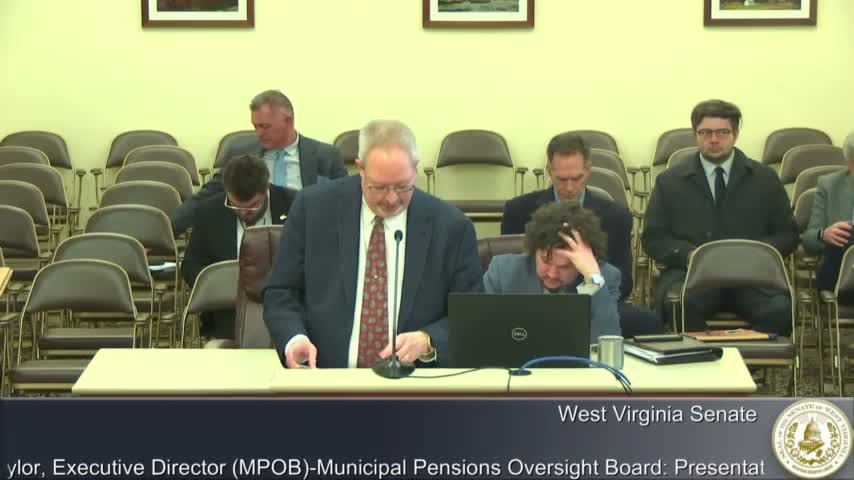
Blair Taylor, executive director of the Municipal Pensions Oversight Board, told the Pensions Committee that the board plans to introduce legislation to change how municipal police and fire disability pensions are treated when beneficiaries reach regular retirement age.
Taylor said the proposed bill, which would amend the disability section of the municipal code (cited in the meeting as 8-22-24), contains two parts. The first would allow a police officer or firefighter who was injured in the line of duty and has 21–30 years of service to convert a duty-related disability pension (currently fixed at 60% of pay) to a regular retirement benefit once they reach the regular retirement age (stated in the presentation as age 50). Taylor said the provision would apply only to duty-related disabilities and would explicitly prohibit local pension boards from reclassifying previously awarded non-duty total disabilities as duty-related to qualify for the change.
The second change would remove the annual requirement that non-duty disability recipients provide their federal 1040 tax returns to local police or fire pension boards once those recipients reach Social Security normal retirement age (a range Taylor described as between 65 and 67 depending on birth year). Taylor said West Virginia’s minimum-wage threshold used in the current earnings-offset calculation was cited in the presentation as $18,200 and that the threshold would be indexed with future minimum-wage changes.
On actuarial cost, Taylor said staff had consulted an actuary and found the fiscal impact to be negligible for eliminating the 1040 requirement; the conversion for duty-related disabilities would carry a small additional cost, but he estimated only about three people across all 53 municipal plans would qualify under the draft language. “They would no longer be required to provide their 1040 tax return to their local pension board,” Taylor said about the second change. He also described the conversion concept: “if they could change to a regular retirement” when they reach regular retirement age.
Senator from Putnam asked whether historical unfunded liabilities remain on the state books; Taylor replied that the municipal unfunded liabilities remain at the municipal level and that the aggregate unfunded liability reported in the last study had fallen to about $748 million from over $1 billion in prior years.
The Oversight Board indicated it has worked with legislative staff on drafting the bill and requested committee members consider cosponsoring once drafting is complete. No committee vote on the bill was taken at this meeting.
Next steps: Taylor said the bill had been sent to bill drafting and will return when drafting is complete; the Oversight Board asked legislators to consider cosponsorship then. The committee did not take formal action on the proposed legislation during this session.
Taylor said the proposed bill, which would amend the disability section of the municipal code (cited in the meeting as 8-22-24), contains two parts. The first would allow a police officer or firefighter who was injured in the line of duty and has 21–30 years of service to convert a duty-related disability pension (currently fixed at 60% of pay) to a regular retirement benefit once they reach the regular retirement age (stated in the presentation as age 50). Taylor said the provision would apply only to duty-related disabilities and would explicitly prohibit local pension boards from reclassifying previously awarded non-duty total disabilities as duty-related to qualify for the change.
The second change would remove the annual requirement that non-duty disability recipients provide their federal 1040 tax returns to local police or fire pension boards once those recipients reach Social Security normal retirement age (a range Taylor described as between 65 and 67 depending on birth year). Taylor said West Virginia’s minimum-wage threshold used in the current earnings-offset calculation was cited in the presentation as $18,200 and that the threshold would be indexed with future minimum-wage changes.
On actuarial cost, Taylor said staff had consulted an actuary and found the fiscal impact to be negligible for eliminating the 1040 requirement; the conversion for duty-related disabilities would carry a small additional cost, but he estimated only about three people across all 53 municipal plans would qualify under the draft language. “They would no longer be required to provide their 1040 tax return to their local pension board,” Taylor said about the second change. He also described the conversion concept: “if they could change to a regular retirement” when they reach regular retirement age.
Senator from Putnam asked whether historical unfunded liabilities remain on the state books; Taylor replied that the municipal unfunded liabilities remain at the municipal level and that the aggregate unfunded liability reported in the last study had fallen to about $748 million from over $1 billion in prior years.
The Oversight Board indicated it has worked with legislative staff on drafting the bill and requested committee members consider cosponsoring once drafting is complete. No committee vote on the bill was taken at this meeting.
Next steps: Taylor said the bill had been sent to bill drafting and will return when drafting is complete; the Oversight Board asked legislators to consider cosponsorship then. The committee did not take formal action on the proposed legislation during this session.
View the Full Meeting & All Its Details
This article offers just a summary. Unlock complete video, transcripts, and insights as a Founder Member.
✓
Watch full, unedited meeting videos
✓
Search every word spoken in unlimited transcripts
✓
AI summaries & real-time alerts (all government levels)
✓
Permanent access to expanding government content
30-day money-back guarantee
