Senate committee advances bill changing coal‑estate consent, royalty and reserve rules after landowner testimony
February 02, 2026 | 2026 Legislature WV, West Virginia
This article was created by AI summarizing key points discussed. AI makes mistakes, so for full details and context, please refer to the video of the full meeting. Please report any errors so we can fix them. Report an error »
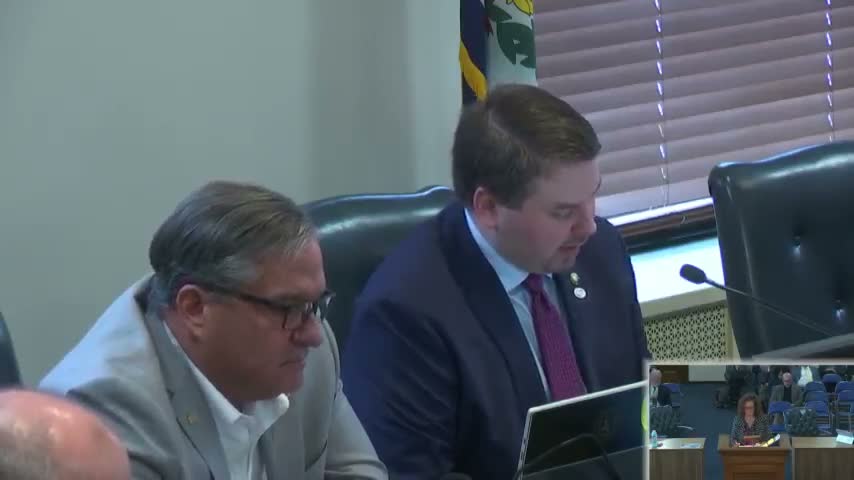
At its meeting, the Senate Energy Industry and Mining Committee voted by voice to report the committee substitute for Senate Bill 686 to the full Senate with a recommendation that it pass. The substitute revises how coal‑estate property rights are treated: if one or more cotenants lawfully agree to mining or development, that activity would not be treated as waste or trespass against the property even if other cotenants have not consented. The substitute raises the consent threshold to 75% and requires consenting owners to pay nonconsenting cotenants a pro rata share of production royalties — an amount equal to 6% or the highest royalty paid to any consenting cotenant, whichever is greater.
David McMahon, a lawyer and co‑founder of the West Virginia Surface Owners Rights Organization, told the committee the change is unnecessary and warned it could encourage longwall mining, which he described as producing substantial surface subsidence. “This is not needed,” McMahon said, and he cited photographs he had provided showing cracked driveways, bowed foundations and sidewalk damage he attributed to longwall extraction. McMahon urged the committee to consider that coal production may eliminate future royalty streams for unknown or unlocatable owners under the bill’s seven‑year claim period.
Committee members and McMahon discussed existing remedies such as partition suits — a procedure by which parties can buy out nonconsenting owners — and McMahon noted that partition may not fully address harms from longwall extraction. Jason Bostick, identified in the transcript as representing the Cull Association, told the committee that federal and state law already require coal operators to repair or compensate for surface damage. “As operators under that law and under the state corresponding statute and rules have to repair or compensate for that damage,” Bostick said, noting the Surface Mining Control and Reclamation Act and subsequent Energy Policy Act amendments that address subsidence.
The committee substitute also creates an administrative process for unknown or unlocatable coal‑interest owners: operators must diligently search for cotenants, reserve funds for unknown owners, report and remit reserve funds to the State Treasurer, and hold those funds in escrow. Funds unclaimed after seven years would be transferred to a reclamation fund (the committee substitute changed the destination fund in committee). The substitute includes additional provisions on lease terms, challenge procedures and procedures for surface owners to quiet title after seven years.
Vice Chair moved to report the committee substitute to the full Senate with a recommendation that it pass and that, under the original double committee reference, it first be referred to the Judiciary Committee. The chair called for a voice vote, members responded "aye," and the motion was declared adopted. The transcript records voice votes and the chair’s declarations; specific roll‑call tallies were not provided.
David McMahon, a lawyer and co‑founder of the West Virginia Surface Owners Rights Organization, told the committee the change is unnecessary and warned it could encourage longwall mining, which he described as producing substantial surface subsidence. “This is not needed,” McMahon said, and he cited photographs he had provided showing cracked driveways, bowed foundations and sidewalk damage he attributed to longwall extraction. McMahon urged the committee to consider that coal production may eliminate future royalty streams for unknown or unlocatable owners under the bill’s seven‑year claim period.
Committee members and McMahon discussed existing remedies such as partition suits — a procedure by which parties can buy out nonconsenting owners — and McMahon noted that partition may not fully address harms from longwall extraction. Jason Bostick, identified in the transcript as representing the Cull Association, told the committee that federal and state law already require coal operators to repair or compensate for surface damage. “As operators under that law and under the state corresponding statute and rules have to repair or compensate for that damage,” Bostick said, noting the Surface Mining Control and Reclamation Act and subsequent Energy Policy Act amendments that address subsidence.
The committee substitute also creates an administrative process for unknown or unlocatable coal‑interest owners: operators must diligently search for cotenants, reserve funds for unknown owners, report and remit reserve funds to the State Treasurer, and hold those funds in escrow. Funds unclaimed after seven years would be transferred to a reclamation fund (the committee substitute changed the destination fund in committee). The substitute includes additional provisions on lease terms, challenge procedures and procedures for surface owners to quiet title after seven years.
Vice Chair moved to report the committee substitute to the full Senate with a recommendation that it pass and that, under the original double committee reference, it first be referred to the Judiciary Committee. The chair called for a voice vote, members responded "aye," and the motion was declared adopted. The transcript records voice votes and the chair’s declarations; specific roll‑call tallies were not provided.
View the Full Meeting & All Its Details
This article offers just a summary. Unlock complete video, transcripts, and insights as a Founder Member.
✓
Watch full, unedited meeting videos
✓
Search every word spoken in unlimited transcripts
✓
AI summaries & real-time alerts (all government levels)
✓
Permanent access to expanding government content
30-day money-back guarantee
