State study recommends phased pilot approach, estimates $6–11M for first phase of Utah Lake restoration
February 02, 2026 | Utah Lake Authority, Utah State Agencies, Utah Government Divisions, Utah Legislative Branch, Utah
This article was created by AI summarizing key points discussed. AI makes mistakes, so for full details and context, please refer to the video of the full meeting. Please report any errors so we can fix them. Report an error »
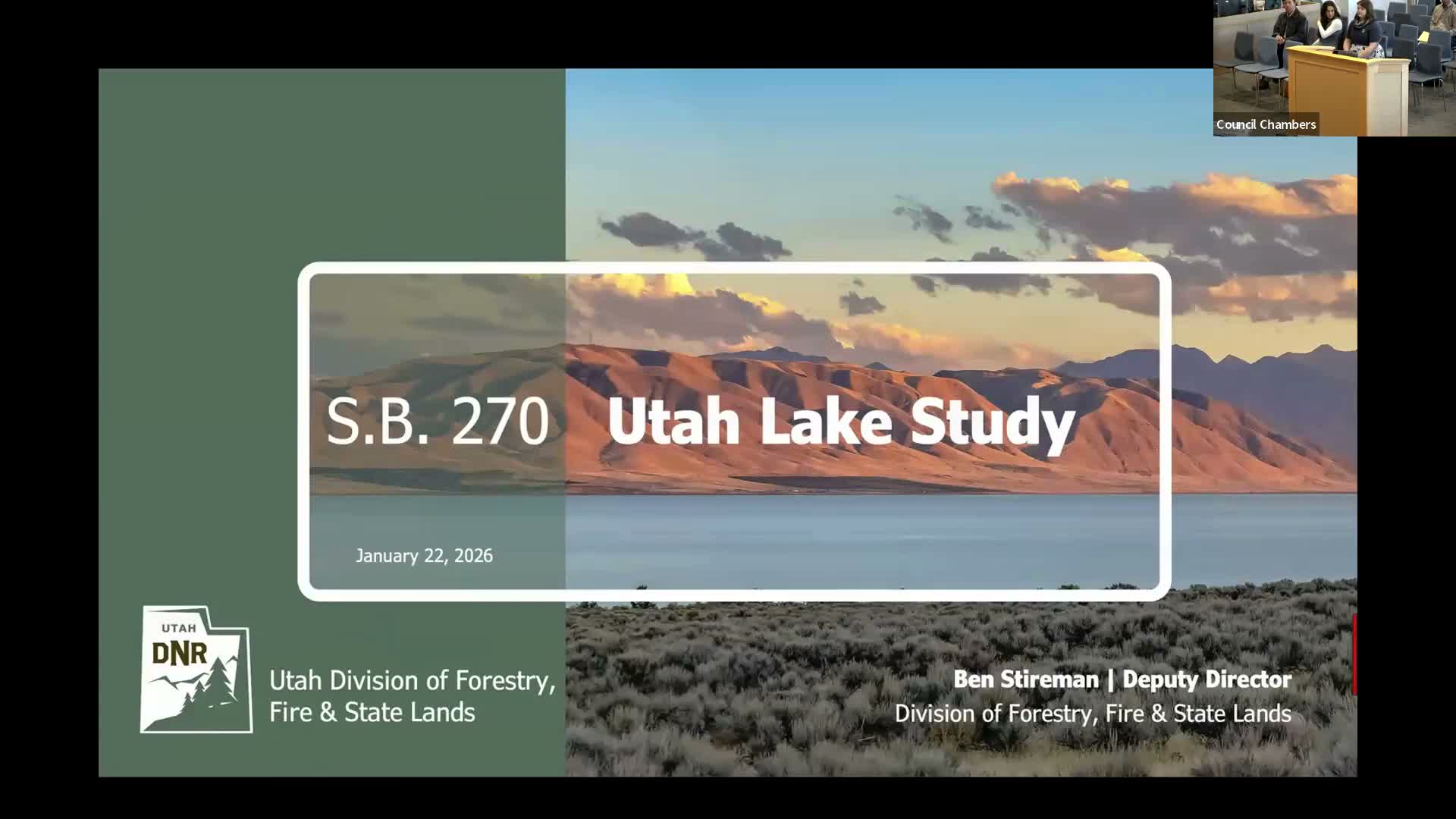
Ben Steyrman, deputy director at the Division of Forestry, Fire and State Lands, told the Utah Lake Authority on Jan. 22 that a study directed by SB 270 recommends a phased, implementable restoration strategy for Utah Lake. "At this point, passive recovery is no longer possible," Steyrman said, summarizing the study's central finding and arguing that simultaneous interventions are required to reverse decades of ecological decline.
The study identifies four primary stressors: invasive common carp, unstable sediments and sediment resuspension, excess nutrients and unnatural annual water-level fluctuations. Steyrman said the lake currently supports an estimated 7.5 million carp, a population the study ties to degraded water clarity and habitat loss. The plan calls for beginning with pilot projects of roughly 100 acres to test approaches and avoid costly lakewide mistakes; Phase 1 is proposed to run from 2026 through 2030, followed by scale-up in 2030–2035 if pilots succeed.
Steyrman described pilot work that would combine carp control, habitat and sediment management, nutrient-reduction measures and enhancements to recreation and access. He warned of potential unintended consequences from single-pronged actions—such as clearing carp without addressing nutrients, which could increase algal blooms, or improving clarity without creating refuges for the June sucker, a species previously the focus of recovery spending.
The study includes a funding estimate for Phase 1 of approximately $6 million to $11 million, with $11 million described as an ideal level to ensure a comprehensive suite of interventions. Steyrman said the Water Development Commission discussed similar ranges while reviewing implementation requirements. He emphasized that the study's purpose is to produce actionable pilots and not to generate additional studies: "This isn't a study that will result in another study," he said.
Steyrman credited Jacobs Engineering and an interagency steering committee for conducting rapid outreach and analysis. He also said stakeholder engagement included cities, counties, water users, the state engineer and other entities with governance or operational interests in Utah Lake. The presentation closed with an appeal for dedicated funding and staffing to implement the recommended pilot projects and to adapt based on results.
Next steps described to the board included advancing pilot project design, securing funding partners, and careful sequencing of work to reduce risk. Steyrman offered to follow up with board members who expressed interest in legislative contacts to explore potential appropriations support.
The Authority did not vote on a funding request during the meeting; Steyrman said no formal request was filed this session because the study timeline precluded earlier submission.
The study identifies four primary stressors: invasive common carp, unstable sediments and sediment resuspension, excess nutrients and unnatural annual water-level fluctuations. Steyrman said the lake currently supports an estimated 7.5 million carp, a population the study ties to degraded water clarity and habitat loss. The plan calls for beginning with pilot projects of roughly 100 acres to test approaches and avoid costly lakewide mistakes; Phase 1 is proposed to run from 2026 through 2030, followed by scale-up in 2030–2035 if pilots succeed.
Steyrman described pilot work that would combine carp control, habitat and sediment management, nutrient-reduction measures and enhancements to recreation and access. He warned of potential unintended consequences from single-pronged actions—such as clearing carp without addressing nutrients, which could increase algal blooms, or improving clarity without creating refuges for the June sucker, a species previously the focus of recovery spending.
The study includes a funding estimate for Phase 1 of approximately $6 million to $11 million, with $11 million described as an ideal level to ensure a comprehensive suite of interventions. Steyrman said the Water Development Commission discussed similar ranges while reviewing implementation requirements. He emphasized that the study's purpose is to produce actionable pilots and not to generate additional studies: "This isn't a study that will result in another study," he said.
Steyrman credited Jacobs Engineering and an interagency steering committee for conducting rapid outreach and analysis. He also said stakeholder engagement included cities, counties, water users, the state engineer and other entities with governance or operational interests in Utah Lake. The presentation closed with an appeal for dedicated funding and staffing to implement the recommended pilot projects and to adapt based on results.
Next steps described to the board included advancing pilot project design, securing funding partners, and careful sequencing of work to reduce risk. Steyrman offered to follow up with board members who expressed interest in legislative contacts to explore potential appropriations support.
The Authority did not vote on a funding request during the meeting; Steyrman said no formal request was filed this session because the study timeline precluded earlier submission.
Don't Miss a Word: See the Full Meeting!
Go beyond summaries. Unlock every video, transcript, and key insight with a Founder Membership.
✓
Get instant access to full meeting videos
✓
Search and clip any phrase from complete transcripts
✓
Receive AI-powered summaries & custom alerts
✓
Enjoy lifetime, unrestricted access to government data
30-day money-back guarantee
