OMB tells House Finance vetoes tied to oil forecast decline; disaster and fire funds eyed for supplemental
January 26, 2026 | 2026 Legislature Alaska, Alaska
This article was created by AI summarizing key points discussed. AI makes mistakes, so for full details and context, please refer to the video of the full meeting. Please report any errors so we can fix them. Report an error »
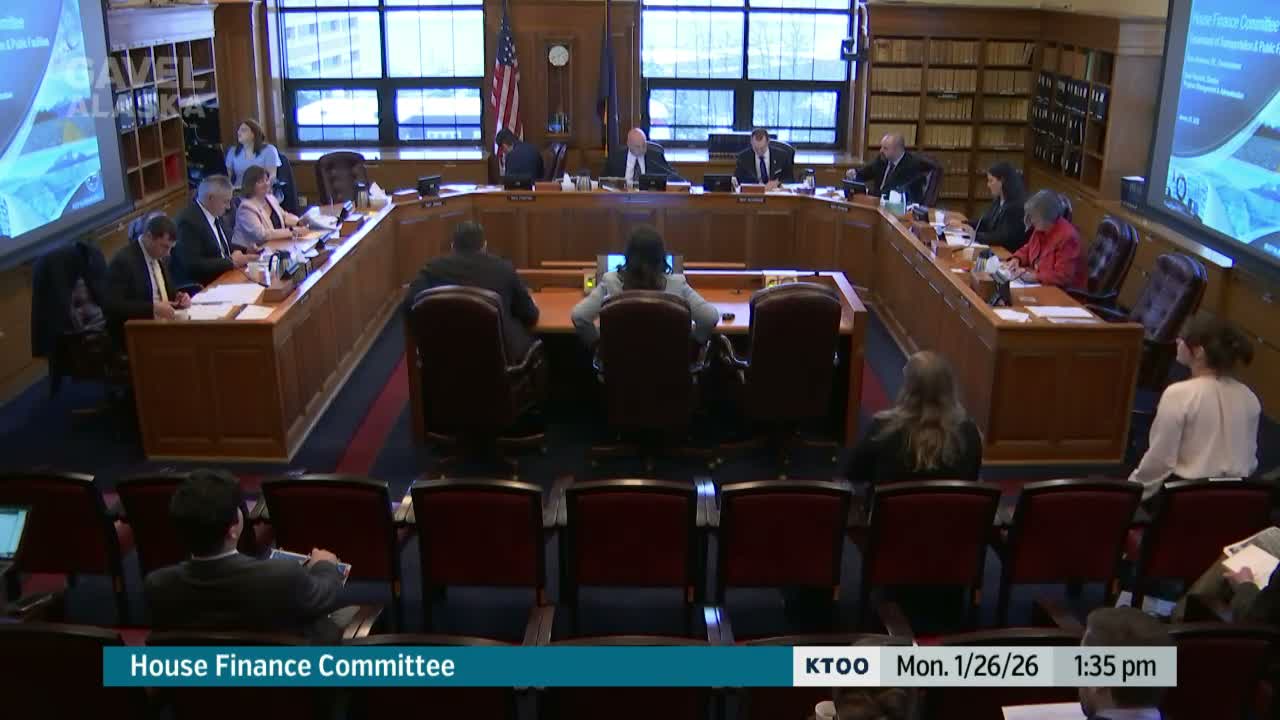
Juneau — The state’s Office of Management and Budget told the House Finance Committee on Jan. 26 that a drop in oil price forecasts prompted the governor to exercise substantial line-item vetoes to avoid risking the general fund. Lacey Sanders, director of the Office of Management and Budget, said the FY26 budget had been built on a spring forecast using $68 per barrel but that the Department of Revenue later projected $64 per barrel, and the administration proposed roughly $122,000,000 in vetoes across operating and capital bills.
Sanders told the committee the operating vetoes total $57,500,000 in unrestricted general funds. She highlighted two items identified as likely supplemental requests in the governor’s December update: a disaster relief capitalization veto of about $10,300,000 (OMB is asking the legislature to add back $40,000,000) and a fire suppression capitalization veto of about $26,000,000 (the veto would retain $47,500,000 in fire response funding). "These costs aren't all incurred in one year — they're over time," Sanders said, noting some disaster and fire costs relate to prior years and that the administration is working to smooth funding across multiple years.
Members pressed OMB on other vetoed priorities. Representative Galvin asked why several education-related line items tied to teacher recruitment and incentives, including a $500,000 national-board certification payment, were zeroed out despite being described during session as high priorities. Sanders replied that reductions were a function of declining revenue and that OMB had no internal offset to restore those specific line items at this time.
Sanders also described the capital-appropriations reporting process (the Capital Appropriations Status Report, CASR), explaining the legislature often works from data that can be six months old and suggested the committee and agencies find ways to provide more current balances before reappropriating funds.
The hearing closed with Sanders reiterating that the administration will continue to work with departments and the legislature on supplemental requests and follow-ups. The committee scheduled its next meeting for Jan. 27, 2026 to introduce and hold a first hearing on House Bill 283, the Appropriations Supplemental.
The testimony and answers today set the fiscal frame for expected supplemental legislation and additional hearings this week.
Sanders told the committee the operating vetoes total $57,500,000 in unrestricted general funds. She highlighted two items identified as likely supplemental requests in the governor’s December update: a disaster relief capitalization veto of about $10,300,000 (OMB is asking the legislature to add back $40,000,000) and a fire suppression capitalization veto of about $26,000,000 (the veto would retain $47,500,000 in fire response funding). "These costs aren't all incurred in one year — they're over time," Sanders said, noting some disaster and fire costs relate to prior years and that the administration is working to smooth funding across multiple years.
Members pressed OMB on other vetoed priorities. Representative Galvin asked why several education-related line items tied to teacher recruitment and incentives, including a $500,000 national-board certification payment, were zeroed out despite being described during session as high priorities. Sanders replied that reductions were a function of declining revenue and that OMB had no internal offset to restore those specific line items at this time.
Sanders also described the capital-appropriations reporting process (the Capital Appropriations Status Report, CASR), explaining the legislature often works from data that can be six months old and suggested the committee and agencies find ways to provide more current balances before reappropriating funds.
The hearing closed with Sanders reiterating that the administration will continue to work with departments and the legislature on supplemental requests and follow-ups. The committee scheduled its next meeting for Jan. 27, 2026 to introduce and hold a first hearing on House Bill 283, the Appropriations Supplemental.
The testimony and answers today set the fiscal frame for expected supplemental legislation and additional hearings this week.
View the Full Meeting & All Its Details
This article offers just a summary. Unlock complete video, transcripts, and insights as a Founder Member.
✓
Watch full, unedited meeting videos
✓
Search every word spoken in unlimited transcripts
✓
AI summaries & real-time alerts (all government levels)
✓
Permanent access to expanding government content
30-day money-back guarantee
