Task force hears national expert: Alaska chronic absence rose during pandemic; experts urge prevention, data and family engagement
January 23, 2026 | 2026 Legislature Alaska, Alaska
This article was created by AI summarizing key points discussed. AI makes mistakes, so for full details and context, please refer to the video of the full meeting. Please report any errors so we can fix them. Report an error »
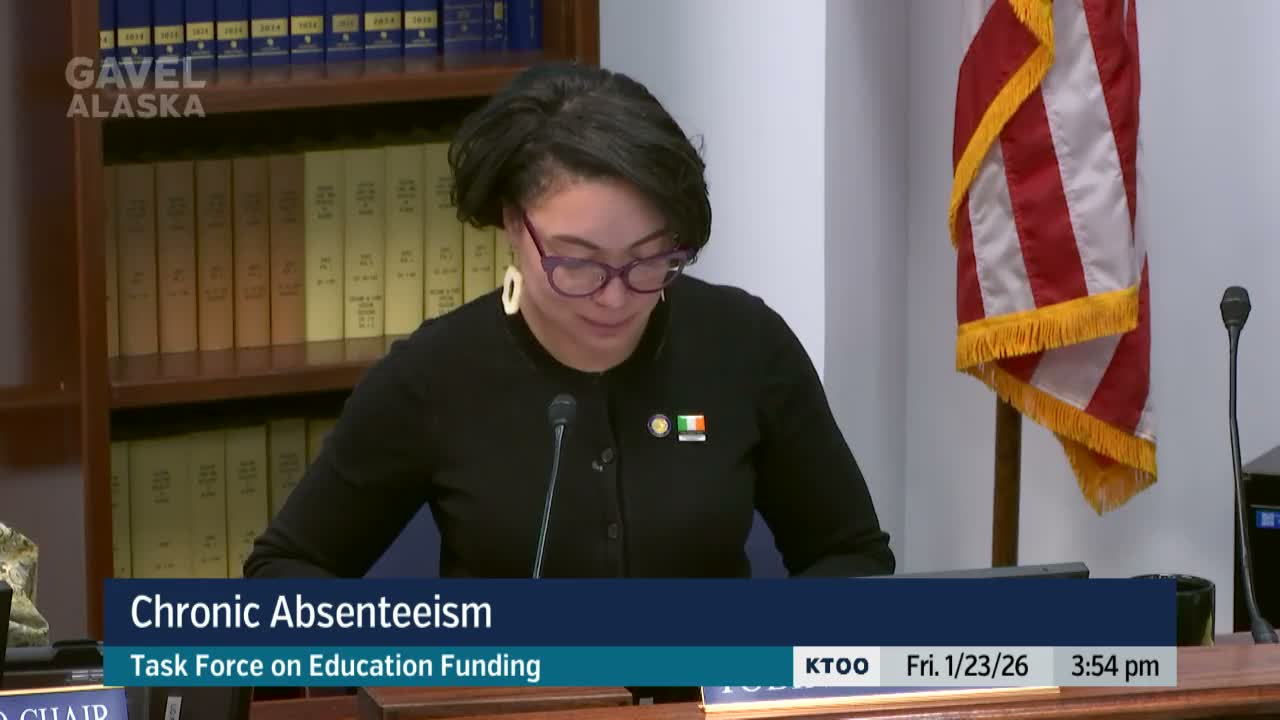
Hedy Chang, executive director of the national nonprofit Attendance Works, told the Legislative Task Force on Education Funding on Jan. 23 that chronic absence — defined as missing 10% or more of the school year — has climbed sharply during the pandemic and that Alaska’s statewide rate remains substantially elevated.
“The point of this metric is for us to notice kids who are missing out on the opportunity to benefit from whatever is being taught in the classroom,” Chang said in a presentation that combined national research with Alaska data. She reported Alaska’s chronic‑absence rate rose from about 28% before the pandemic to roughly 43% statewide afterward, while acknowledging local variation across districts.
Chang urged the task force to treat chronic absence as a prevention and equity problem rather than primarily a truancy problem. Her recommended strategies include publishing and using accurate, comparable attendance dashboards; investing in universal, tiered and trauma‑informed supports; strengthening family engagement; and coordinating school climate work so students feel safe and connected. She also cited research and district examples showing that community‑oriented interventions — home visits, positive messaging and school‑community partnerships — can reduce chronic absence.
When members raised whether punitive measures (court proceedings or withholding benefits) improve attendance, Chang pointed to studies — including a South Carolina analysis and local experiments — showing punitive approaches can make attendance worse. She said simpler, relationship‑focused communications had better effects than threatening notices and recommended school‑level solutions such as limiting extracurricular participation for students who are not meeting attendance expectations rather than creating new economic hardships for families.
Task force members pressed for actionable targets. Chang said Attendance Works has urged jurisdictions to aim for a 50% reduction in chronic absence over five years — roughly a 4% reduction per year for jurisdictions starting near 40% — as an ambitious but realistic goal. Members also discussed how to present grade‑level and district dashboards without compromising privacy in very small districts.
The meeting included contextual remarks from former Alaska education commissioner and Aleutian Region superintendent Michael Hanley, who reminded members to interpret attendance and performance data in light of local community conditions and cautioned that policy solutions are rarely simple statutes. The task force closed the discussion by asking staff to gather district policies and data‑dashboard capabilities for future deliberations.
What’s next: task force staff will request information from the Department of Education and local districts about data dashboards, grade‑level reporting and current attendance‑related policies to inform policy options at the next meeting.
“The point of this metric is for us to notice kids who are missing out on the opportunity to benefit from whatever is being taught in the classroom,” Chang said in a presentation that combined national research with Alaska data. She reported Alaska’s chronic‑absence rate rose from about 28% before the pandemic to roughly 43% statewide afterward, while acknowledging local variation across districts.
Chang urged the task force to treat chronic absence as a prevention and equity problem rather than primarily a truancy problem. Her recommended strategies include publishing and using accurate, comparable attendance dashboards; investing in universal, tiered and trauma‑informed supports; strengthening family engagement; and coordinating school climate work so students feel safe and connected. She also cited research and district examples showing that community‑oriented interventions — home visits, positive messaging and school‑community partnerships — can reduce chronic absence.
When members raised whether punitive measures (court proceedings or withholding benefits) improve attendance, Chang pointed to studies — including a South Carolina analysis and local experiments — showing punitive approaches can make attendance worse. She said simpler, relationship‑focused communications had better effects than threatening notices and recommended school‑level solutions such as limiting extracurricular participation for students who are not meeting attendance expectations rather than creating new economic hardships for families.
Task force members pressed for actionable targets. Chang said Attendance Works has urged jurisdictions to aim for a 50% reduction in chronic absence over five years — roughly a 4% reduction per year for jurisdictions starting near 40% — as an ambitious but realistic goal. Members also discussed how to present grade‑level and district dashboards without compromising privacy in very small districts.
The meeting included contextual remarks from former Alaska education commissioner and Aleutian Region superintendent Michael Hanley, who reminded members to interpret attendance and performance data in light of local community conditions and cautioned that policy solutions are rarely simple statutes. The task force closed the discussion by asking staff to gather district policies and data‑dashboard capabilities for future deliberations.
What’s next: task force staff will request information from the Department of Education and local districts about data dashboards, grade‑level reporting and current attendance‑related policies to inform policy options at the next meeting.
Don't Miss a Word: See the Full Meeting!
Go beyond summaries. Unlock every video, transcript, and key insight with a Founder Membership.
✓
Get instant access to full meeting videos
✓
Search and clip any phrase from complete transcripts
✓
Receive AI-powered summaries & custom alerts
✓
Enjoy lifetime, unrestricted access to government data
30-day money-back guarantee
