Experts tell Alaska task force chronic absence is a statewide problem tied to trauma, access and school climate
January 23, 2026 | 2026 Legislature Alaska, Alaska
This article was created by AI summarizing key points discussed. AI makes mistakes, so for full details and context, please refer to the video of the full meeting. Please report any errors so we can fix them. Report an error »
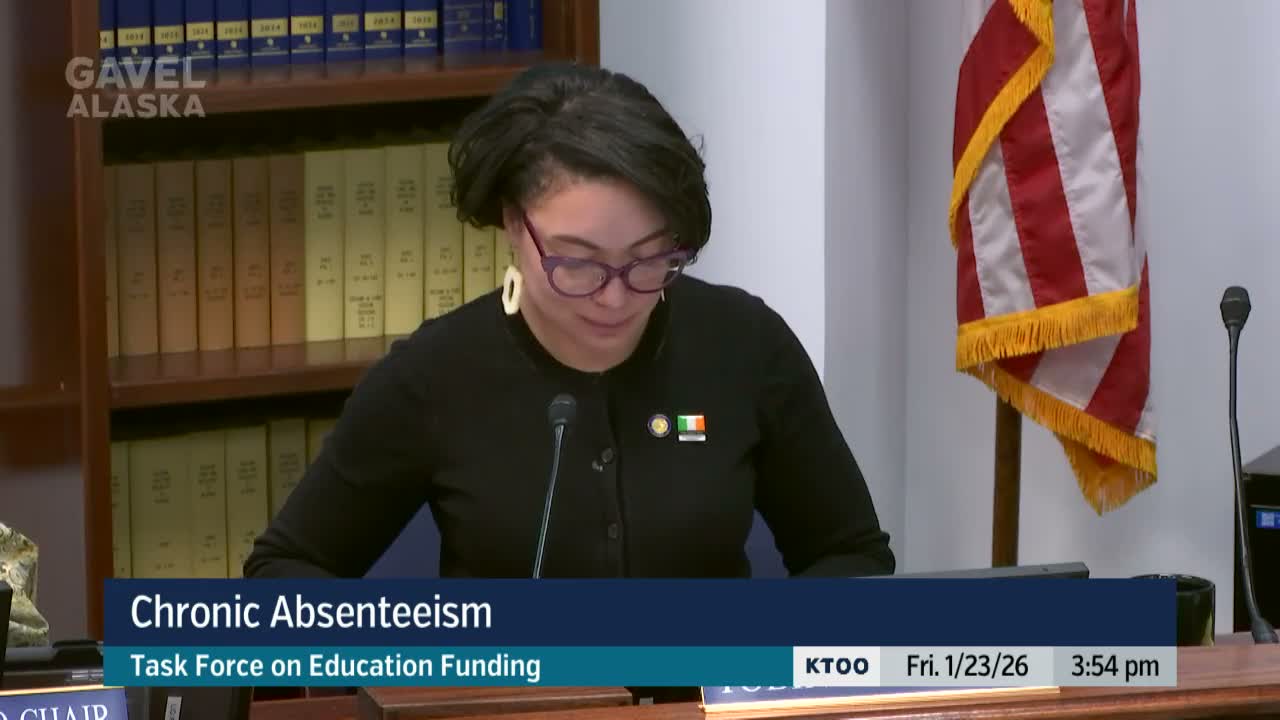
Mike Hanley, superintendent of the Aleutian Region School District and former state education commissioner, and Hetty Chang, executive director of Attendance Works, told a joint legislative task force in Juneau on Jan. 23 that chronic absenteeism in Alaska must be understood in the context of community conditions, not as a single data point.
Hanley said legislators should visit local schools to see the conditions behind the numbers and cited the state education statute he read into the record (identified in the transcript as “14 0 3 0 1 6”) to emphasize education’s broader purpose. Hanley gave the example of Atka — where a 25% chronic‑absence rate represents three of 12 students involved in cultural activities and language preservation — to show that percentages can misrepresent small communities.
Attendance Works’ Hetty Chang defined chronic absence as missing 10% or more of the school year and described the measure as a tool to identify students missing learning opportunities for any reason. Chang presented national research showing chronic absence nearly doubled during the pandemic and has fallen only slowly since. She told the committee Alaska’s publicly available data rose from about 28% pre‑pandemic to nearly 50% during the pandemic and is currently around 43% statewide, with wide variation by district and grade.
Chang said high absence rates are linked with lower third‑grade reading rates, higher suspension rates, lower graduation odds and weakened classroom culture when many students are missing. She emphasized prevention and trauma‑informed responses: accurate and comparable attendance data, family engagement, multi‑tiered interventions, school‑climate investments (safety, belonging, adult well‑being) and community partnerships to tackle underlying barriers such as health care access, housing instability and transportation.
When asked about targets, Chang said Attendance Works recommends aiming to reduce chronic absence by 50% over five years (roughly a 4% annual reduction if a district is near 40%). She also described research showing punitive approaches — court referrals or threats to families — have generally not improved attendance and can worsen outcomes; in contrast, simpler, relationship‑based outreach and clearer family communications produced better results in studies she cited.
The task force and presenters discussed practical tradeoffs for Alaska, including privacy concerns for small districts that limit public dashboards, and the need to contextualize metrics for rural and tribal communities where cultural activities and transportation pose unique challenges. Hanley and Chang both urged the committee to couple data collection with site visits, community engagement, and investments that make school attendance feasible and attractive for students.
The task force did not vote on policy at the meeting but directed staff to gather district policies and attendance dashboards for further review at upcoming sessions.
Hanley said legislators should visit local schools to see the conditions behind the numbers and cited the state education statute he read into the record (identified in the transcript as “14 0 3 0 1 6”) to emphasize education’s broader purpose. Hanley gave the example of Atka — where a 25% chronic‑absence rate represents three of 12 students involved in cultural activities and language preservation — to show that percentages can misrepresent small communities.
Attendance Works’ Hetty Chang defined chronic absence as missing 10% or more of the school year and described the measure as a tool to identify students missing learning opportunities for any reason. Chang presented national research showing chronic absence nearly doubled during the pandemic and has fallen only slowly since. She told the committee Alaska’s publicly available data rose from about 28% pre‑pandemic to nearly 50% during the pandemic and is currently around 43% statewide, with wide variation by district and grade.
Chang said high absence rates are linked with lower third‑grade reading rates, higher suspension rates, lower graduation odds and weakened classroom culture when many students are missing. She emphasized prevention and trauma‑informed responses: accurate and comparable attendance data, family engagement, multi‑tiered interventions, school‑climate investments (safety, belonging, adult well‑being) and community partnerships to tackle underlying barriers such as health care access, housing instability and transportation.
When asked about targets, Chang said Attendance Works recommends aiming to reduce chronic absence by 50% over five years (roughly a 4% annual reduction if a district is near 40%). She also described research showing punitive approaches — court referrals or threats to families — have generally not improved attendance and can worsen outcomes; in contrast, simpler, relationship‑based outreach and clearer family communications produced better results in studies she cited.
The task force and presenters discussed practical tradeoffs for Alaska, including privacy concerns for small districts that limit public dashboards, and the need to contextualize metrics for rural and tribal communities where cultural activities and transportation pose unique challenges. Hanley and Chang both urged the committee to couple data collection with site visits, community engagement, and investments that make school attendance feasible and attractive for students.
The task force did not vote on policy at the meeting but directed staff to gather district policies and attendance dashboards for further review at upcoming sessions.
View the Full Meeting & All Its Details
This article offers just a summary. Unlock complete video, transcripts, and insights as a Founder Member.
✓
Watch full, unedited meeting videos
✓
Search every word spoken in unlimited transcripts
✓
AI summaries & real-time alerts (all government levels)
✓
Permanent access to expanding government content
30-day money-back guarantee
