House labor panel hears HJR 20 urging federal hiring goals for veteran apprentices on DOD projects
January 23, 2026 | 2026 Legislature Alaska, Alaska
This article was created by AI summarizing key points discussed. AI makes mistakes, so for full details and context, please refer to the video of the full meeting. Please report any errors so we can fix them. Report an error »
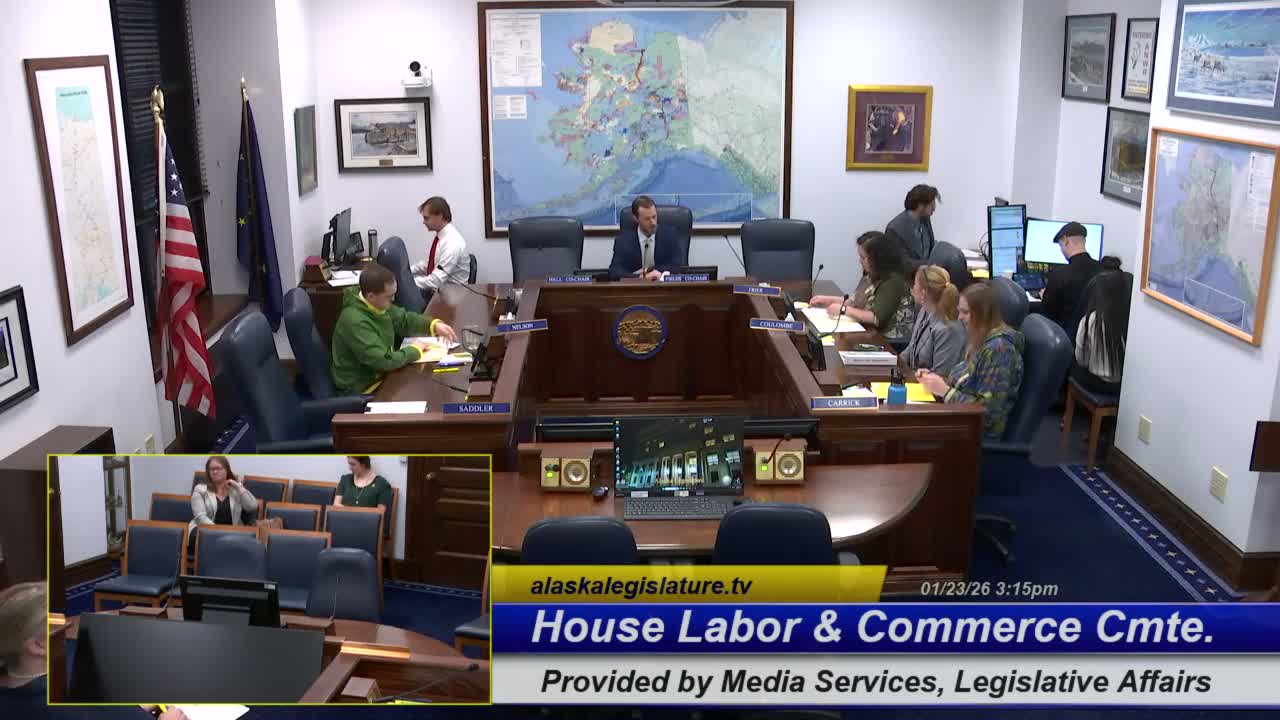
The House Labor and Commerce Committee held a first hearing on Jan. 23 on House Joint Resolution 20, introduced by Representative David Nelson, which urges the U.S. Congress to establish hiring goals for apprentices — including a provision that no less than 10% of a DOD construction project’s workforce be apprentices and that at least 10% of those apprentices be veterans.
Representative David Nelson, sponsor of HJR 20 and representative for House District 18, said the resolution aims to help service members transition to civilian careers. For context, he cited Bureau of Labor Statistics data for 2024 showing "60 percent of unemployed veterans were age 25 through 54," and argued that targeted hiring goals would "assist veterans and those preparing to transition from the armed forces to civilian life." Nelson added that DOD-funded construction projects are a natural fit for apprenticeships because many veterans have security clearances and relevant training.
Union and veterans advocates who testified supported the resolution. Kyle Kaiser, president and founder of Viper Transitions and a veteran, said apprenticeships smooth the transition from military service to civilian trades: "Apprenticeship to get into it, you don't need to know anything. That's why you're an apprentice," he said, and emphasized that employers must have work and placements available for apprentices.
Michael Smith, international representative for veterans affairs with the International Brotherhood of Electrical Workers (IBEW), told the committee he "fully support[s] this resolution," saying apprenticeships provide the structure many veterans seek and that placements on familiar federal installations can ease transitions. Mike Kufcheck, director of veterans affairs for IBEW Local 11, also supported HJR 20 and argued veterans bring reliability, safety awareness and training that fit trade work. Kufcheck said, "if a veteran man or woman has a career and can provide for themselves and their family, it reduces depression and stress that helps assist in reducing our veteran suicide rates."
Members pressed the sponsor for clarifications. Representative Clem asked whether the resolution prescribes a specific percentage for veterans; Nelson clarified the resolution "would just urge Congress to establish" hiring goals and used the 10% figure as an example of the kind of target the resolution encourages. Clem also asked how union and nonunion apprenticeships interact; committee responses and the sponsor noted the resolution supports registered apprenticeships and encompasses both union and nonunion programs.
Representative Sadler asked whether the resolution would be limited to projects funded through the National Defense Authorization Act (NDAA); Nelson said the intent is for the resolution to be "open and as wide encompassing as it could be" and would apply to DOD projects on military installations generally, though actual implementation would be up to Congress.
The committee took no formal vote on HJR 20 at the hearing. The chair said he would like to take the resolution "back up, or this resolution back up, and pass it at a future committee hearing" to give members additional time to review the draft. The committee adjourned at 3:26 p.m.
The hearing transcript shows broad support from veterans and union representatives and clarifies that HJR 20 is an urging resolution for federal action; it does not itself impose hiring requirements. The next procedural step is a future committee hearing to consider moving the resolution forward.
Representative David Nelson, sponsor of HJR 20 and representative for House District 18, said the resolution aims to help service members transition to civilian careers. For context, he cited Bureau of Labor Statistics data for 2024 showing "60 percent of unemployed veterans were age 25 through 54," and argued that targeted hiring goals would "assist veterans and those preparing to transition from the armed forces to civilian life." Nelson added that DOD-funded construction projects are a natural fit for apprenticeships because many veterans have security clearances and relevant training.
Union and veterans advocates who testified supported the resolution. Kyle Kaiser, president and founder of Viper Transitions and a veteran, said apprenticeships smooth the transition from military service to civilian trades: "Apprenticeship to get into it, you don't need to know anything. That's why you're an apprentice," he said, and emphasized that employers must have work and placements available for apprentices.
Michael Smith, international representative for veterans affairs with the International Brotherhood of Electrical Workers (IBEW), told the committee he "fully support[s] this resolution," saying apprenticeships provide the structure many veterans seek and that placements on familiar federal installations can ease transitions. Mike Kufcheck, director of veterans affairs for IBEW Local 11, also supported HJR 20 and argued veterans bring reliability, safety awareness and training that fit trade work. Kufcheck said, "if a veteran man or woman has a career and can provide for themselves and their family, it reduces depression and stress that helps assist in reducing our veteran suicide rates."
Members pressed the sponsor for clarifications. Representative Clem asked whether the resolution prescribes a specific percentage for veterans; Nelson clarified the resolution "would just urge Congress to establish" hiring goals and used the 10% figure as an example of the kind of target the resolution encourages. Clem also asked how union and nonunion apprenticeships interact; committee responses and the sponsor noted the resolution supports registered apprenticeships and encompasses both union and nonunion programs.
Representative Sadler asked whether the resolution would be limited to projects funded through the National Defense Authorization Act (NDAA); Nelson said the intent is for the resolution to be "open and as wide encompassing as it could be" and would apply to DOD projects on military installations generally, though actual implementation would be up to Congress.
The committee took no formal vote on HJR 20 at the hearing. The chair said he would like to take the resolution "back up, or this resolution back up, and pass it at a future committee hearing" to give members additional time to review the draft. The committee adjourned at 3:26 p.m.
The hearing transcript shows broad support from veterans and union representatives and clarifies that HJR 20 is an urging resolution for federal action; it does not itself impose hiring requirements. The next procedural step is a future committee hearing to consider moving the resolution forward.
View the Full Meeting & All Its Details
This article offers just a summary. Unlock complete video, transcripts, and insights as a Founder Member.
✓
Watch full, unedited meeting videos
✓
Search every word spoken in unlimited transcripts
✓
AI summaries & real-time alerts (all government levels)
✓
Permanent access to expanding government content
30-day money-back guarantee
