Senate Finance Committee hears fall revenue forecast as oil, Permanent Fund drive outlook
January 23, 2026 | 2026 Legislature Alaska, Alaska
This article was created by AI summarizing key points discussed. AI makes mistakes, so for full details and context, please refer to the video of the full meeting. Please report any errors so we can fix them. Report an error »
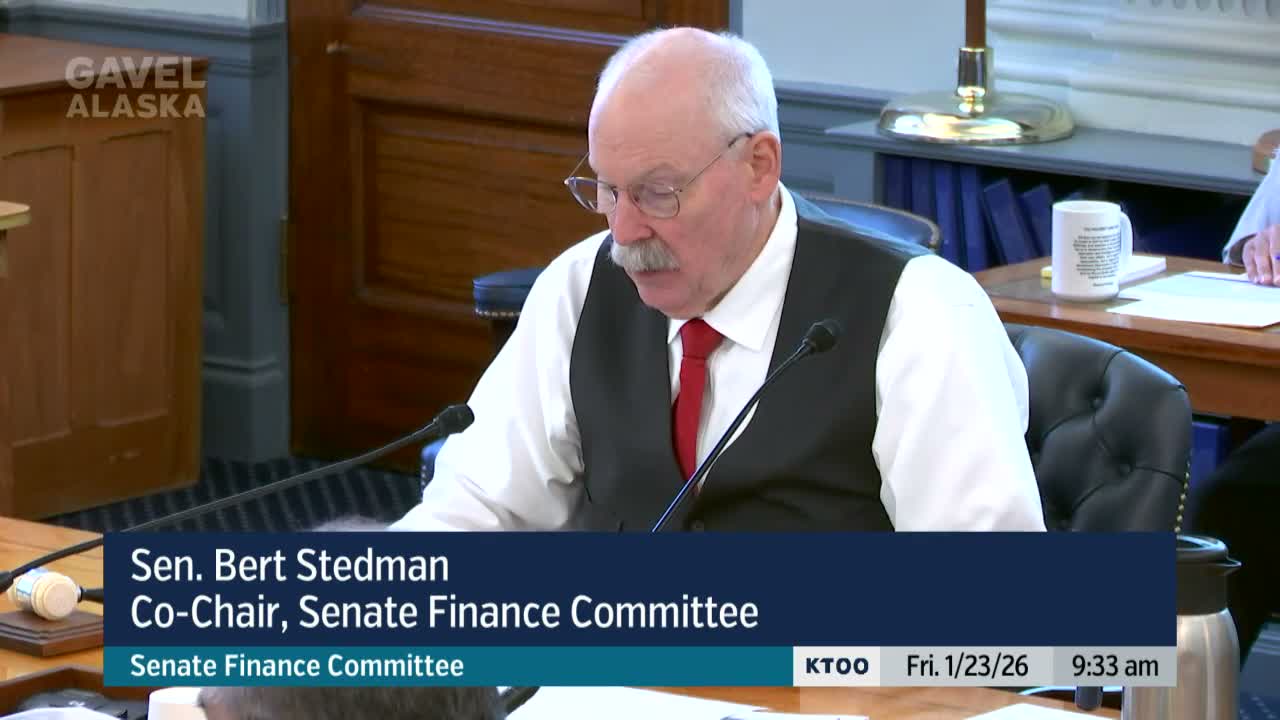
Acting Revenue Commissioner Janelle Earls and Dan Stickel, the Department of Revenuechief economist, briefed the Alaska State Senate Finance Committee on Jan. 23 on the departments fall revenue forecast and key assumptions that will underlie the governors FY27 budget.
Stickel said the fall forecast, released Dec. 11 with the full revenue sources book Dec. 18, projects total state revenue of about $17.8 billion for fiscal 2026 and $15.3 billion for fiscal 2027, down from $19.2 billion in fiscal 2025. "The revenue forecast was the fall revenue forecast was released on December 11," he said. He told senators the forecast represents one scenario within a range of potential outcomes and that the department uses the futures market and other data sources on tax.alaska.gov to build assumptions.
Why it matters: Stickel emphasized Alaskas reliance on three principal revenue sourcesinvestment earnings, federal receipts and petroleumwhich together contributed roughly 93% of the states revenue in FY25. The Permanent Fund percent-of-market-value transfer is the largest source of unrestricted revenue, generating about $3.7 billion in FY25 and forecast at $3.8 billion in FY26 and $4.0 billion in FY27. The departments long-term assumption for the Permanent Fund is a 7.3% annual return.
On oil, Stickel described the petroleum assumptions that sharply affect the unrestricted forecast: the department used an Alaska North Slope oil price of $65.48 per barrel for fiscal 2026 and $62 per barrel for fiscal 2027. He warned of price uncertainty and translated price sensitivity into fiscal terms: "each $1 change in the oil price equates to about $30,000,000 of unrestricted state revenue." Stickel said production is expected to exceed 500,000 barrels per day on average in FY27 as the Picka project comes online and could rise further as Willow and later phases advance.
The presentation also noted a reduced production-tax outlook: production tax revenue was $635 million in FY25, and the department forecasts $316 million for FY26 and $286 million for FY27, reflecting that, at current prices and spending, many producers will be at or below the statutory minimum tax floor.
Legal and classification questions: Stickel told senators the department revised its treatment of certain National Petroleum Reserve-Alaska (NPRA) receipts. Beginning in FY27 the forecast shows the anticipated 74.5% unrestricted share of NPRA bonuses, rents and royalties as unrestricted revenue after a review of federal and state law and passage of the "1 Big Beautiful Bill" Act. When Senator Keel asked what federal change drove that reclassification, Stickel said the department had concluded the prior restricted treatment did not accurately reflect federal law and state statute and deferred detailed legal questions to the Department of Law.
Lawmakersrequests and next steps: Senators pressed the department for additional detail. The committee chair and members asked that the Department of Natural Resources and Revenue produce a breakout of barrels into legacy, 20% GVR and 30% GVR categories and aggregate those categories so the committee can assess how different barrel types flow to severance, royalties and the Permanent Fund. Senators also requested a five-year lookback on development costs and inflation impacts, and said the committee may invite industry witnesses to testify about cost pressures. The committee requested a formal legal review of the NPRA reclassification and scheduled a follow-up meeting to begin work on the governors FY27 budget.
The committee adjourned at 10:25 a.m. and will reconvene Monday at 9 a.m. with the Office of Management and Budget and Legislative Finance to review the governors budget submission.
Stickel said the fall forecast, released Dec. 11 with the full revenue sources book Dec. 18, projects total state revenue of about $17.8 billion for fiscal 2026 and $15.3 billion for fiscal 2027, down from $19.2 billion in fiscal 2025. "The revenue forecast was the fall revenue forecast was released on December 11," he said. He told senators the forecast represents one scenario within a range of potential outcomes and that the department uses the futures market and other data sources on tax.alaska.gov to build assumptions.
Why it matters: Stickel emphasized Alaskas reliance on three principal revenue sourcesinvestment earnings, federal receipts and petroleumwhich together contributed roughly 93% of the states revenue in FY25. The Permanent Fund percent-of-market-value transfer is the largest source of unrestricted revenue, generating about $3.7 billion in FY25 and forecast at $3.8 billion in FY26 and $4.0 billion in FY27. The departments long-term assumption for the Permanent Fund is a 7.3% annual return.
On oil, Stickel described the petroleum assumptions that sharply affect the unrestricted forecast: the department used an Alaska North Slope oil price of $65.48 per barrel for fiscal 2026 and $62 per barrel for fiscal 2027. He warned of price uncertainty and translated price sensitivity into fiscal terms: "each $1 change in the oil price equates to about $30,000,000 of unrestricted state revenue." Stickel said production is expected to exceed 500,000 barrels per day on average in FY27 as the Picka project comes online and could rise further as Willow and later phases advance.
The presentation also noted a reduced production-tax outlook: production tax revenue was $635 million in FY25, and the department forecasts $316 million for FY26 and $286 million for FY27, reflecting that, at current prices and spending, many producers will be at or below the statutory minimum tax floor.
Legal and classification questions: Stickel told senators the department revised its treatment of certain National Petroleum Reserve-Alaska (NPRA) receipts. Beginning in FY27 the forecast shows the anticipated 74.5% unrestricted share of NPRA bonuses, rents and royalties as unrestricted revenue after a review of federal and state law and passage of the "1 Big Beautiful Bill" Act. When Senator Keel asked what federal change drove that reclassification, Stickel said the department had concluded the prior restricted treatment did not accurately reflect federal law and state statute and deferred detailed legal questions to the Department of Law.
Lawmakersrequests and next steps: Senators pressed the department for additional detail. The committee chair and members asked that the Department of Natural Resources and Revenue produce a breakout of barrels into legacy, 20% GVR and 30% GVR categories and aggregate those categories so the committee can assess how different barrel types flow to severance, royalties and the Permanent Fund. Senators also requested a five-year lookback on development costs and inflation impacts, and said the committee may invite industry witnesses to testify about cost pressures. The committee requested a formal legal review of the NPRA reclassification and scheduled a follow-up meeting to begin work on the governors FY27 budget.
The committee adjourned at 10:25 a.m. and will reconvene Monday at 9 a.m. with the Office of Management and Budget and Legislative Finance to review the governors budget submission.
View the Full Meeting & All Its Details
This article offers just a summary. Unlock complete video, transcripts, and insights as a Founder Member.
✓
Watch full, unedited meeting videos
✓
Search every word spoken in unlimited transcripts
✓
AI summaries & real-time alerts (all government levels)
✓
Permanent access to expanding government content
30-day money-back guarantee
