General Affairs Committee hears two gubernatorial nominees for Problem Gambling Commission
January 26, 2026 | 2026 Legislature NE, Nebraska
This article was created by AI summarizing key points discussed. AI makes mistakes, so for full details and context, please refer to the video of the full meeting. Please report any errors so we can fix them. Report an error »
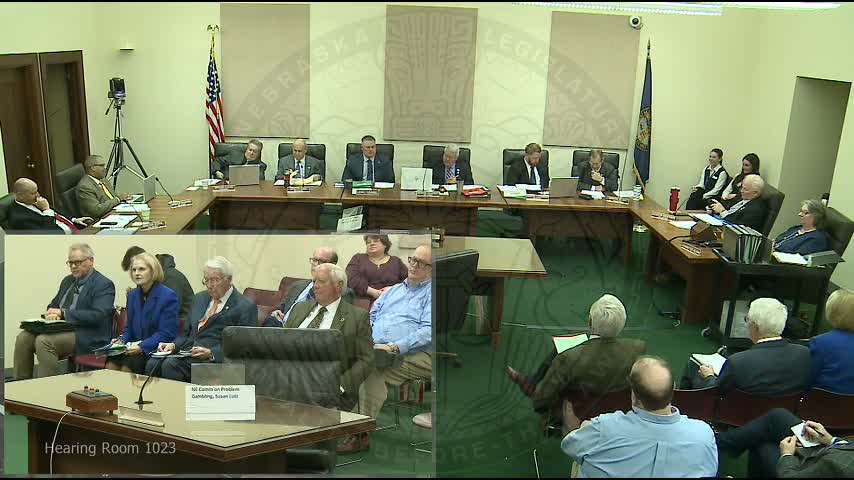
Senator Rick Holcroft, chair of the General Affairs Committee, convened a hearing that included gubernatorial appointments to the Problem Gambling Commission.
Matthew Monheiser, testifying by phone, said he was seeking renewal of his commission appointment and described multiple prior terms of service. Monheiser warned that a pending administrative change could move the commission into the Department of Health and Human Services and said he was "not sure of the details" but worried that DHHS might not be able to maintain the commission’s current focus on outreach and treatment allocation. He deferred specific program metrics to commission staff and said he would arrange for the executive director to share numbers with committee members.
Susan Lutz, who identified herself as chair of the Problem Gambling Commission and a Norfolk resident, described 13 years of service and said separating the commission from DHHS in 2013 improved transparency and ensured that funds statutorily earmarked for problem gambling were used for treatment, messaging and helpline services. Lutz gave budget context, saying statute appropriations were about $3,200,000 last year and that the commission used roughly $2,800,000, with about $2,200,000 directed to counselor contracts and outreach. She said the commission served over 400 people last year and cited 134 new intakes at the most recent meeting.
Committee members pressed nominees on several operational points. Senator Victor Rountree asked how many people were in the program; Lutz said the division’s executive director would have precise caseload figures. Senators also asked about telehealth services (Lutz said telehealth is available), whether there is a graduation or ‘‘graduated’’ standard for counseling (Lutz said there is not a uniform standard), and whether some counseling recipients should share costs (Lutz said the commission has discussed that possibility).
Both nominees expressed a desire to continue the commission’s current work. Monheiser said, "I sure hope that the commission continues as is." Lutz said moving the commission back under DHHS would ‘‘lose a lot of transparency’’ and could affect the tailored services the commission provides.
The committee closed the appointment hearings for these nominees without a recorded vote during the public hearing.
What happens next: the committee may consider these appointments in its business meeting; any formal confirmation, referral or vote will be recorded in committee minutes.
Matthew Monheiser, testifying by phone, said he was seeking renewal of his commission appointment and described multiple prior terms of service. Monheiser warned that a pending administrative change could move the commission into the Department of Health and Human Services and said he was "not sure of the details" but worried that DHHS might not be able to maintain the commission’s current focus on outreach and treatment allocation. He deferred specific program metrics to commission staff and said he would arrange for the executive director to share numbers with committee members.
Susan Lutz, who identified herself as chair of the Problem Gambling Commission and a Norfolk resident, described 13 years of service and said separating the commission from DHHS in 2013 improved transparency and ensured that funds statutorily earmarked for problem gambling were used for treatment, messaging and helpline services. Lutz gave budget context, saying statute appropriations were about $3,200,000 last year and that the commission used roughly $2,800,000, with about $2,200,000 directed to counselor contracts and outreach. She said the commission served over 400 people last year and cited 134 new intakes at the most recent meeting.
Committee members pressed nominees on several operational points. Senator Victor Rountree asked how many people were in the program; Lutz said the division’s executive director would have precise caseload figures. Senators also asked about telehealth services (Lutz said telehealth is available), whether there is a graduation or ‘‘graduated’’ standard for counseling (Lutz said there is not a uniform standard), and whether some counseling recipients should share costs (Lutz said the commission has discussed that possibility).
Both nominees expressed a desire to continue the commission’s current work. Monheiser said, "I sure hope that the commission continues as is." Lutz said moving the commission back under DHHS would ‘‘lose a lot of transparency’’ and could affect the tailored services the commission provides.
The committee closed the appointment hearings for these nominees without a recorded vote during the public hearing.
What happens next: the committee may consider these appointments in its business meeting; any formal confirmation, referral or vote will be recorded in committee minutes.
View the Full Meeting & All Its Details
This article offers just a summary. Unlock complete video, transcripts, and insights as a Founder Member.
✓
Watch full, unedited meeting videos
✓
Search every word spoken in unlimited transcripts
✓
AI summaries & real-time alerts (all government levels)
✓
Permanent access to expanding government content
30-day money-back guarantee
