Anderson council advances sewer bond and rate ordinances amid concern over CSOs and long-term costs
January 23, 2026 | Anderson City, Madison County, Indiana
This article was created by AI summarizing key points discussed. AI makes mistakes, so for full details and context, please refer to the video of the full meeting. Please report any errors so we can fix them. Report an error »
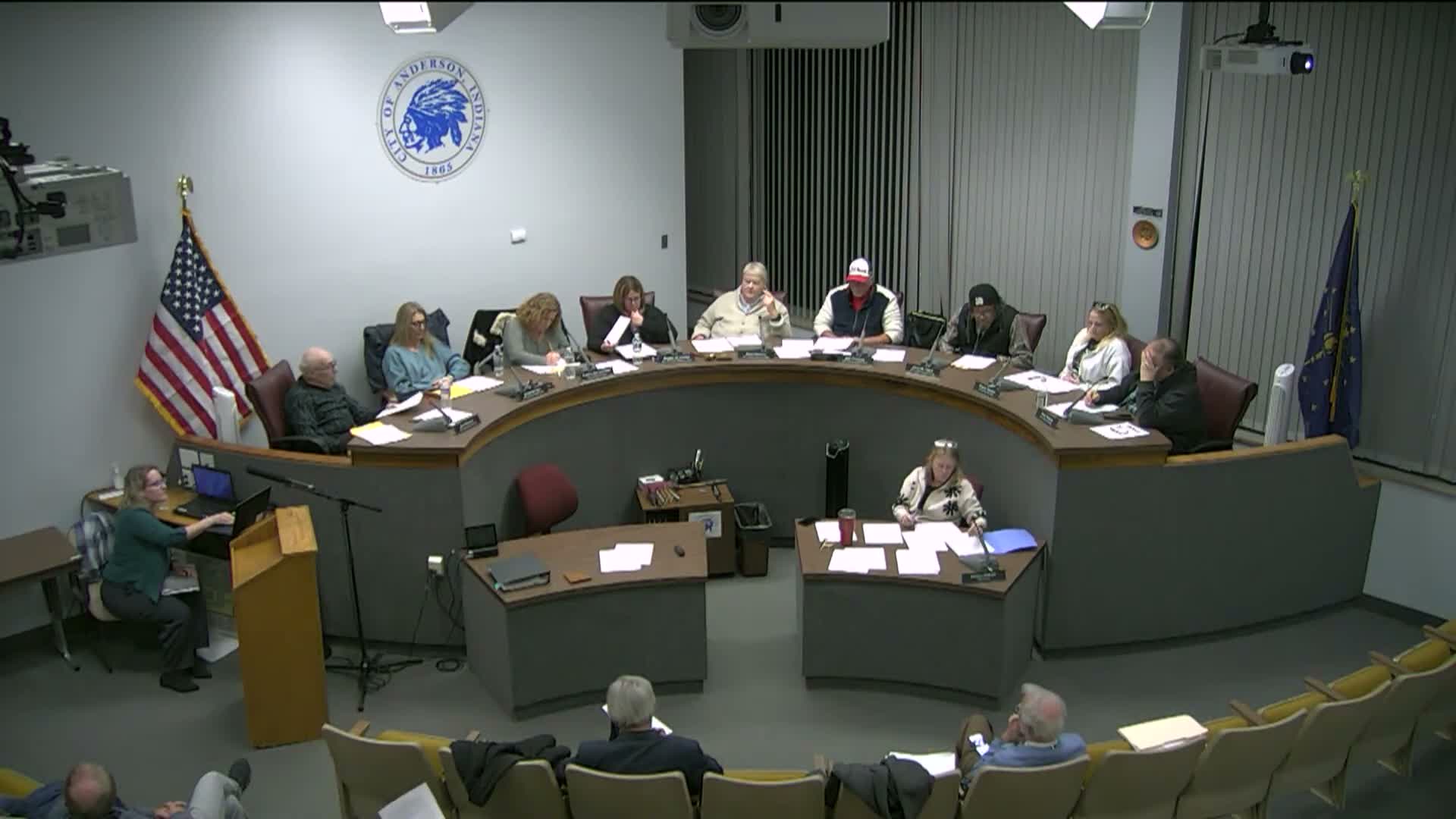
The Anderson City Council passed first readings Jan. 22 for a pair of sewer ordinances to authorize revenue bonds and raise sewer rates by 18% to address operating shortfalls and long-term compliance costs under a federal consent decree.
Mayor Tom Broderick and city staff said the sewer utility faces statutory and contractual obligations that require revenue coverage and capital work. Tim Lyons, assistant city attorney, described the consent decree and its history, including modifications extending implementation deadlines; he said the city has proposed a modified long-term-control approach to regulators and is seeking additional time while implementing prioritized projects. Lyons summarized recent work and said the city’s December submittal to regulators estimated long-term capital of roughly $84 million tied to CSO reductions and an additional ~$103 million in other capital needs.
What the ordinances do: Ordinance 4-26 would authorize up to $10 million in revenue bonds for sewer improvements; Ordinance 5-26 would amend sewer rates and charges (staff presented an 18% increase) to restore coverage and support the two-year capital plan. Jennifer Wilson (revenue analyst) said staff’s test-year analysis (2024) shows a $3.575 million deficit for 2025–26 without action and that the 18% increase would raise coverage from a projected 63% to about 151%. "With this rate increase the coverage would be at a 151%," Wilson said.
Engineering work and CSO effect: Chris Kaufman (AEGIS) described the White River interceptor final phase, a large-diameter pipeline that staff say will remove two CSO outlets (identified in the discussion as CSO 25 and 26) and reduce overflow volume and frequency. Ryan Paschal, superintendent of water pollution control, said eliminating those outlets and ongoing improvements will reduce the duration and volume of CSO events, though he emphasized design uses a wet reference year and that complete elimination of all overflows would be highly costly.
Public concerns and council debate: Several residents warned that the public struggles to pay existing bills; one audience member said township assistance recipients already face hardship. Speakers pressed whether rate increases primarily cover capital or day-to-day operating shortfalls; staff said much of the current increase restores operating funds while bonding covers a portion of capital (staff cited bonding at ~2% of total revenues in the electric example and described similar structuring for sewer). Some councilors said they would not support a rushed increase without an approved multiyear plan; others warned that failure to act could damage the city’s bond rating and hinder future borrowing.
Votes and next steps: The clerk recorded five affirmative votes on the sewer bond ordinance and five affirmatives for the sewer-rate ordinance’s first reading; both measures passed first reading and will return for a public hearing (Feb. 17) and final readings later in the month. Staff said they will continue negotiations with the EPA and IDEM over the consent-decree modification and prepare more detailed capital and financial plans for upcoming work.
Community takeaway: The ordinances clear a procedural hurdle tonight, but officials acknowledged further community engagement and more granular spending and affordability information will be necessary in coming weeks. Residents urged clearer tracking of CSO locations, more outreach on federal grant opportunities and assurances on protections for low-income households.
Mayor Tom Broderick and city staff said the sewer utility faces statutory and contractual obligations that require revenue coverage and capital work. Tim Lyons, assistant city attorney, described the consent decree and its history, including modifications extending implementation deadlines; he said the city has proposed a modified long-term-control approach to regulators and is seeking additional time while implementing prioritized projects. Lyons summarized recent work and said the city’s December submittal to regulators estimated long-term capital of roughly $84 million tied to CSO reductions and an additional ~$103 million in other capital needs.
What the ordinances do: Ordinance 4-26 would authorize up to $10 million in revenue bonds for sewer improvements; Ordinance 5-26 would amend sewer rates and charges (staff presented an 18% increase) to restore coverage and support the two-year capital plan. Jennifer Wilson (revenue analyst) said staff’s test-year analysis (2024) shows a $3.575 million deficit for 2025–26 without action and that the 18% increase would raise coverage from a projected 63% to about 151%. "With this rate increase the coverage would be at a 151%," Wilson said.
Engineering work and CSO effect: Chris Kaufman (AEGIS) described the White River interceptor final phase, a large-diameter pipeline that staff say will remove two CSO outlets (identified in the discussion as CSO 25 and 26) and reduce overflow volume and frequency. Ryan Paschal, superintendent of water pollution control, said eliminating those outlets and ongoing improvements will reduce the duration and volume of CSO events, though he emphasized design uses a wet reference year and that complete elimination of all overflows would be highly costly.
Public concerns and council debate: Several residents warned that the public struggles to pay existing bills; one audience member said township assistance recipients already face hardship. Speakers pressed whether rate increases primarily cover capital or day-to-day operating shortfalls; staff said much of the current increase restores operating funds while bonding covers a portion of capital (staff cited bonding at ~2% of total revenues in the electric example and described similar structuring for sewer). Some councilors said they would not support a rushed increase without an approved multiyear plan; others warned that failure to act could damage the city’s bond rating and hinder future borrowing.
Votes and next steps: The clerk recorded five affirmative votes on the sewer bond ordinance and five affirmatives for the sewer-rate ordinance’s first reading; both measures passed first reading and will return for a public hearing (Feb. 17) and final readings later in the month. Staff said they will continue negotiations with the EPA and IDEM over the consent-decree modification and prepare more detailed capital and financial plans for upcoming work.
Community takeaway: The ordinances clear a procedural hurdle tonight, but officials acknowledged further community engagement and more granular spending and affordability information will be necessary in coming weeks. Residents urged clearer tracking of CSO locations, more outreach on federal grant opportunities and assurances on protections for low-income households.
View the Full Meeting & All Its Details
This article offers just a summary. Unlock complete video, transcripts, and insights as a Founder Member.
✓
Watch full, unedited meeting videos
✓
Search every word spoken in unlimited transcripts
✓
AI summaries & real-time alerts (all government levels)
✓
Permanent access to expanding government content
30-day money-back guarantee
