Bloomington planners propose allowing 80% impervious coverage for developments using affordable-housing incentive; commission seeks answers
January 19, 2026 | Bloomington City, Monroe County, Indiana
This article was created by AI summarizing key points discussed. AI makes mistakes, so for full details and context, please refer to the video of the full meeting. Please report any errors so we can fix them. Report an error »
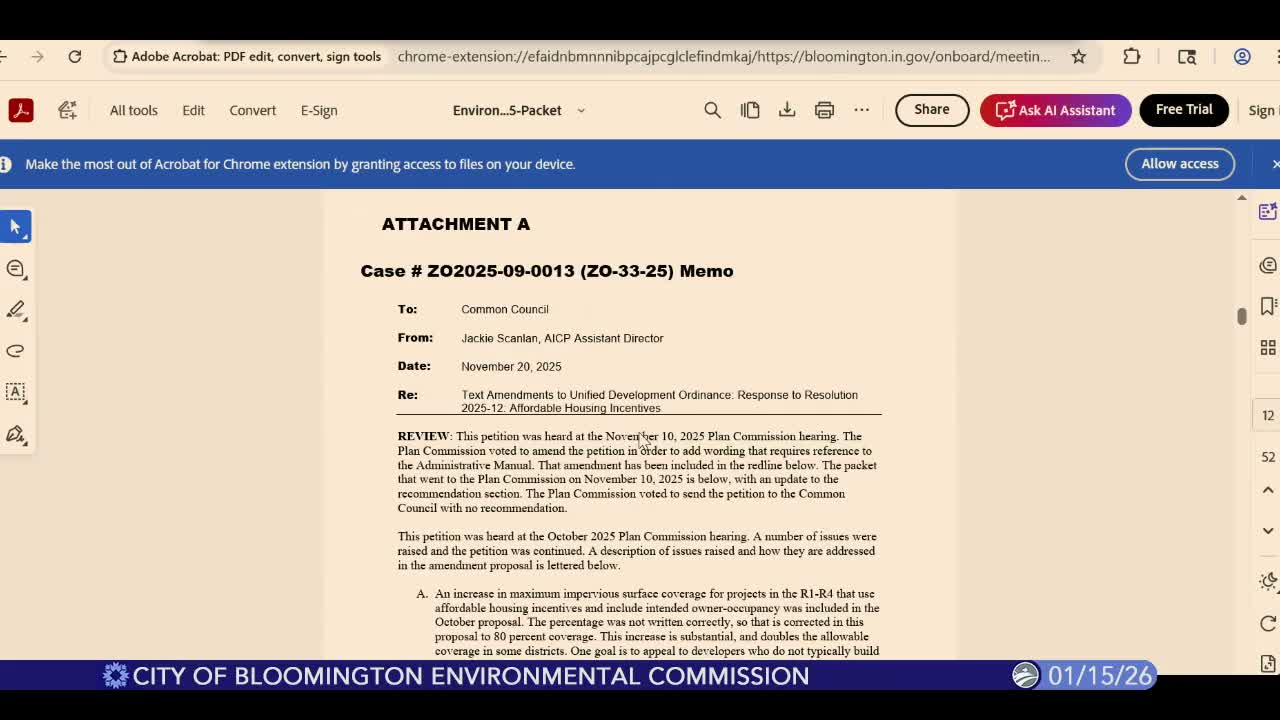
Jamie Kreindler, senior zoning planner for Bloomington City, told the Environmental Commission on Jan. 15 that a proposed Unified Development Ordinance incentive would allow developments using the affordable-housing incentive to increase maximum impervious-surface coverage to 80%.
The change is framed as a dimensional incentive to encourage density: according to Kreindler, the current code sets maximum impervious coverage for lower-density residential districts at roughly 30% (R‑1), 40% (R‑2), 45% (R‑3) and 50% (R‑4), and the proposal would offer relaxed limits for projects that incorporate affordable units. “One of the changes that is being proposed to council has to do with the maximum impervious surface coverage and increasing that to 80% for developments that are using affordable housing,” Kreindler said.
Commissioners expressed repeated concerns about the environmental tradeoffs of raising impervious coverage. Members asked how the change would affect green space and tree canopy, whether it would increase surface parking or reduce communal open space, and how stormwater detention or retention would be required to offset run‑off risks. One commissioner asked whether the incentive applies to single lots or large developments; Kreindler said it is meant for developments that use the affordable-housing incentives and could apply to larger projects but sometimes could affect individual lots.
Rachel (senior environmental planner) and other staff recommended the commission compile targeted questions for Jackie Scanlon, the assistant planning director who helped draft the memo. Council had the proposal on its agenda the previous evening but continued the item; staff and commissioners expected the council to revisit it on Feb. 4. Commissioners agreed to try to gather technical questions and possibly draft a comment memo; packets for council are typically published the Friday before the meeting, and staff advised a submission about 10 days prior to ensure inclusion.
Why it matters: increasing impervious surface can increase runoff, strain stormwater infrastructure, and reduce on‑site tree canopy and usable green space — consequences that affect stormwater costs and neighborhood livability. Commissioners said they support sensible density and affordable housing goals but want specific assurances about stormwater management, tree preservation, and the feasibility of requiring communal green space or other offsets.
What’s next: staff said they would ask Jackie Scanlon for clarifications and timing; the council is expected to take the item up in early February, and the Environmental Commission may submit a formal memo to planning and council if it can finalize recommendations in time.
Quote: Jamie Kreindler, senior zoning planner: “So in the current UDO, there’s incentives for developers that use affordable housing as a part of their project… One of the changes being proposed is increasing [maximum impervious surface coverage] to 80% for developments that are using affordable housing.”
Quote: Rachel (senior environmental planner): “So, things like social and demographic data are not able to play into government decisions,” explaining limits on using demographic factors in some official determinations as described to the commission.
Provenance: Presentation and Q&A (topic introduced SEG 072; discussion continued through SEG 483).
The change is framed as a dimensional incentive to encourage density: according to Kreindler, the current code sets maximum impervious coverage for lower-density residential districts at roughly 30% (R‑1), 40% (R‑2), 45% (R‑3) and 50% (R‑4), and the proposal would offer relaxed limits for projects that incorporate affordable units. “One of the changes that is being proposed to council has to do with the maximum impervious surface coverage and increasing that to 80% for developments that are using affordable housing,” Kreindler said.
Commissioners expressed repeated concerns about the environmental tradeoffs of raising impervious coverage. Members asked how the change would affect green space and tree canopy, whether it would increase surface parking or reduce communal open space, and how stormwater detention or retention would be required to offset run‑off risks. One commissioner asked whether the incentive applies to single lots or large developments; Kreindler said it is meant for developments that use the affordable-housing incentives and could apply to larger projects but sometimes could affect individual lots.
Rachel (senior environmental planner) and other staff recommended the commission compile targeted questions for Jackie Scanlon, the assistant planning director who helped draft the memo. Council had the proposal on its agenda the previous evening but continued the item; staff and commissioners expected the council to revisit it on Feb. 4. Commissioners agreed to try to gather technical questions and possibly draft a comment memo; packets for council are typically published the Friday before the meeting, and staff advised a submission about 10 days prior to ensure inclusion.
Why it matters: increasing impervious surface can increase runoff, strain stormwater infrastructure, and reduce on‑site tree canopy and usable green space — consequences that affect stormwater costs and neighborhood livability. Commissioners said they support sensible density and affordable housing goals but want specific assurances about stormwater management, tree preservation, and the feasibility of requiring communal green space or other offsets.
What’s next: staff said they would ask Jackie Scanlon for clarifications and timing; the council is expected to take the item up in early February, and the Environmental Commission may submit a formal memo to planning and council if it can finalize recommendations in time.
Quote: Jamie Kreindler, senior zoning planner: “So in the current UDO, there’s incentives for developers that use affordable housing as a part of their project… One of the changes being proposed is increasing [maximum impervious surface coverage] to 80% for developments that are using affordable housing.”
Quote: Rachel (senior environmental planner): “So, things like social and demographic data are not able to play into government decisions,” explaining limits on using demographic factors in some official determinations as described to the commission.
Provenance: Presentation and Q&A (topic introduced SEG 072; discussion continued through SEG 483).
View the Full Meeting & All Its Details
This article offers just a summary. Unlock complete video, transcripts, and insights as a Founder Member.
✓
Watch full, unedited meeting videos
✓
Search every word spoken in unlimited transcripts
✓
AI summaries & real-time alerts (all government levels)
✓
Permanent access to expanding government content
30-day money-back guarantee
