Larimer County outlines 2026 Community Mitigation Grant with smaller fund pool, March 8 application deadline
February 02, 2026 | Larimer County, Colorado
This article was created by AI summarizing key points discussed. AI makes mistakes, so for full details and context, please refer to the video of the full meeting. Please report any errors so we can fix them. Report an error »
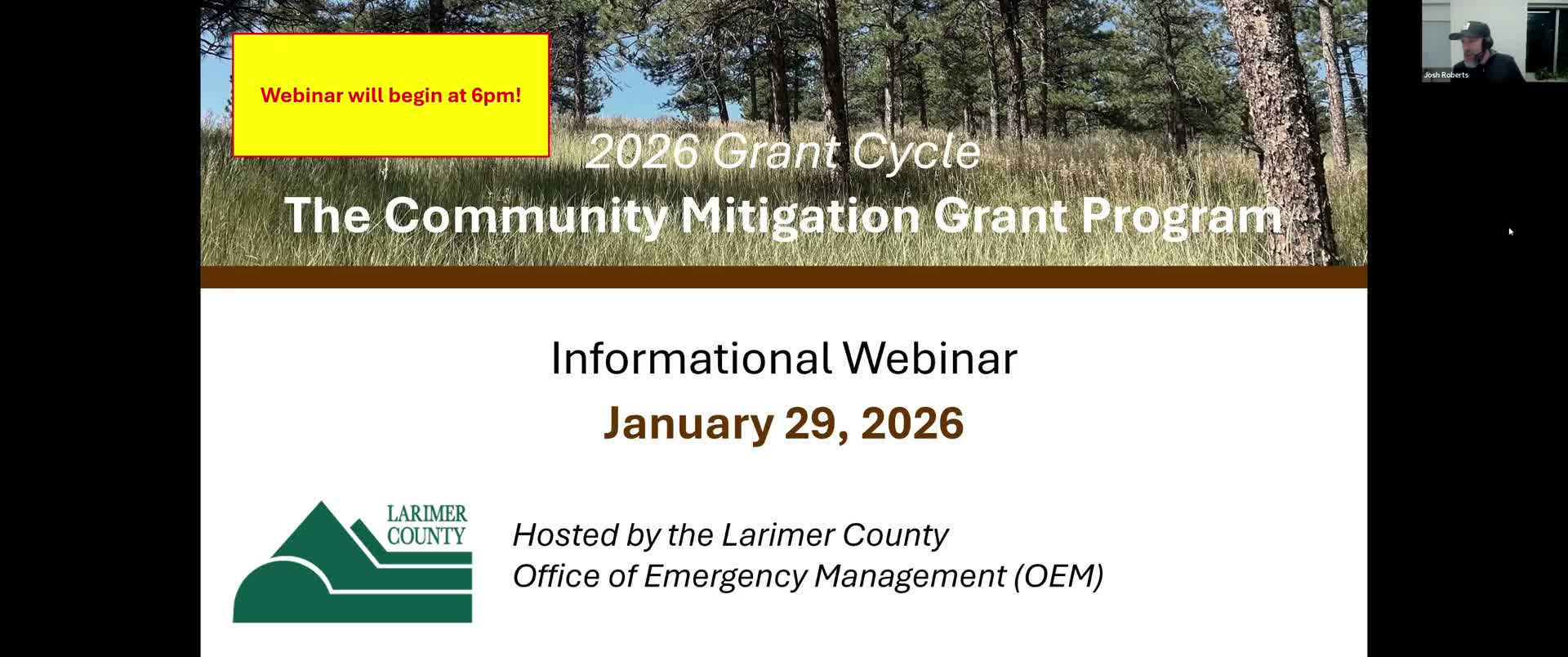
Josh Roberts, mitigation coordinator with the Larimer County Office of Emergency Management, led a webinar that laid out rules, deadlines and priorities for the 2026 Community Mitigation Grant program, and answered applicants’ questions.
Roberts said the county’s operating contribution for the 2026 cycle is $50,000, down from $100,000 last year, and that the office also expects to use roughly $15,000 in carryover grant funds. "Last year, we had a $100,000 in the total pool. This year, we've got 50,000," Roberts said, later adding that the carryover amount has "some different strings tied to it." He estimated the total pool at about $65,000 but warned that carryover funds require different payment and reporting procedures.
Why it matters: The reduced county-funded pool and the carryover restrictions affect how many projects the program can support and how funds will be administered. Applicants should plan for the program’s reimbursement model and the county’s preference for spreading limited funds across multiple communities.
Who can apply and what’s eligible: Roberts said eligible applicants include community groups, local nonprofit organizations and charitable foundations that represent a neighborhood or community. He emphasized the program’s priority for grassroots groups and said projects must be located in Larimer County and must mitigate risk from one or more hazards. Typical eligible activities include vegetation clearing, fuels reduction, chipping slash via contractors, high-visibility street or address signage and equipment purchases for community-maintained open space.
What’s not allowed: Roberts identified several ineligible costs: food and beverages, paying for staff capacity or pre-application project planning. He also said road-surface repairs or work that directly alters a road feature (paving, culvert or drainage repairs) are not eligible. "Road work to us is really, anything that's touching the surface of the road, or, you know, a feature of that road like a culvert," Roberts said, but he clarified exceptions such as trimming limbs or thinning vegetation that improve emergency access.
Award amounts and payment: The program's typical award ceiling is $10,000 per project, though Roberts said small exceptions have occurred when other projects have underruns. He explained that county operating funds will generally be reimbursed to grantees after they submit receipts and proof of payment, while the carryover (Fireshed Fund) dollars may be paid differently and will require multiple vendor quotes and modest extra reporting.
Application and scoring guidance: The online application opened Jan. 12 and applicants must submit by 11:59 PM on Sunday, March 8; late submissions will not be accepted. Roberts advised applicants to draft answers offline using the downloadable PDF of application fields and then paste them into the web form. He urged applicants to address the scoring criteria directly: the project’s contribution to community resilience and risk reduction (5 points) and the extent of community involvement and partnerships (10 points) are high priorities.
Post-award rules and administration: Awardees must sign a one-page agreement before spending funds, hold a community meeting to discuss the project (the county asks to be notified and may attend), and submit a final report with photos and financial documentation. If a project scope changes, grantees should notify staff and obtain approval so the county can amend the agreement.
Notable examples and Q&A takeaways: Roberts highlighted a past Springfield HOA project that cleared a five-acre open space, purchased a mower and rented a chipper. In audience Q&A, Roberts confirmed that hiring contractors for defined mitigation work is generally eligible, that reflective house-number signage is an acceptable project, and that modifications to road geometry to allow engine access are not eligible under current rules.
Next steps and deadlines: Applicants must file by 11:59 PM on March 8. Award announcements will be posted by May 4. Projects and all closeout documentation must be complete by 11:59 PM on Nov. 1 to align with the county fiscal year. Roberts encouraged prospective applicants to email or call with questions and said staff will provide support and template materials for permission letters, budgets and outreach.
Roberts invited follow-up contact and closed the webinar after answering attendee questions; several participants thanked staff for the guidance.
Roberts said the county’s operating contribution for the 2026 cycle is $50,000, down from $100,000 last year, and that the office also expects to use roughly $15,000 in carryover grant funds. "Last year, we had a $100,000 in the total pool. This year, we've got 50,000," Roberts said, later adding that the carryover amount has "some different strings tied to it." He estimated the total pool at about $65,000 but warned that carryover funds require different payment and reporting procedures.
Why it matters: The reduced county-funded pool and the carryover restrictions affect how many projects the program can support and how funds will be administered. Applicants should plan for the program’s reimbursement model and the county’s preference for spreading limited funds across multiple communities.
Who can apply and what’s eligible: Roberts said eligible applicants include community groups, local nonprofit organizations and charitable foundations that represent a neighborhood or community. He emphasized the program’s priority for grassroots groups and said projects must be located in Larimer County and must mitigate risk from one or more hazards. Typical eligible activities include vegetation clearing, fuels reduction, chipping slash via contractors, high-visibility street or address signage and equipment purchases for community-maintained open space.
What’s not allowed: Roberts identified several ineligible costs: food and beverages, paying for staff capacity or pre-application project planning. He also said road-surface repairs or work that directly alters a road feature (paving, culvert or drainage repairs) are not eligible. "Road work to us is really, anything that's touching the surface of the road, or, you know, a feature of that road like a culvert," Roberts said, but he clarified exceptions such as trimming limbs or thinning vegetation that improve emergency access.
Award amounts and payment: The program's typical award ceiling is $10,000 per project, though Roberts said small exceptions have occurred when other projects have underruns. He explained that county operating funds will generally be reimbursed to grantees after they submit receipts and proof of payment, while the carryover (Fireshed Fund) dollars may be paid differently and will require multiple vendor quotes and modest extra reporting.
Application and scoring guidance: The online application opened Jan. 12 and applicants must submit by 11:59 PM on Sunday, March 8; late submissions will not be accepted. Roberts advised applicants to draft answers offline using the downloadable PDF of application fields and then paste them into the web form. He urged applicants to address the scoring criteria directly: the project’s contribution to community resilience and risk reduction (5 points) and the extent of community involvement and partnerships (10 points) are high priorities.
Post-award rules and administration: Awardees must sign a one-page agreement before spending funds, hold a community meeting to discuss the project (the county asks to be notified and may attend), and submit a final report with photos and financial documentation. If a project scope changes, grantees should notify staff and obtain approval so the county can amend the agreement.
Notable examples and Q&A takeaways: Roberts highlighted a past Springfield HOA project that cleared a five-acre open space, purchased a mower and rented a chipper. In audience Q&A, Roberts confirmed that hiring contractors for defined mitigation work is generally eligible, that reflective house-number signage is an acceptable project, and that modifications to road geometry to allow engine access are not eligible under current rules.
Next steps and deadlines: Applicants must file by 11:59 PM on March 8. Award announcements will be posted by May 4. Projects and all closeout documentation must be complete by 11:59 PM on Nov. 1 to align with the county fiscal year. Roberts encouraged prospective applicants to email or call with questions and said staff will provide support and template materials for permission letters, budgets and outreach.
Roberts invited follow-up contact and closed the webinar after answering attendee questions; several participants thanked staff for the guidance.
View the Full Meeting & All Its Details
This article offers just a summary. Unlock complete video, transcripts, and insights as a Founder Member.
✓
Watch full, unedited meeting videos
✓
Search every word spoken in unlimited transcripts
✓
AI summaries & real-time alerts (all government levels)
✓
Permanent access to expanding government content
30-day money-back guarantee
