Work group reviews C2 packet: agency IT projects, Secretary of State planning and DoIT cybersecurity requests
January 23, 2026 | Appropriations & Finance, House of Representatives, Committees, Legislative, New Mexico
This article was created by AI summarizing key points discussed. AI makes mistakes, so for full details and context, please refer to the video of the full meeting. Please report any errors so we can fix them. Report an error »
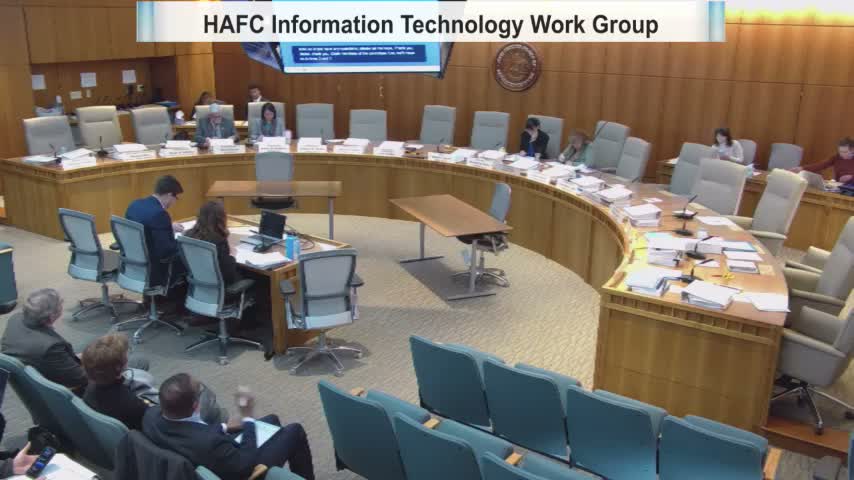
Emily Hilla (LFC) and Jacob Gebel (DFA) briefed the work group on C2 appropriations and reauthorizations. They said LFC recommended fewer new projects and prioritized closing existing procurements, while the executive recommended a larger slate of new agency IT investments. Jacob reviewed selected items including the district attorneys' network infrastructure ($1.04M executive; $500k LFC), the State Engineer's Waters replacement planning, and a long list of agency IT modernization requests.
Greg, chief information officer for the Secretary of State, told the committee his office needs planning funds to scope replacement of the statewide voter registration system and to complete an election management solution currently being implemented. "The money to evaluate service and plan for its replacement is critical to the office," he said, noting the current system (2017 go‑live) is nearing end‑of‑life and vendor support is changing.
Members questioned whether planning funds could saddle a future incoming secretary with a deployment they might not want; Greg and staff said the intention is to provide robust information so any incoming secretary can decide with reliable estimates and options. For the Department of Public Safety, staff described two executive requests — a virtual Real Time Crime Center and an intelligence‑led policing expansion — focused on integrating dispatch, CCTV, LPRs, gunshot detection and other feeds into statewide analytic platforms; staff warned about cost escalation and the need for implementation space or cloud planning.
DoIT: Chair and members reviewed a proposed increase in recurring resources for the Office of Cybersecurity (closing a roughly $6M gap toward the department’s recurring request) and a $16M one‑time cybersecurity initiative for executive‑branch agencies and public education institutions. Members asked staff to provide a detailed line distribution, and asked whether judicial or district attorney systems could leverage DoIT services and what statutory changes, if any, would be required.
Next steps: staff will circulate detailed line‑item distributions, follow up on unobligated balances on multi‑year IT projects, and provide further analysis on DoIT recurring vs one‑time options; no formal votes were taken.
Greg, chief information officer for the Secretary of State, told the committee his office needs planning funds to scope replacement of the statewide voter registration system and to complete an election management solution currently being implemented. "The money to evaluate service and plan for its replacement is critical to the office," he said, noting the current system (2017 go‑live) is nearing end‑of‑life and vendor support is changing.
Members questioned whether planning funds could saddle a future incoming secretary with a deployment they might not want; Greg and staff said the intention is to provide robust information so any incoming secretary can decide with reliable estimates and options. For the Department of Public Safety, staff described two executive requests — a virtual Real Time Crime Center and an intelligence‑led policing expansion — focused on integrating dispatch, CCTV, LPRs, gunshot detection and other feeds into statewide analytic platforms; staff warned about cost escalation and the need for implementation space or cloud planning.
DoIT: Chair and members reviewed a proposed increase in recurring resources for the Office of Cybersecurity (closing a roughly $6M gap toward the department’s recurring request) and a $16M one‑time cybersecurity initiative for executive‑branch agencies and public education institutions. Members asked staff to provide a detailed line distribution, and asked whether judicial or district attorney systems could leverage DoIT services and what statutory changes, if any, would be required.
Next steps: staff will circulate detailed line‑item distributions, follow up on unobligated balances on multi‑year IT projects, and provide further analysis on DoIT recurring vs one‑time options; no formal votes were taken.
View the Full Meeting & All Its Details
This article offers just a summary. Unlock complete video, transcripts, and insights as a Founder Member.
✓
Watch full, unedited meeting videos
✓
Search every word spoken in unlimited transcripts
✓
AI summaries & real-time alerts (all government levels)
✓
Permanent access to expanding government content
30-day money-back guarantee
