Jefferson County reviews event-permit draft after Symmetry festival draws noise and safety questions
October 26, 2025 | Jefferson County, Iowa
This article was created by AI summarizing key points discussed. AI makes mistakes, so for full details and context, please refer to the video of the full meeting. Please report any errors so we can fix them. Report an error »
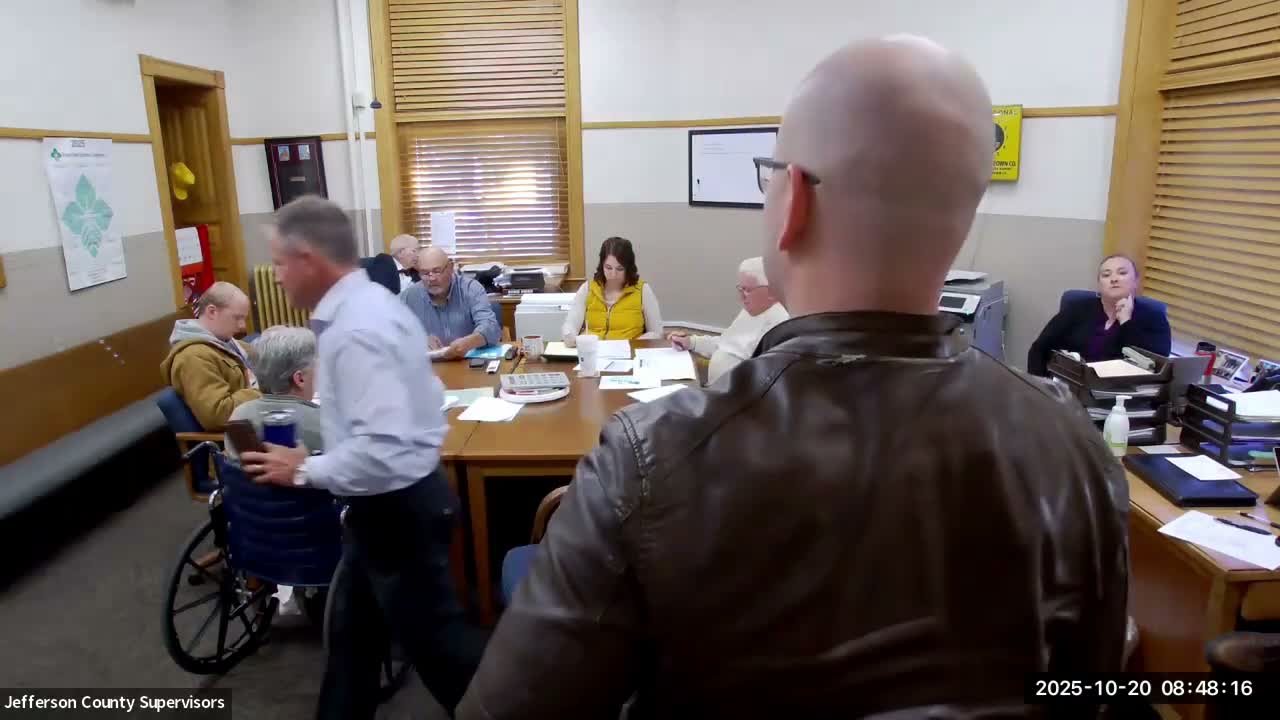
Don Revolinski, the presenter for the Symmetry Music & Arts Festival, told the Jefferson County Board of Supervisors the second-annual festival drew about 1,200 attendees, 100 staff, 75 volunteers and 200 artists and "produced an estimated $1,200,000 in total local economic output," based on Iowa Tourism and U.S. Bureau of Economic Analysis spending models. Supervisors and nearby residents pressed Revolinski on security, underage access and drug overdoses; he said the festival used a single gated entrance with wristbands, 25 on-site security staff in rotating shifts, an on-site medical team and harm-reduction volunteers who administered Narcan during an overdose in 2024.
After the presentation the board considered a draft event-permit and noise ordinance circulated by a staff drafter. The draft defines a "large event" as any organized gathering of 100 or more people outside municipal boundaries, requires a safety and emergency plan, adequate fencing or barriers, and compliance with ANSI-calibrated sound-level meters for measuring noise at neighboring property lines. It sets maximum permissible noise at 80 decibels during daytime hours (7 a.m.–10 p.m.) and 60 decibels at night (10 p.m.–7 a.m.), and allows law-enforcement to suspend or revoke permits and levy fines up to $650 per violation.
Residents and supervisors repeatedly raised a technical gap the draft does not fully resolve: bass frequencies travel farther and can be perceived inside homes at levels that a standard dBA reading might not fully capture. A supervisor summarized the practical trade-offs: decibel thresholds are objectively measurable but may not address the low-frequency bass that many neighbors cited as the principal nuisance. Revolinski said organizers had engaged an acoustics consultant in 2025, reoriented and deadened side/back sound, and shut the main stage at 1:30 a.m. He also offered to explore reorienting the stage in 2026 and to work more closely with nearby businesses to ensure local supplies and services were available to visitors.
The board did not vote to adopt the draft ordinance. Supervisors emphasized two policy principles for further work: ensure the rule is broadly applicable (weddings, municipal fireworks, revivals, and other gatherings) rather than targeted at one organizer, and refine measurement and enforcement language so it realistically addresses bass/low-frequency impacts. The item was left for additional drafting and possible testing of sound-measure methods before future consideration.
After the presentation the board considered a draft event-permit and noise ordinance circulated by a staff drafter. The draft defines a "large event" as any organized gathering of 100 or more people outside municipal boundaries, requires a safety and emergency plan, adequate fencing or barriers, and compliance with ANSI-calibrated sound-level meters for measuring noise at neighboring property lines. It sets maximum permissible noise at 80 decibels during daytime hours (7 a.m.–10 p.m.) and 60 decibels at night (10 p.m.–7 a.m.), and allows law-enforcement to suspend or revoke permits and levy fines up to $650 per violation.
Residents and supervisors repeatedly raised a technical gap the draft does not fully resolve: bass frequencies travel farther and can be perceived inside homes at levels that a standard dBA reading might not fully capture. A supervisor summarized the practical trade-offs: decibel thresholds are objectively measurable but may not address the low-frequency bass that many neighbors cited as the principal nuisance. Revolinski said organizers had engaged an acoustics consultant in 2025, reoriented and deadened side/back sound, and shut the main stage at 1:30 a.m. He also offered to explore reorienting the stage in 2026 and to work more closely with nearby businesses to ensure local supplies and services were available to visitors.
The board did not vote to adopt the draft ordinance. Supervisors emphasized two policy principles for further work: ensure the rule is broadly applicable (weddings, municipal fireworks, revivals, and other gatherings) rather than targeted at one organizer, and refine measurement and enforcement language so it realistically addresses bass/low-frequency impacts. The item was left for additional drafting and possible testing of sound-measure methods before future consideration.
View the Full Meeting & All Its Details
This article offers just a summary. Unlock complete video, transcripts, and insights as a Founder Member.
✓
Watch full, unedited meeting videos
✓
Search every word spoken in unlimited transcripts
✓
AI summaries & real-time alerts (all government levels)
✓
Permanent access to expanding government content
30-day money-back guarantee
