Jefferson County work session plans Tall Cop training, discusses Narcan distribution and service gaps
February 09, 2025 | Jefferson County, Iowa
This article was created by AI summarizing key points discussed. AI makes mistakes, so for full details and context, please refer to the video of the full meeting. Please report any errors so we can fix them. Report an error »
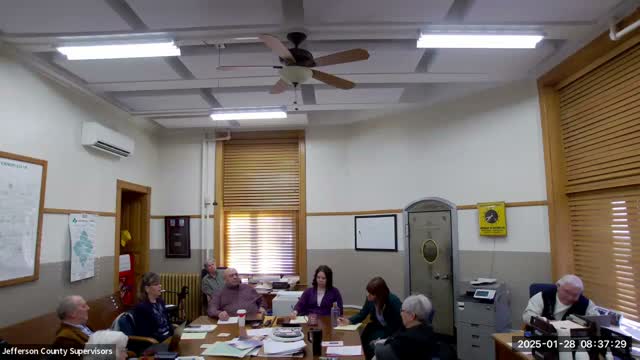
Jefferson County stakeholders met in a work session to plan a Tall Cop training event and to discuss how opioid-settlement funds can bolster local prevention and treatment services.
Speaker 4 said the Tall Cop program is scheduled for April 29, with a professional continuing-education session from 8 a.m. to noon and a community evening session from 6 p.m. to 7:30 p.m. "The date is April 29. From 8 to noon is the continuing education piece for professionals," Speaker 4 said, adding that organizers had sought an auditorium but were concerned about daytime school parking.
The organizers relayed an arts-and-convention-center quote of $710 for room rental, sound/projector and coffee and asked the group to authorize up to $800 to include light refreshments and avoid parking challenges at the high school. "So I'm asking on this piece to spend up to $800 to have it up here where people will not have to fight for parking," Speaker 4 said. Participants discussed budget timing and noted that $20,000 in opioid-settlement funding had already been authorized for programming; Speaker 4 recommended up to $2,000 be set aside as a cushion for CE administration and room costs.
Speaker 6 described the administrative path for CE credits: organizers plan to use Indian Hills' provider number to process credits for multiple disciplines (nursing, EMS, respiratory therapy, social work). Speaker 6 said there is a $20 processing fee and a $10 certificate fee per attendee and warned that CE approvals require at least four weeks lead time. "We're using their number... there's a $20 course fee to process the course, so it costs $20," Speaker 6 said.
Security and event logistics were also discussed. Speaker 4 said organizers requested two uniformed officers for the evening meeting and had begun coordinating with a city officer and another contact to provide coverage. Participants said law-enforcement participation at past Tall Cop events suggested a security presence might be expected.
Public-health distribution of naloxone (Narcan) was raised as a potential complementary measure. Speaker 6 said the health department could serve as a Narcan distribution site at no charge and intended to place the item on the Board of Health agenda for Feb. 20. "The health department could distribute or if you wanted to come get some Narcan, I could just give it to you. It's taxpayer funded. There are no questions asked," Speaker 6 said, adding that details—hours, storage and distribution logistics—would be discussed at the board meeting.
Several participants described persistent local gaps in treatment and recovery supports: only one counselor through CETA was available one day per week, in-person 12-step meeting attendance has declined since COVID, and clinic capacity for prenatal education and follow-up varied by provider. Speaker 2, identifying as an addiction counselor and educator, described a separate community lecture series and urged coordination with local partners to reach people in need.
Transportation to court-ordered treatment and outpatient services was discussed as a practical barrier. Speakers proposed options including Medicaid transportation, hospital ticket vouchers already used in some cases, a small voucher or punch-card program funded by opioid dollars, or contracting with a local mobile-companion taxi service for program participants.
Next steps and follow-ups included finalizing the venue and CE approvals, confirming security arrangements, scheduling outreach materials for social media, and placing Narcan distribution on the Board of Health agenda. The group set a follow-up work session for Feb. 25 to advance planning and report back on action items.
No formal roll-call votes were recorded in the transcript; participants reached informal consensus on budgeting and scheduling but deferred some administrative decisions (invoicing timing, formal contracting and board approvals) to staff and the Board of Health.
Speaker 4 said the Tall Cop program is scheduled for April 29, with a professional continuing-education session from 8 a.m. to noon and a community evening session from 6 p.m. to 7:30 p.m. "The date is April 29. From 8 to noon is the continuing education piece for professionals," Speaker 4 said, adding that organizers had sought an auditorium but were concerned about daytime school parking.
The organizers relayed an arts-and-convention-center quote of $710 for room rental, sound/projector and coffee and asked the group to authorize up to $800 to include light refreshments and avoid parking challenges at the high school. "So I'm asking on this piece to spend up to $800 to have it up here where people will not have to fight for parking," Speaker 4 said. Participants discussed budget timing and noted that $20,000 in opioid-settlement funding had already been authorized for programming; Speaker 4 recommended up to $2,000 be set aside as a cushion for CE administration and room costs.
Speaker 6 described the administrative path for CE credits: organizers plan to use Indian Hills' provider number to process credits for multiple disciplines (nursing, EMS, respiratory therapy, social work). Speaker 6 said there is a $20 processing fee and a $10 certificate fee per attendee and warned that CE approvals require at least four weeks lead time. "We're using their number... there's a $20 course fee to process the course, so it costs $20," Speaker 6 said.
Security and event logistics were also discussed. Speaker 4 said organizers requested two uniformed officers for the evening meeting and had begun coordinating with a city officer and another contact to provide coverage. Participants said law-enforcement participation at past Tall Cop events suggested a security presence might be expected.
Public-health distribution of naloxone (Narcan) was raised as a potential complementary measure. Speaker 6 said the health department could serve as a Narcan distribution site at no charge and intended to place the item on the Board of Health agenda for Feb. 20. "The health department could distribute or if you wanted to come get some Narcan, I could just give it to you. It's taxpayer funded. There are no questions asked," Speaker 6 said, adding that details—hours, storage and distribution logistics—would be discussed at the board meeting.
Several participants described persistent local gaps in treatment and recovery supports: only one counselor through CETA was available one day per week, in-person 12-step meeting attendance has declined since COVID, and clinic capacity for prenatal education and follow-up varied by provider. Speaker 2, identifying as an addiction counselor and educator, described a separate community lecture series and urged coordination with local partners to reach people in need.
Transportation to court-ordered treatment and outpatient services was discussed as a practical barrier. Speakers proposed options including Medicaid transportation, hospital ticket vouchers already used in some cases, a small voucher or punch-card program funded by opioid dollars, or contracting with a local mobile-companion taxi service for program participants.
Next steps and follow-ups included finalizing the venue and CE approvals, confirming security arrangements, scheduling outreach materials for social media, and placing Narcan distribution on the Board of Health agenda. The group set a follow-up work session for Feb. 25 to advance planning and report back on action items.
No formal roll-call votes were recorded in the transcript; participants reached informal consensus on budgeting and scheduling but deferred some administrative decisions (invoicing timing, formal contracting and board approvals) to staff and the Board of Health.
View the Full Meeting & All Its Details
This article offers just a summary. Unlock complete video, transcripts, and insights as a Founder Member.
✓
Watch full, unedited meeting videos
✓
Search every word spoken in unlimited transcripts
✓
AI summaries & real-time alerts (all government levels)
✓
Permanent access to expanding government content
30-day money-back guarantee
