Residents and students assail board conduct at Rochester Community Schools meeting
January 26, 2026 | Rochester Community School District, School Boards, Michigan
This article was created by AI summarizing key points discussed. AI makes mistakes, so for full details and context, please refer to the video of the full meeting. Please report any errors so we can fix them. Report an error »
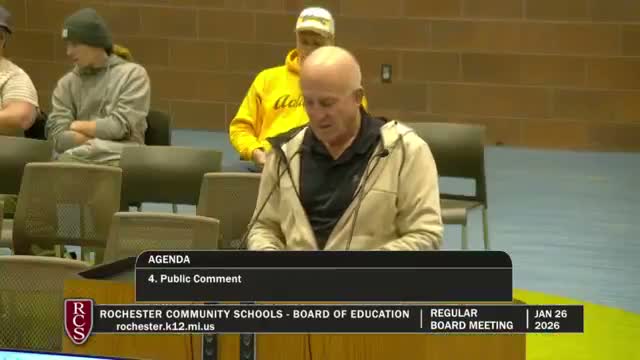
A series of emotionally charged public comments at the Rochester Community Schools Board of Education meeting Tuesday evening criticized the board's leadership and called for greater transparency and community engagement.
Mike Reno, a longtime resident and former board member, told trustees he sees a pattern of "raw political power" used to limit participation and said recent changes — including removing public comment on individual agenda items and moving meeting times — make it harder for residents to engage. He accused the board of sidelining minority trustees and said, "What you guys are doing here is Trumpian **********."
Other speakers raised specific policy concerns. Rick Baldick warned that past adoption of a bell-framework contributed to a substantial enrollment loss and urged the board to make full curriculum materials public before it considers the state's new health framework. "You better show the public the curriculum," he said, warning of a possible "exodus" of families if the district does not provide transparency.
Student Sam Van Dale criticized the board directly and urged several trustees to resign, saying trustees had "your egos inflamed" and insisting, "You guys should put in a resignation letter tonight." Stephanie Van Dale later echoed calls for resignations and criticized trustees for not standing during the pledge.
Not all public comment was critical. Parent Kyle Medier praised Adams High School and principal Luke Swanson for launching a Unified Sports program that integrates students with and without disabilities; he called the program "one of the best money we spend in the district." Trustee Carol Beth Litcuie, speaking as a resident, asked when the board will publicly review the state's new health framework and said early public discussion could help "rebuild trust and keep our focus where it belongs."
The chair reminded speakers throughout the public comment period of the three-minute time limit and the requirement that commenters avoid identifying students by name. The board did not respond to comments during the meeting but noted follow-up may occur after the session.
The public-comment session underscored a divided community: several residents and one student pressed the board for greater transparency and accountability, while others highlighted successful district programs and urged constructive engagement. The board proceeded with its agenda after public comment.
Mike Reno, a longtime resident and former board member, told trustees he sees a pattern of "raw political power" used to limit participation and said recent changes — including removing public comment on individual agenda items and moving meeting times — make it harder for residents to engage. He accused the board of sidelining minority trustees and said, "What you guys are doing here is Trumpian **********."
Other speakers raised specific policy concerns. Rick Baldick warned that past adoption of a bell-framework contributed to a substantial enrollment loss and urged the board to make full curriculum materials public before it considers the state's new health framework. "You better show the public the curriculum," he said, warning of a possible "exodus" of families if the district does not provide transparency.
Student Sam Van Dale criticized the board directly and urged several trustees to resign, saying trustees had "your egos inflamed" and insisting, "You guys should put in a resignation letter tonight." Stephanie Van Dale later echoed calls for resignations and criticized trustees for not standing during the pledge.
Not all public comment was critical. Parent Kyle Medier praised Adams High School and principal Luke Swanson for launching a Unified Sports program that integrates students with and without disabilities; he called the program "one of the best money we spend in the district." Trustee Carol Beth Litcuie, speaking as a resident, asked when the board will publicly review the state's new health framework and said early public discussion could help "rebuild trust and keep our focus where it belongs."
The chair reminded speakers throughout the public comment period of the three-minute time limit and the requirement that commenters avoid identifying students by name. The board did not respond to comments during the meeting but noted follow-up may occur after the session.
The public-comment session underscored a divided community: several residents and one student pressed the board for greater transparency and accountability, while others highlighted successful district programs and urged constructive engagement. The board proceeded with its agenda after public comment.
Don't Miss a Word: See the Full Meeting!
Go beyond summaries. Unlock every video, transcript, and key insight with a Founder Membership.
✓
Get instant access to full meeting videos
✓
Search and clip any phrase from complete transcripts
✓
Receive AI-powered summaries & custom alerts
✓
Enjoy lifetime, unrestricted access to government data
30-day money-back guarantee
