Board approves superintendent's annual goals after debate over measurability
January 26, 2026 | Rochester Community School District, School Boards, Michigan
This article was created by AI summarizing key points discussed. AI makes mistakes, so for full details and context, please refer to the video of the full meeting. Please report any errors so we can fix them. Report an error »
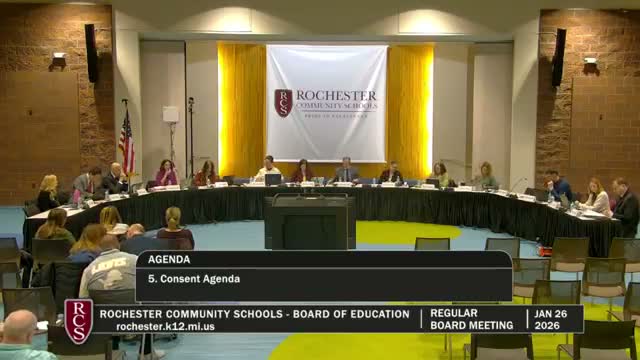
The Rochester Community Schools Board of Education voted to approve Superintendent Jason Russo's goals for the year after more than an hour of discussion about measurability, implementation and how the board should evaluate outcomes.
Russo presented a revised package that tightened the PSAT/SAT readiness target and increased an early-childhood enrollment percentage goal for pre-K. He described Goal 1 as a district-average PSAT/SAT stretch target and defended the change by citing a decade of local data: "So the jump from PSAT 8, 9, 10, SAT, the average across the last 10 to 12 years in RCS was between... 41.8 and 42.6," Russo said, and argued that a 43-point stretch goal is achievable given recent focused work in high schools.
Trustees pressed for clarity on Goal 2, the data-protocol implementation. Trustee Beattel asked whether the protocol was an implementation task or an outcome-driven goal; Russo said the aim is to "improve data literacy amongst our professionals" and to make that consistent across buildings so it translates into student achievement. Trustee Lecui pushed for evidence showing how implementation will change student outcomes.
Trustee Lacoue moved an amendment to revise Goal 3 to require the board receive "a culminating list of year 3 goals that include clear, measurable student achievement and/or operational outcomes with defined metrics and evidence for board evaluation by 05/15/2026." Trustees debated whether that level of specificity belonged at goal-setting time or during later development. The amendment (and a minor amendment to change wording to "and/or") failed on the board floor; the record shows the amendment did not pass by a 2-5 vote. The original motion to adopt the goals as presented passed later with a 5-1-1 tally (five yes, one no, one abstention).
Board members who opposed adding more prescriptive language said some strategic-plan items are operational rather than student-outcome driven and that detailed metrics often evolve as plans are developed. Supporters of the amendment said fewer, more measurable goals would better enable board evaluation.
The board directed staff to continue developing artifacts and evidence tied to the goals and to present follow-up material (for example, meeting artifacts and implementation documentation) as the year proceeds.
The vote finalizes the superintendent's evaluation goals and sets a process expectation that the administration supply the written documentation and implementation evidence trustees requested.
Russo presented a revised package that tightened the PSAT/SAT readiness target and increased an early-childhood enrollment percentage goal for pre-K. He described Goal 1 as a district-average PSAT/SAT stretch target and defended the change by citing a decade of local data: "So the jump from PSAT 8, 9, 10, SAT, the average across the last 10 to 12 years in RCS was between... 41.8 and 42.6," Russo said, and argued that a 43-point stretch goal is achievable given recent focused work in high schools.
Trustees pressed for clarity on Goal 2, the data-protocol implementation. Trustee Beattel asked whether the protocol was an implementation task or an outcome-driven goal; Russo said the aim is to "improve data literacy amongst our professionals" and to make that consistent across buildings so it translates into student achievement. Trustee Lecui pushed for evidence showing how implementation will change student outcomes.
Trustee Lacoue moved an amendment to revise Goal 3 to require the board receive "a culminating list of year 3 goals that include clear, measurable student achievement and/or operational outcomes with defined metrics and evidence for board evaluation by 05/15/2026." Trustees debated whether that level of specificity belonged at goal-setting time or during later development. The amendment (and a minor amendment to change wording to "and/or") failed on the board floor; the record shows the amendment did not pass by a 2-5 vote. The original motion to adopt the goals as presented passed later with a 5-1-1 tally (five yes, one no, one abstention).
Board members who opposed adding more prescriptive language said some strategic-plan items are operational rather than student-outcome driven and that detailed metrics often evolve as plans are developed. Supporters of the amendment said fewer, more measurable goals would better enable board evaluation.
The board directed staff to continue developing artifacts and evidence tied to the goals and to present follow-up material (for example, meeting artifacts and implementation documentation) as the year proceeds.
The vote finalizes the superintendent's evaluation goals and sets a process expectation that the administration supply the written documentation and implementation evidence trustees requested.
View the Full Meeting & All Its Details
This article offers just a summary. Unlock complete video, transcripts, and insights as a Founder Member.
✓
Watch full, unedited meeting videos
✓
Search every word spoken in unlimited transcripts
✓
AI summaries & real-time alerts (all government levels)
✓
Permanent access to expanding government content
30-day money-back guarantee
