Board refers proposed anti-moonlighting policy to committee after bargaining-unit concerns
January 26, 2026 | Rochester Community School District, School Boards, Michigan
This article was created by AI summarizing key points discussed. AI makes mistakes, so for full details and context, please refer to the video of the full meeting. Please report any errors so we can fix them. Report an error »
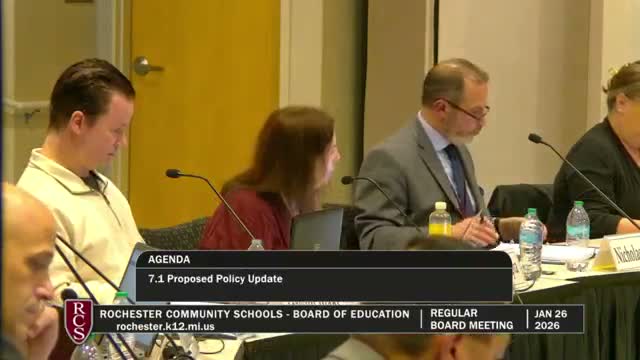
The board held a first reading of proposed Policy 4,003 ("Conditions of Employment"), a recommended anti-moonlighting policy from legal counsel Miller Johnson, and voted to send the proposal back to the district's SPCC committee for further review and bargaining-unit consultation.
HR representative Dave Murphy read the policy language for the record: "School district employees are prohibited from simultaneously working for another entity when when that work conflicts with their employment for the school district." Murphy said the recommendation stems from questions multiple districts have raised about employees working for other educational entities during district hours and not from any specific incident in Rochester.
Trustees raised concerns about vagueness and potential disciplinary consequences if "conflict" is not narrowly defined. One trustee said language that bars work "when that work conflicts" could be interpreted inconsistently and argued the district should build bargaining-unit trust before adopting a policy that could lead to punitive action. Other trustees said the policy is standard and that collective-bargaining agreements provide grievance processes if members believe policy enforcement is unfair.
After discussion, the board voted 4-2-1 to refer Policy 4,003 back to the SPCC for additional language refinement and to ensure the bargaining units have an opportunity to weigh in before the second reading.
District staff noted HR customarily discusses such matters with affected groups and that the first reading provides an opportunity to refine language before any adoption vote.
HR representative Dave Murphy read the policy language for the record: "School district employees are prohibited from simultaneously working for another entity when when that work conflicts with their employment for the school district." Murphy said the recommendation stems from questions multiple districts have raised about employees working for other educational entities during district hours and not from any specific incident in Rochester.
Trustees raised concerns about vagueness and potential disciplinary consequences if "conflict" is not narrowly defined. One trustee said language that bars work "when that work conflicts" could be interpreted inconsistently and argued the district should build bargaining-unit trust before adopting a policy that could lead to punitive action. Other trustees said the policy is standard and that collective-bargaining agreements provide grievance processes if members believe policy enforcement is unfair.
After discussion, the board voted 4-2-1 to refer Policy 4,003 back to the SPCC for additional language refinement and to ensure the bargaining units have an opportunity to weigh in before the second reading.
District staff noted HR customarily discusses such matters with affected groups and that the first reading provides an opportunity to refine language before any adoption vote.
View the Full Meeting & All Its Details
This article offers just a summary. Unlock complete video, transcripts, and insights as a Founder Member.
✓
Watch full, unedited meeting videos
✓
Search every word spoken in unlimited transcripts
✓
AI summaries & real-time alerts (all government levels)
✓
Permanent access to expanding government content
30-day money-back guarantee
