Stamford planning board approves capital project closeouts and accepts $125,000 developer payment for traffic signals
December 22, 2025 | Stamford City, Fairfield, Connecticut
This article was created by AI summarizing key points discussed. AI makes mistakes, so for full details and context, please refer to the video of the full meeting. Please report any errors so we can fix them. Report an error »
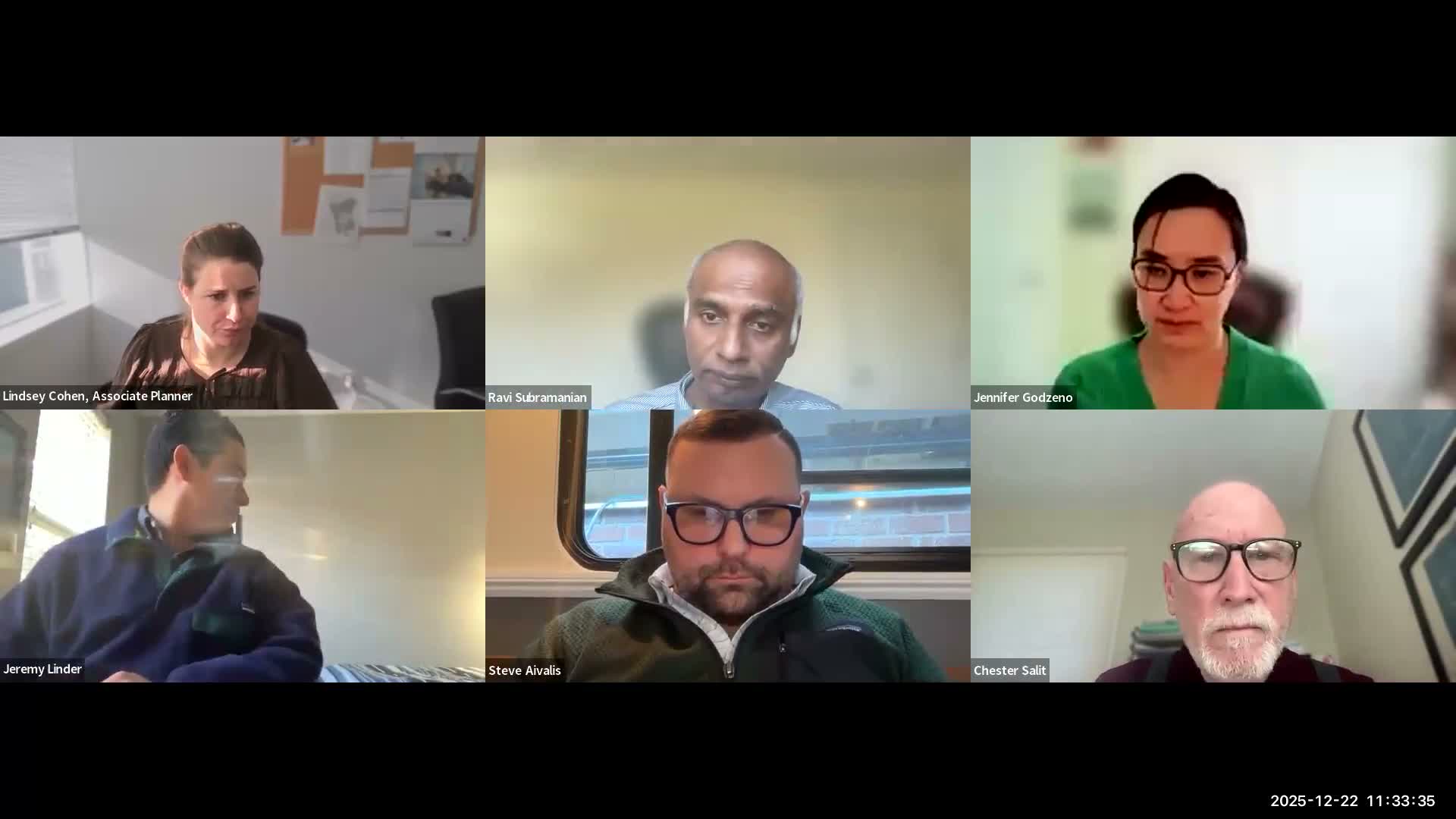
The Stamford planning board at a special Dec. 22 meeting approved a series of capital project closeouts and account reallocations and voted to accept a $125,000 payment from a developer to fund traffic-signal improvements.
The presiding member read three related items under Stamford City Code section 8.2: closeout recommendations for capital projects CP711 (utility paving) and C612 (street patch/resurfacing) and requests to substitute funding sources so eligible projects use Local Capital Improvement Program (LCIP) grant funds while ineligible projects use bond funds. The presiding member read the closeout amounts (about $1,220,801.59 and $1,223,801.59). A staff member explained the swaps were administrative: “They’re just switching the accounts,” and that the utility paving project was not eligible for the LCIP grant because the project bid did not meet applicable state or federal requirements.
Board members moved and passed the closeout motion and subsequent appropriations unanimously. The presiding member recorded motions moved by Jeremy and seconded by Ravi for the closeouts and related appropriations; the board indicated unanimous approval each time.
The board also considered Citywide Signals project C56174, a $125,000 payment from a developer tied to improvements associated with a development at 1130 Broad Street. Staff described the item as both the city’s acceptance of a private contribution and use of the funds for citywide signal accounts: “It is the acceptance of the private contribution for the purpose of using them for citywide signals,” staff said. A board member asked whether the city could repurpose the payment, and staff replied that redirecting the funds without the developer’s agreement could breach the condition of approval. One member said, “I oppose approval,” but the board moved, seconded and the presiding member said the motion passed unanimously.
The transactions are administrative in nature: staff repeatedly described them as swaps of funding sources to align eligible work with grant funding and ineligible work with bond funding, and the board did not add conditions beyond standard acceptance and appropriation procedures. The board noted these items were added to the agenda on short notice and expressed interest in streamlining administrative procedures for private contributions where possible.
Next steps: the appropriations and acceptance of the developer payment were approved at the meeting and staff will carry out the accounting changes. The board reminded members the next regular public hearing on the capital budget is scheduled for Jan. 13.
The presiding member read three related items under Stamford City Code section 8.2: closeout recommendations for capital projects CP711 (utility paving) and C612 (street patch/resurfacing) and requests to substitute funding sources so eligible projects use Local Capital Improvement Program (LCIP) grant funds while ineligible projects use bond funds. The presiding member read the closeout amounts (about $1,220,801.59 and $1,223,801.59). A staff member explained the swaps were administrative: “They’re just switching the accounts,” and that the utility paving project was not eligible for the LCIP grant because the project bid did not meet applicable state or federal requirements.
Board members moved and passed the closeout motion and subsequent appropriations unanimously. The presiding member recorded motions moved by Jeremy and seconded by Ravi for the closeouts and related appropriations; the board indicated unanimous approval each time.
The board also considered Citywide Signals project C56174, a $125,000 payment from a developer tied to improvements associated with a development at 1130 Broad Street. Staff described the item as both the city’s acceptance of a private contribution and use of the funds for citywide signal accounts: “It is the acceptance of the private contribution for the purpose of using them for citywide signals,” staff said. A board member asked whether the city could repurpose the payment, and staff replied that redirecting the funds without the developer’s agreement could breach the condition of approval. One member said, “I oppose approval,” but the board moved, seconded and the presiding member said the motion passed unanimously.
The transactions are administrative in nature: staff repeatedly described them as swaps of funding sources to align eligible work with grant funding and ineligible work with bond funding, and the board did not add conditions beyond standard acceptance and appropriation procedures. The board noted these items were added to the agenda on short notice and expressed interest in streamlining administrative procedures for private contributions where possible.
Next steps: the appropriations and acceptance of the developer payment were approved at the meeting and staff will carry out the accounting changes. The board reminded members the next regular public hearing on the capital budget is scheduled for Jan. 13.
Don't Miss a Word: See the Full Meeting!
Go beyond summaries. Unlock every video, transcript, and key insight with a Founder Membership.
✓
Get instant access to full meeting videos
✓
Search and clip any phrase from complete transcripts
✓
Receive AI-powered summaries & custom alerts
✓
Enjoy lifetime, unrestricted access to government data
30-day money-back guarantee
