Effingham staff recommends EPA SRF loan to fund mandated wastewater plant upgrade
January 20, 2026 | Effingham, Effingham County, Illinois
This article was created by AI summarizing key points discussed. AI makes mistakes, so for full details and context, please refer to the video of the full meeting. Please report any errors so we can fix them. Report an error »
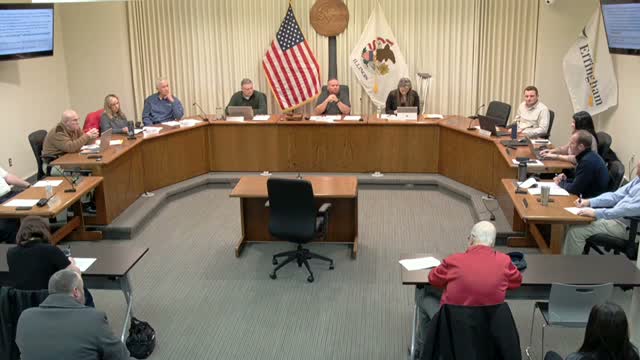
Effingham Public Works Director Jeremy Harmon told the council that the city’s wastewater treatment plant needs a complete overhaul to meet new phosphorus limits in its MPDS permit and that construction costs have grown far beyond early estimates. "They have estimated, as of right now, the construction portion alone is about $16,500,000," Harmon said, and added that engineering and contingencies could push the total toward $18–$20 million.
Harmon recommended pursuing an EPA State Revolving Fund (SRF) loan instead of a general bond, citing a preliminary small-community interest rate of about 1.62% and the program’s 30-year term. "Just doing a quick math on this, we would really only have to borrow about 17,000,000 at 1.62%. Our annual payment would be about 716,000," Harmon said, and noted estimated principal and interest of roughly $4.5 million over the SRF term after accounting for possible principal forgiveness.
City staff reported a preliminary SRF points score “right on the cusp” of qualifying for principal forgiveness. Harmon said staff is "pretty confident that we could get, at least 15% principal forgiveness on that," which would reduce the loan principal by an estimated $1.5 million on a $20 million project.
Harmon contrasted the SRF option with a municipal bond financed over 20 years at roughly 4%, which staff estimated could result in about $9 million in interest over the loan life. He warned, however, that SRF financing carries additional procurement and compliance burdens: a formal project plan, environmental reviews, Buy America and apprenticeship rules, non‑sole‑sourcing requirements and about an 8‑ to 12‑month approval timeline before funds are accessible.
Harmon told the council the permit deadline to be compliant is 2030 and that pursuing the SRF loan would likely require amending the design contract with CMT to prepare the project plan for state review. "That's kind of what my suggestion would be, and recommendation would be," Harmon said. "We'll have to amend our design contract with CMT to start on that project plan. They'll give us an estimate for that."
Councilors discussed trade‑offs including sewer‑fund cash balances (reported in the meeting as roughly $3 million maintained for operations), the multi‑decade payment obligation under a 30‑year SRF loan, and the impact on capital maintenance and rate pressure. Several members supported pursuing the SRF route to limit immediate rate hikes and to secure principal forgiveness, while noting the city must weigh long‑term constraints on capital spending.
Next steps: staff will prepare an amended design contract and a project plan to submit for SRF consideration and will return to council with funding details and formal action requests when ready.
Harmon recommended pursuing an EPA State Revolving Fund (SRF) loan instead of a general bond, citing a preliminary small-community interest rate of about 1.62% and the program’s 30-year term. "Just doing a quick math on this, we would really only have to borrow about 17,000,000 at 1.62%. Our annual payment would be about 716,000," Harmon said, and noted estimated principal and interest of roughly $4.5 million over the SRF term after accounting for possible principal forgiveness.
City staff reported a preliminary SRF points score “right on the cusp” of qualifying for principal forgiveness. Harmon said staff is "pretty confident that we could get, at least 15% principal forgiveness on that," which would reduce the loan principal by an estimated $1.5 million on a $20 million project.
Harmon contrasted the SRF option with a municipal bond financed over 20 years at roughly 4%, which staff estimated could result in about $9 million in interest over the loan life. He warned, however, that SRF financing carries additional procurement and compliance burdens: a formal project plan, environmental reviews, Buy America and apprenticeship rules, non‑sole‑sourcing requirements and about an 8‑ to 12‑month approval timeline before funds are accessible.
Harmon told the council the permit deadline to be compliant is 2030 and that pursuing the SRF loan would likely require amending the design contract with CMT to prepare the project plan for state review. "That's kind of what my suggestion would be, and recommendation would be," Harmon said. "We'll have to amend our design contract with CMT to start on that project plan. They'll give us an estimate for that."
Councilors discussed trade‑offs including sewer‑fund cash balances (reported in the meeting as roughly $3 million maintained for operations), the multi‑decade payment obligation under a 30‑year SRF loan, and the impact on capital maintenance and rate pressure. Several members supported pursuing the SRF route to limit immediate rate hikes and to secure principal forgiveness, while noting the city must weigh long‑term constraints on capital spending.
Next steps: staff will prepare an amended design contract and a project plan to submit for SRF consideration and will return to council with funding details and formal action requests when ready.
View the Full Meeting & All Its Details
This article offers just a summary. Unlock complete video, transcripts, and insights as a Founder Member.
✓
Watch full, unedited meeting videos
✓
Search every word spoken in unlimited transcripts
✓
AI summaries & real-time alerts (all government levels)
✓
Permanent access to expanding government content
30-day money-back guarantee
