Committee advances contentious bill to shift some aquaculture and marketing functions to Agribusiness Development Corporation
January 31, 2026 | House Committee on Agriculture & Food Systems, House of Representatives, Legislative , Hawaii
This article was created by AI summarizing key points discussed. AI makes mistakes, so for full details and context, please refer to the video of the full meeting. Please report any errors so we can fix them. Report an error »
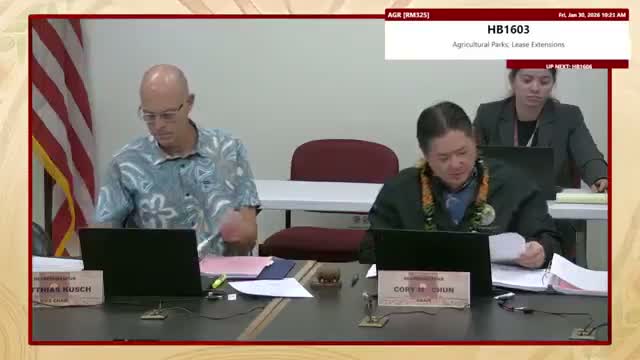
House Bill 1606 drew sustained debate on Jan. 30 as the committee considered whether to move the Agricultural Development Division and the Aquaculture and Livestock Support Services Branch out of the Department of Agriculture and Biosecurity (DAB) and into the Agribusiness Development Corporation (ADC).
DAB witnesses argued the transfer carries program and federal‑funding risks. Department testimony said the goals of HB1606 — improving marketing, statistics and aquaculture support — could be met by adding staff or targeted positions at ADC rather than moving entire divisions and risking disruption to federal grants and long‑standing MOUs. A DAB witness summarized the department’s view: “DAB does not believe transferring either division is necessary” and warned partner MOUs and federal relationships would not automatically migrate to ADC.
ADC and industry witnesses urged consolidation or at least exploration of a transfer to improve access to land and development resources. Wendy Gady, ADC’s executive director, told the committee that ADC’s ability to acquire land is a major asset for scaling aquaculture and that alignment with other DBEDT agencies could support industry growth. The Hawaii Aquaculture and Aquaponics Association supported further discussion of consolidation while urging that aquatic animal health and import regulation remain with DAB.
Farm organizations asked for a clear implementation plan and raised equity concerns. Testimony from farm advocates stressed that past ADC programming had emphasized larger‑scale development and urged safeguards so smallholders and family farms continue to receive support.
Decision and vote: The committee voted to pass HB1606 as House Draft 1 with technical amendments and an amended effective date. The roll-call noted Representative Peruso voting 'no' and Representative Matsumoto recorded 'with reservations'; the chair announced the motion passed.
Next steps: Sponsors and agencies will need to reconcile which functions (regulatory, programmatic, grant‑related) move and which remain, and produce transition language and timelines to protect federal funding and program continuity.
DAB witnesses argued the transfer carries program and federal‑funding risks. Department testimony said the goals of HB1606 — improving marketing, statistics and aquaculture support — could be met by adding staff or targeted positions at ADC rather than moving entire divisions and risking disruption to federal grants and long‑standing MOUs. A DAB witness summarized the department’s view: “DAB does not believe transferring either division is necessary” and warned partner MOUs and federal relationships would not automatically migrate to ADC.
ADC and industry witnesses urged consolidation or at least exploration of a transfer to improve access to land and development resources. Wendy Gady, ADC’s executive director, told the committee that ADC’s ability to acquire land is a major asset for scaling aquaculture and that alignment with other DBEDT agencies could support industry growth. The Hawaii Aquaculture and Aquaponics Association supported further discussion of consolidation while urging that aquatic animal health and import regulation remain with DAB.
Farm organizations asked for a clear implementation plan and raised equity concerns. Testimony from farm advocates stressed that past ADC programming had emphasized larger‑scale development and urged safeguards so smallholders and family farms continue to receive support.
Decision and vote: The committee voted to pass HB1606 as House Draft 1 with technical amendments and an amended effective date. The roll-call noted Representative Peruso voting 'no' and Representative Matsumoto recorded 'with reservations'; the chair announced the motion passed.
Next steps: Sponsors and agencies will need to reconcile which functions (regulatory, programmatic, grant‑related) move and which remain, and produce transition language and timelines to protect federal funding and program continuity.
View the Full Meeting & All Its Details
This article offers just a summary. Unlock complete video, transcripts, and insights as a Founder Member.
✓
Watch full, unedited meeting videos
✓
Search every word spoken in unlimited transcripts
✓
AI summaries & real-time alerts (all government levels)
✓
Permanent access to expanding government content
30-day money-back guarantee
