Maryland Commission on Civil Rights Seeks Modest Budget Increase as Case Backlogs Persist
January 31, 2026 | Education, Business and Administration Subcommittee, Budget and Taxation Committee, SENATE, SENATE, Committees, Legislative, Maryland
This article was created by AI summarizing key points discussed. AI makes mistakes, so for full details and context, please refer to the video of the full meeting. Please report any errors so we can fix them. Report an error »
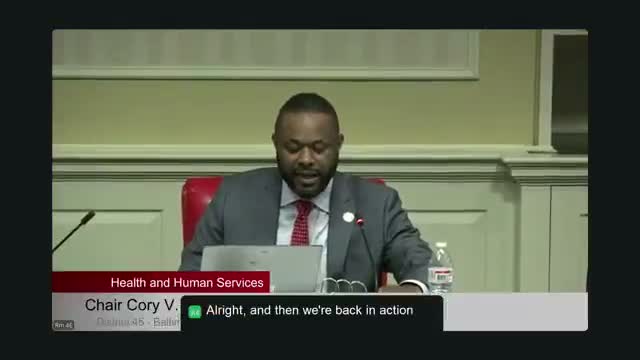
Department of Legislative Services analyst Connor Brown told the Senate Health and Human Services Subcommittee that the Maryland Commission on Civil Rights (MCCR) fiscal 2027 allowance increases about $517,000, or roughly 7.5%, bringing total funding to approximately $7.4 million. Brown said roughly 88% of the agency's budget supports personnel and noted the allowance reflects 49 regular positions plus three contractual full-time equivalents.
MCCR Executive Director Cleveland Horton told the committee the agency continues to face staffing pressures even as demand rises. "We have already matched last year's inquiries halfway through the year," Horton said, and the commission projects inquiries could nearly double compared with the prior fiscal year. Horton said that growth has strained intake and investigative capacity and contributed to longer average processing times.
DLS highlighted case-processing benchmarks that MCCR has set—180 days or fewer for employment and public-accommodation cases and 100 days for housing cases—and noted MCCR missed those benchmarks every year from fiscal 2021 through fiscal 2025. Brown said employment cases accounted for the bulk of long-running matters and reported an increase in the average days-to-resolution for employment cases to about 531 days in fiscal 2025.
Horton described steps the agency is taking to reduce backlogs. He said MCCR is rolling out a new case-management system in 2026 to improve data control and reporting and is relaunching an alternative dispute resolution (ADR) program. "Last fiscal year, we did a little over 50 mediations, which resulted in over $500,000 in monetary benefits being received for victims of unlawful discrimination," Horton said, citing early ADR outcomes.
Brown told the committee that DLS recommends adopting a committee narrative asking MCCR to report on measures implemented to reduce case backlogs. Horton said the commission concurred with the DLS recommendation and welcomed committee oversight of those reporting measures.
Committee members asked how the commission measures success given staffing additions in fiscal 2026 and rising intake. Horton said MCCR monitors individual investigator caseloads (targeting roughly 40 cases per investigator) and disaggregates the delay between time-to-intake and time-to-investigation assignment to understand where backlogs form.
The session record shows vacancies remain a concern: DLS reported eight vacant positions as of the commission's December response to the JCR, and the commission explained some positions remain held vacant to meet prior personnel-reduction targets. The chair closed the exchange after the committee expressed support for the DLS narrative request and thanked staff for their work.
The committee did not take a final recorded vote on the MCCR allowance during this session; DLS recommended concurrence with the governor's allowance and adoption of narrative language requesting a backlog report.
MCCR Executive Director Cleveland Horton told the committee the agency continues to face staffing pressures even as demand rises. "We have already matched last year's inquiries halfway through the year," Horton said, and the commission projects inquiries could nearly double compared with the prior fiscal year. Horton said that growth has strained intake and investigative capacity and contributed to longer average processing times.
DLS highlighted case-processing benchmarks that MCCR has set—180 days or fewer for employment and public-accommodation cases and 100 days for housing cases—and noted MCCR missed those benchmarks every year from fiscal 2021 through fiscal 2025. Brown said employment cases accounted for the bulk of long-running matters and reported an increase in the average days-to-resolution for employment cases to about 531 days in fiscal 2025.
Horton described steps the agency is taking to reduce backlogs. He said MCCR is rolling out a new case-management system in 2026 to improve data control and reporting and is relaunching an alternative dispute resolution (ADR) program. "Last fiscal year, we did a little over 50 mediations, which resulted in over $500,000 in monetary benefits being received for victims of unlawful discrimination," Horton said, citing early ADR outcomes.
Brown told the committee that DLS recommends adopting a committee narrative asking MCCR to report on measures implemented to reduce case backlogs. Horton said the commission concurred with the DLS recommendation and welcomed committee oversight of those reporting measures.
Committee members asked how the commission measures success given staffing additions in fiscal 2026 and rising intake. Horton said MCCR monitors individual investigator caseloads (targeting roughly 40 cases per investigator) and disaggregates the delay between time-to-intake and time-to-investigation assignment to understand where backlogs form.
The session record shows vacancies remain a concern: DLS reported eight vacant positions as of the commission's December response to the JCR, and the commission explained some positions remain held vacant to meet prior personnel-reduction targets. The chair closed the exchange after the committee expressed support for the DLS narrative request and thanked staff for their work.
The committee did not take a final recorded vote on the MCCR allowance during this session; DLS recommended concurrence with the governor's allowance and adoption of narrative language requesting a backlog report.
Don't Miss a Word: See the Full Meeting!
Go beyond summaries. Unlock every video, transcript, and key insight with a Founder Membership.
✓
Get instant access to full meeting videos
✓
Search and clip any phrase from complete transcripts
✓
Receive AI-powered summaries & custom alerts
✓
Enjoy lifetime, unrestricted access to government data
30-day money-back guarantee
