Maryland EMS Seeks $1.1M for Communications and Tracking as System Pressures Continue
January 31, 2026 | Education, Business and Administration Subcommittee, Budget and Taxation Committee, SENATE, SENATE, Committees, Legislative, Maryland
This article was created by AI summarizing key points discussed. AI makes mistakes, so for full details and context, please refer to the video of the full meeting. Please report any errors so we can fix them. Report an error »
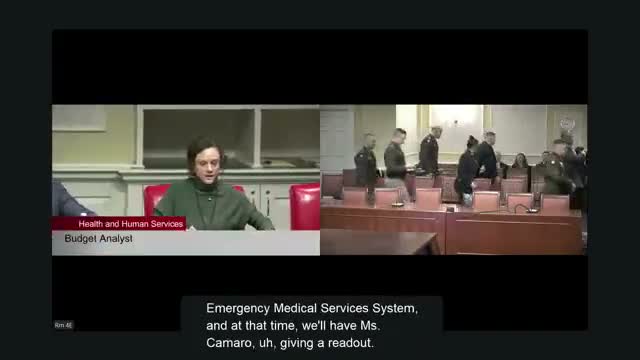
Naomi Camaro, a budget analyst with the Department of Legislative Services, told the subcommittee the Maryland Institute for Emergency Medical Services Systems (MEMS) fiscal 2027 budget increases by about $1.1 million over the FY26 working appropriation to roughly $26.6 million. Camaro said the growth is largely driven by upgrades to microwave links that support statewide emergency communications (~$880,000) and higher employee and retiree health insurance costs.
Dr. Ted Delbridge, executive director of MEMS, described the agency’s role coordinating statewide emergency medical services: setting clinical protocols, licensing EMS clinicians and commercial ambulance services, and running communications and data systems used to route and monitor EMS responses. He said nearly half of hospitals meet MEMS’ goal that EMS-to-emergency-department transfer-of-care occur within 35 minutes 90% of the time and that MEMS supplies regular reports to hospitals and the Health Services Cost Review Commission to foster improvements.
Delbridge highlighted the AED registry MEMS rolled out last year. "There are currently more than 17,000 registered AEDs in Maryland, and 1,380 have naloxone colocated with them," he said, adding that MEMS is targeting an October 2027 timeline to place naloxone alongside AEDs at certain public locations. The registry also supports recently passed state legislation that requires AED registration at some public locations and mandates co-location work.
On funding, Delbridge said the Maryland Emergency Medical Service Operation Fund is generated primarily by a fee on motor-vehicle registration renewals (about $24.50 per registration) and, to a much lesser extent, a surcharge on moving-traffic violation fines. He noted portions of the fund support grants, MEMS operations, and the Maryland Fire Rescue Institute.
The committee asked follow-up questions about vacancy rates, system performance, and how MEMS measures and reports on transfer-of-care intervals. MEMS committed to continue sharing data to help hospitals and jurisdictions shorten transfer delays. DLS recommended concurrence with the governor's allowance; MEMS leaders expressed appreciation for the review and cooperation with analysts.
Dr. Ted Delbridge, executive director of MEMS, described the agency’s role coordinating statewide emergency medical services: setting clinical protocols, licensing EMS clinicians and commercial ambulance services, and running communications and data systems used to route and monitor EMS responses. He said nearly half of hospitals meet MEMS’ goal that EMS-to-emergency-department transfer-of-care occur within 35 minutes 90% of the time and that MEMS supplies regular reports to hospitals and the Health Services Cost Review Commission to foster improvements.
Delbridge highlighted the AED registry MEMS rolled out last year. "There are currently more than 17,000 registered AEDs in Maryland, and 1,380 have naloxone colocated with them," he said, adding that MEMS is targeting an October 2027 timeline to place naloxone alongside AEDs at certain public locations. The registry also supports recently passed state legislation that requires AED registration at some public locations and mandates co-location work.
On funding, Delbridge said the Maryland Emergency Medical Service Operation Fund is generated primarily by a fee on motor-vehicle registration renewals (about $24.50 per registration) and, to a much lesser extent, a surcharge on moving-traffic violation fines. He noted portions of the fund support grants, MEMS operations, and the Maryland Fire Rescue Institute.
The committee asked follow-up questions about vacancy rates, system performance, and how MEMS measures and reports on transfer-of-care intervals. MEMS committed to continue sharing data to help hospitals and jurisdictions shorten transfer delays. DLS recommended concurrence with the governor's allowance; MEMS leaders expressed appreciation for the review and cooperation with analysts.
View the Full Meeting & All Its Details
This article offers just a summary. Unlock complete video, transcripts, and insights as a Founder Member.
✓
Watch full, unedited meeting videos
✓
Search every word spoken in unlimited transcripts
✓
AI summaries & real-time alerts (all government levels)
✓
Permanent access to expanding government content
30-day money-back guarantee
