Plan commission continues review of UDO amendments on solar, battery storage, setbacks and decommissioning
January 26, 2026 | Pulaski County, Indiana
This article was created by AI summarizing key points discussed. AI makes mistakes, so for full details and context, please refer to the video of the full meeting. Please report any errors so we can fix them. Report an error »
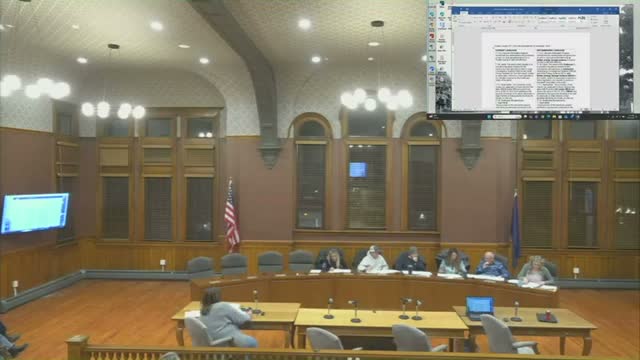
At its Jan. 26 meeting the Pulaski County Planning Commission continued a detailed review of proposed text amendments to the county’s Unified Development Ordinance affecting commercial solar projects and battery energy storage systems (BESS).
Staff walked the commission through edits to sections of the UDO that add BESS definitions and requirements, expand commercial solar standards, and clarify insurance, financial assurance and liability language. The commission discussed multiple items staff said will ultimately be supported by separate agreements (road‑use, drainage, site‑security and emergency‑response plans) rather than being fully specified in the ordinance text.
Key points under discussion included landscaping and screening requirements, setbacks from property lines and residential structures, decommissioning timelines, and operational controls. Commissioners debated replacing native grass buffers with shorter evergreen screening to provide year‑round concealment; concerns were raised that planting too close to rights‑of‑way could increase vehicle‑deer collisions. Staff proposed restricting species and planting distances so screening performs its visual function without compromising road safety or panel performance.
Setback distances generated extended debate. The draft included numbers ranging from 75 feet (drainage‑board recommendation) to 150 feet (earlier draft), and some members proposed a 1,000‑foot setback from residential structures 'fit for human habitation' with the possibility of waivers. Commissioners discussed measuring setbacks from the property line versus from a structure and the legal and practical implications of defining 'residential structure.'
On decommissioning, staff proposed clear triggers and timeframes; draft language would require decommissioning activities to begin within one year of the project's last date of energy production. Road‑use provisions call for developers to repair county‑maintained roads used during construction and to return surfaces to condition equal to or better than preconstruction at the developer’s expense.
Several residents in public comment urged the commission to restore special exceptions and other protections that were removed earlier, saying those changes diminished nonparticipating landowners’ opportunities for formal review. One resident asked whether the moratorium question could be placed on the ballot as a polling question; staff and counsel noted limitations on what can be submitted as a binding legal question under state election rules.
Staff said attorneys and the drainage/hwy officials will supply more precise language on liability, insurance and drainage prior to the commission’s next meeting; commissioners scheduled follow‑up work and another internal meeting before Feb. 17. The commission will continue refining the UDO amendments with the goal of bolstering public safety, clarifying enforcement and improving the county’s ability to require site‑specific agreements where detailed operational controls are necessary.
Next steps: staff to convene follow‑up meetings, circulate revised draft text and compile requested technical input (insurance amounts, decommissioning bonds, emergency‑response elements) for the commission’s next meeting on Feb. 17.
Staff walked the commission through edits to sections of the UDO that add BESS definitions and requirements, expand commercial solar standards, and clarify insurance, financial assurance and liability language. The commission discussed multiple items staff said will ultimately be supported by separate agreements (road‑use, drainage, site‑security and emergency‑response plans) rather than being fully specified in the ordinance text.
Key points under discussion included landscaping and screening requirements, setbacks from property lines and residential structures, decommissioning timelines, and operational controls. Commissioners debated replacing native grass buffers with shorter evergreen screening to provide year‑round concealment; concerns were raised that planting too close to rights‑of‑way could increase vehicle‑deer collisions. Staff proposed restricting species and planting distances so screening performs its visual function without compromising road safety or panel performance.
Setback distances generated extended debate. The draft included numbers ranging from 75 feet (drainage‑board recommendation) to 150 feet (earlier draft), and some members proposed a 1,000‑foot setback from residential structures 'fit for human habitation' with the possibility of waivers. Commissioners discussed measuring setbacks from the property line versus from a structure and the legal and practical implications of defining 'residential structure.'
On decommissioning, staff proposed clear triggers and timeframes; draft language would require decommissioning activities to begin within one year of the project's last date of energy production. Road‑use provisions call for developers to repair county‑maintained roads used during construction and to return surfaces to condition equal to or better than preconstruction at the developer’s expense.
Several residents in public comment urged the commission to restore special exceptions and other protections that were removed earlier, saying those changes diminished nonparticipating landowners’ opportunities for formal review. One resident asked whether the moratorium question could be placed on the ballot as a polling question; staff and counsel noted limitations on what can be submitted as a binding legal question under state election rules.
Staff said attorneys and the drainage/hwy officials will supply more precise language on liability, insurance and drainage prior to the commission’s next meeting; commissioners scheduled follow‑up work and another internal meeting before Feb. 17. The commission will continue refining the UDO amendments with the goal of bolstering public safety, clarifying enforcement and improving the county’s ability to require site‑specific agreements where detailed operational controls are necessary.
Next steps: staff to convene follow‑up meetings, circulate revised draft text and compile requested technical input (insurance amounts, decommissioning bonds, emergency‑response elements) for the commission’s next meeting on Feb. 17.
Don't Miss a Word: See the Full Meeting!
Go beyond summaries. Unlock every video, transcript, and key insight with a Founder Membership.
✓
Get instant access to full meeting videos
✓
Search and clip any phrase from complete transcripts
✓
Receive AI-powered summaries & custom alerts
✓
Enjoy lifetime, unrestricted access to government data
30-day money-back guarantee
