St. Louis County trains volunteers for annual Point‑in‑Time count, sets Feb. 5 and Feb. 12 deadlines
January 26, 2026 | St. Louis County, Minnesota
This article was created by AI summarizing key points discussed. AI makes mistakes, so for full details and context, please refer to the video of the full meeting. Please report any errors so we can fix them. Report an error »
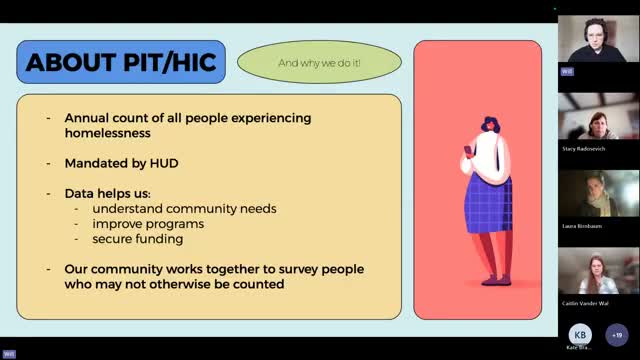
St. Louis County held a virtual training session for Point‑in‑Time (PIT) and Housing Inventory Count (HIC) volunteers and providers, during which county contractor Will outlined reporting deadlines, data handling procedures and who must participate in each count. The session covered HMIS updates, the county’s edited PIT survey, and how volunteers should return and secure completed surveys.
Why it matters: The PIT and HIC inform local homeless‑service planning and federal reporting. Accurate, timely data affect bed counts, program eligibility and resource allocation across the county’s continuum of care.
Will, a contractor with St. Louis County, told attendees that the PIT and HIC are annual counts required by HUD and occur on a designated night in January (date not specified). He advised HMIS users to have their data up to date by Feb. 5 to allow time for corrections and asked non‑HMIS providers to submit aggregate or self‑calculating tool data by Feb. 12. "If you keep up to date with your data, for PIT night, then you just need to finish up that date and get it all submitted by then," he said.
The county asked FHPAP providers to use the project code typed as "rapid rehousing" for HUD‑designated homeless participants and to ensure that the number of people served matches bed counts, even if the total is zero. Will also explained the Airtable/HMIS workflow: ICA typically produces an Airtable roster of projects; if counts differ, providers must correct HMIS and ensure Airtable reflects those corrections.
Survey logistics addressed practical security and submission steps. Volunteers at warming centers or named sites (Damiano, UGM, site leads) should hand paper surveys to the site lead the night of the PIT; organizations without a site lead were instructed to return paper surveys to the government services center by Feb. 5. Will advised scanning paper surveys into a single packet if emailing and then shredding the originals. In response to a question about the online form, Will confirmed that PittLive requires clicking a submit button and that submissions are routed to ICA.
The training clarified who is and is not counted. Enumerators should ask where a person slept on PIT night; if the person was sheltered, the HIC typically captures that data and the PIT survey can end early. Excluded categories listed by Will include residents of hospitals, psychiatric facilities, nursing homes, jails/prisons, foster care/group homes and chemical dependency facilities; housing choice voucher holders are excluded unless the voucher is dedicated exclusively to serving homeless persons. Will recommended that people not officially enrolled in emergency housing be offered a PIT survey and noted coordinated entry assessors will survey individuals on wait lists.
On a substantive change for this year, the county is collecting "doubled‑up" information for people ages 18–24 who are heads of household (for example, couch‑surfing or staying with family); Will said the county is not yet collecting similar data for older couch‑hopping adults. "This is where we'll start... very much a pilot year," a participant summarized, noting the Youth Action Board and TAFE support helped shape the effort.
The training closed with a reminder that survey participation is voluntary and that personal and sensitive data must be handled to protect respondent safety. Will said he will include regional contacts (Tommy for southern St. Louis County, Stacy for northern St. Louis County) and other resources in a follow‑up email and asked volunteers to contact him or Tanya if they need assistance.
Next steps: Participants were asked to check email for the county PIT survey and to join a practice run at the end of the session. The county will distribute links and a surveyor guide with contact information and other resources.
Why it matters: The PIT and HIC inform local homeless‑service planning and federal reporting. Accurate, timely data affect bed counts, program eligibility and resource allocation across the county’s continuum of care.
Will, a contractor with St. Louis County, told attendees that the PIT and HIC are annual counts required by HUD and occur on a designated night in January (date not specified). He advised HMIS users to have their data up to date by Feb. 5 to allow time for corrections and asked non‑HMIS providers to submit aggregate or self‑calculating tool data by Feb. 12. "If you keep up to date with your data, for PIT night, then you just need to finish up that date and get it all submitted by then," he said.
The county asked FHPAP providers to use the project code typed as "rapid rehousing" for HUD‑designated homeless participants and to ensure that the number of people served matches bed counts, even if the total is zero. Will also explained the Airtable/HMIS workflow: ICA typically produces an Airtable roster of projects; if counts differ, providers must correct HMIS and ensure Airtable reflects those corrections.
Survey logistics addressed practical security and submission steps. Volunteers at warming centers or named sites (Damiano, UGM, site leads) should hand paper surveys to the site lead the night of the PIT; organizations without a site lead were instructed to return paper surveys to the government services center by Feb. 5. Will advised scanning paper surveys into a single packet if emailing and then shredding the originals. In response to a question about the online form, Will confirmed that PittLive requires clicking a submit button and that submissions are routed to ICA.
The training clarified who is and is not counted. Enumerators should ask where a person slept on PIT night; if the person was sheltered, the HIC typically captures that data and the PIT survey can end early. Excluded categories listed by Will include residents of hospitals, psychiatric facilities, nursing homes, jails/prisons, foster care/group homes and chemical dependency facilities; housing choice voucher holders are excluded unless the voucher is dedicated exclusively to serving homeless persons. Will recommended that people not officially enrolled in emergency housing be offered a PIT survey and noted coordinated entry assessors will survey individuals on wait lists.
On a substantive change for this year, the county is collecting "doubled‑up" information for people ages 18–24 who are heads of household (for example, couch‑surfing or staying with family); Will said the county is not yet collecting similar data for older couch‑hopping adults. "This is where we'll start... very much a pilot year," a participant summarized, noting the Youth Action Board and TAFE support helped shape the effort.
The training closed with a reminder that survey participation is voluntary and that personal and sensitive data must be handled to protect respondent safety. Will said he will include regional contacts (Tommy for southern St. Louis County, Stacy for northern St. Louis County) and other resources in a follow‑up email and asked volunteers to contact him or Tanya if they need assistance.
Next steps: Participants were asked to check email for the county PIT survey and to join a practice run at the end of the session. The county will distribute links and a surveyor guide with contact information and other resources.
View the Full Meeting & All Its Details
This article offers just a summary. Unlock complete video, transcripts, and insights as a Founder Member.
✓
Watch full, unedited meeting videos
✓
Search every word spoken in unlimited transcripts
✓
AI summaries & real-time alerts (all government levels)
✓
Permanent access to expanding government content
30-day money-back guarantee
