Chair candidate Michael Gregg emphasizes transparency, mentorship and graduate support in Q&A
January 31, 2026 | Hinckley Institute of Politics, Utah Lobbyist / NGO, Utah Legislative Branch, Utah
This article was created by AI summarizing key points discussed. AI makes mistakes, so for full details and context, please refer to the video of the full meeting. Please report any errors so we can fix them. Report an error »
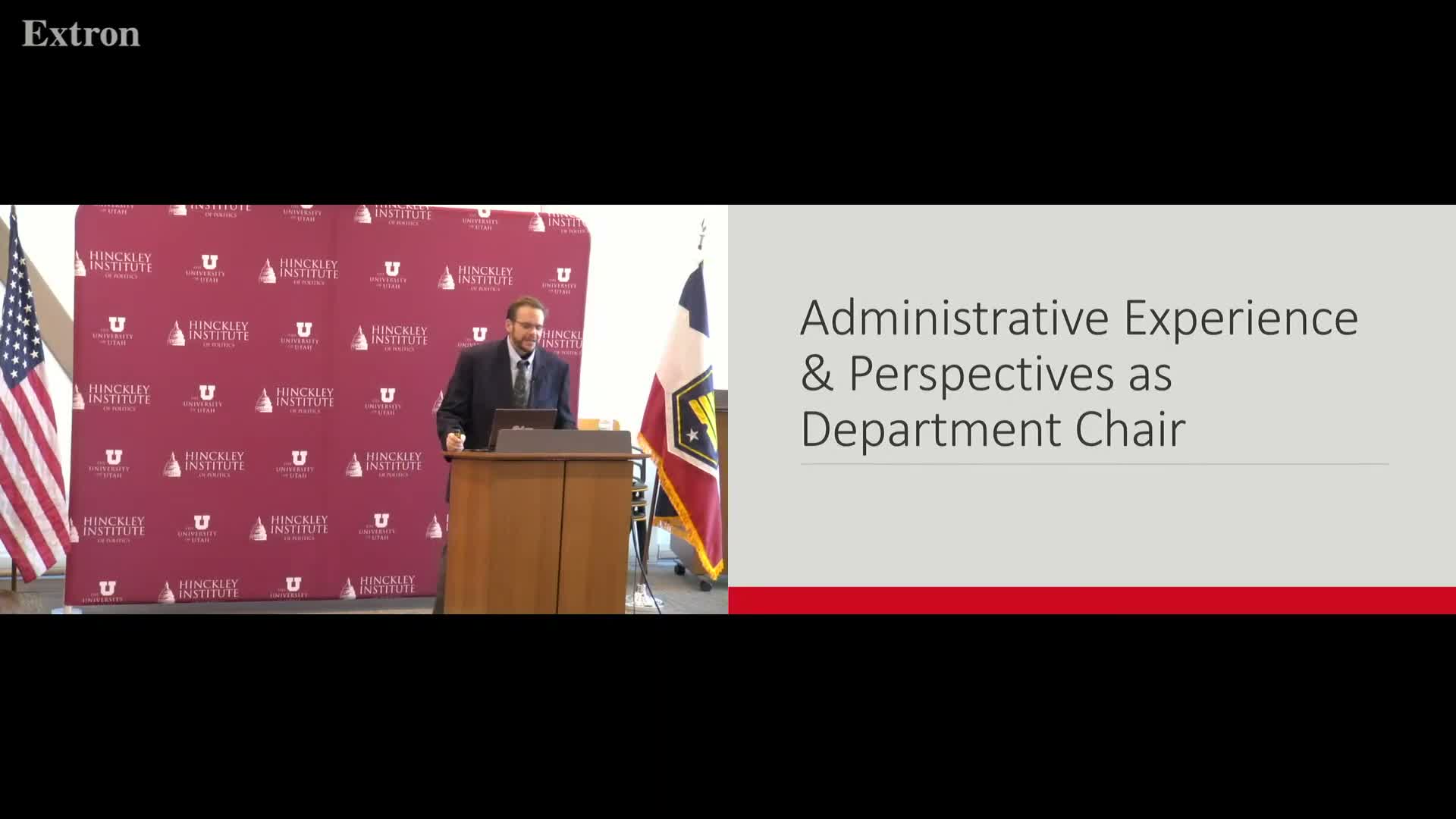
Michael Gregg outlined administrative priorities he would pursue if selected as department chair at a Hinckley Institute of Politics presentation, emphasizing transparency, mentorship, collaborative governance and alumni engagement. "Trust is a chair's most important resource," Gregg said, arguing that openness about decisions and clear evaluation procedures build that trust.
Drawing on prior service—associate chair for an international-studies program at the University of North Texas, a year as department chair there and roles on personnel and faculty councils—he said his leadership approach would be collaborative and focused on retention: "My goal would be to be chair of the department for the term of the chair service, and then return to the faculty and department," he told attendees.
Gregg recounted a concrete lesson from his prior chairmanship: a rushed change to written evaluation narratives created resentment because it failed to address deeper, structural fairness issues in evaluation criteria. A later, inclusive reform process involving town halls, draft circulation and separated stakeholder meetings produced an evaluation system faculty accepted.
In Q&A, attendees pressed Gregg on research funding and graduate-program competitiveness. On funding, Gregg confirmed that the termination of the Minerva program curtailed some plans for China/PLA research but said his team has relied on UCSD datasets to continue analysis. On graduate support he acknowledged broader concerns in the field: "Our graduate students get paid about $16,000 a year and don't have health insurance" in his prior program, he said, and argued departments must prepare students for nonacademic careers and create structured, publication-focused seminars to improve placement.
Attendees also asked how he would respond to pressure for "viewpoint diversity." Gregg said he teaches "theory first" to equip students to analyze contentious topics and that the chair may need to defend academic practice while identifying reasonable compromises.
To build trust at the start of a chair term, Gregg proposed small-group lunches with faculty, separate sessions with graduate students and meetings with staff; he also urged the department to codify evaluation and tenure procedures to set clear expectations. He encouraged using the university’s strategic plan—citing Utah’s 80% graduation-rate goal—to advocate for departmental resources and to develop alumni engagement as a low-cost way to support students and programs.
The forum concluded with applause and an invitation for follow-up conversations.
Drawing on prior service—associate chair for an international-studies program at the University of North Texas, a year as department chair there and roles on personnel and faculty councils—he said his leadership approach would be collaborative and focused on retention: "My goal would be to be chair of the department for the term of the chair service, and then return to the faculty and department," he told attendees.
Gregg recounted a concrete lesson from his prior chairmanship: a rushed change to written evaluation narratives created resentment because it failed to address deeper, structural fairness issues in evaluation criteria. A later, inclusive reform process involving town halls, draft circulation and separated stakeholder meetings produced an evaluation system faculty accepted.
In Q&A, attendees pressed Gregg on research funding and graduate-program competitiveness. On funding, Gregg confirmed that the termination of the Minerva program curtailed some plans for China/PLA research but said his team has relied on UCSD datasets to continue analysis. On graduate support he acknowledged broader concerns in the field: "Our graduate students get paid about $16,000 a year and don't have health insurance" in his prior program, he said, and argued departments must prepare students for nonacademic careers and create structured, publication-focused seminars to improve placement.
Attendees also asked how he would respond to pressure for "viewpoint diversity." Gregg said he teaches "theory first" to equip students to analyze contentious topics and that the chair may need to defend academic practice while identifying reasonable compromises.
To build trust at the start of a chair term, Gregg proposed small-group lunches with faculty, separate sessions with graduate students and meetings with staff; he also urged the department to codify evaluation and tenure procedures to set clear expectations. He encouraged using the university’s strategic plan—citing Utah’s 80% graduation-rate goal—to advocate for departmental resources and to develop alumni engagement as a low-cost way to support students and programs.
The forum concluded with applause and an invitation for follow-up conversations.
Don't Miss a Word: See the Full Meeting!
Go beyond summaries. Unlock every video, transcript, and key insight with a Founder Membership.
✓
Get instant access to full meeting videos
✓
Search and clip any phrase from complete transcripts
✓
Receive AI-powered summaries & custom alerts
✓
Enjoy lifetime, unrestricted access to government data
30-day money-back guarantee
