VRS reports stronger returns, 85% funded status and urges care on benefit changes
January 31, 2026 | 2026 Legislature VA, Virginia
This article was created by AI summarizing key points discussed. AI makes mistakes, so for full details and context, please refer to the video of the full meeting. Please report any errors so we can fix them. Report an error »
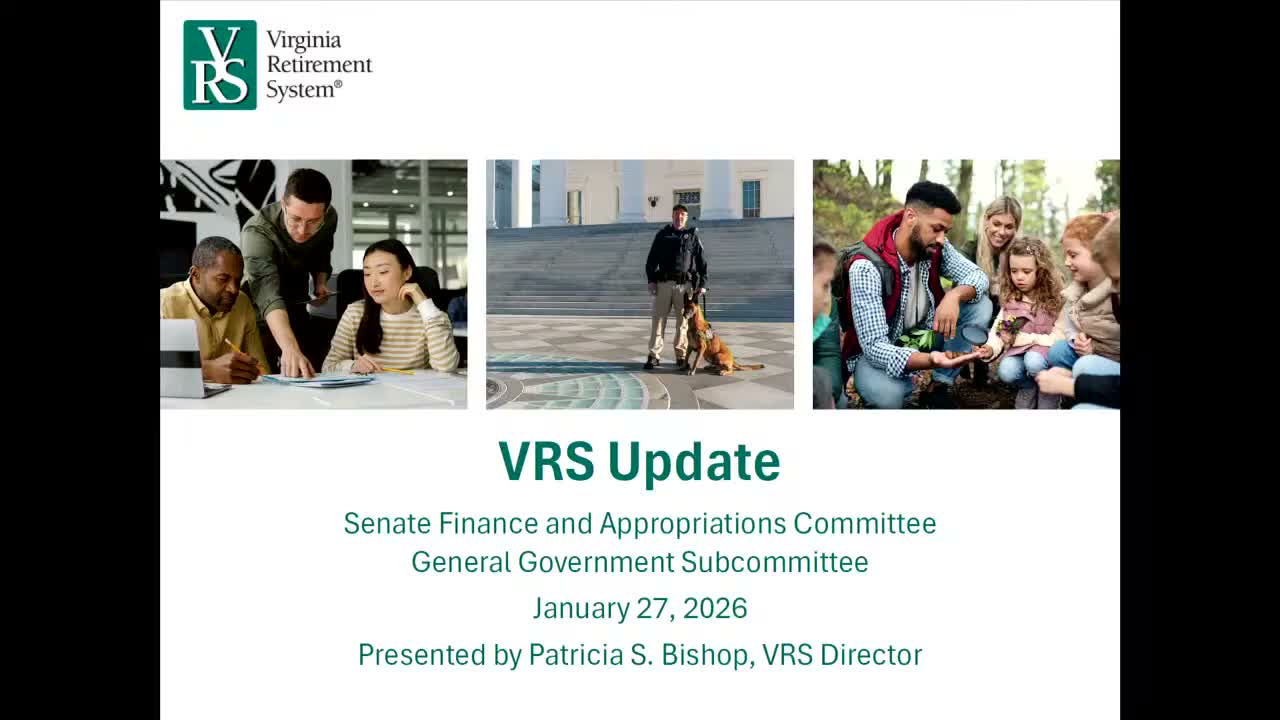
Trish Bishop, director of the Virginia Retirement System, told the Senate general government subcommittee that VRS serves nearly 860,000 members — about 375,000 active employees and roughly 250,000 retirees — and that investment returns have improved the system’s funding position.
"FY 2025, we had a 9.9% return," Bishop said, and the system closed the year "with just short of $123,000,000,000 in market value." She told the panel the state employee and teacher plans are about 85% funded on a market‑value basis and that, across statewide plans, VRS estimates roughly $15,100,000,000 in unfunded liabilities.
Why it matters: funding and contribution rates determined this year roll into the biennial budget, and VRS trustees’ rate requests were included in the governor’s proposed budget, Bishop said. Improved returns can lower required contribution rates and help narrow unfunded liabilities, but she cautioned against assuming the gains remove all fiscal risk.
Bishop described the hybrid retirement plan’s tradeoffs and recent policy changes. The hybrid plan combines a defined‑benefit component with a defined‑contribution portion that depends on voluntary savings. "If they do save, they can generate a higher benefit than Plan 1 or Plan 2," Bishop said, but "it requires people to be proactive and save more in order to generate a similar benefit." She said roughly one‑third of participants already make the maximum voluntary contribution while about 40% make only the minimum.
Bishop also noted an administrative change now in place: "We just recently had auto escalation effective 01/01/2026. Good news story there was only about 1.33 percent of folks opted out." She said VRS will continue outreach and education to improve member outcomes and encourage voluntary contributions.
On judicial retirement, Bishop said judges currently in the hybrid plan will retain service credit accrued under that plan but will move to Plan 2 for future accruals effective July 1 (the date was discussed in the presentation). She summarized VRS’s interpretation of return‑to‑work rules tied to Internal Revenue Service guidance, saying retirees returning to VRS‑covered positions must demonstrate a bona fide break in service and cannot be part of a prearranged return.
Committee members pressed VRS on whether the hybrid plan has affected retention. Bishop said the Department of Human Resource Management and JLARC examined proxies and survey data, but "there wasn't really any reliable dataset" to draw firm statewide conclusions; VRS offered to follow up with more granular locality and plan‑breakdown data.
Bishop closed by urging prudence: because significant unfunded liabilities remain for some plans (she cited about $4,500,000,000 for the state plan and about $9,500,000,000 for the teacher plan on a market‑value basis), lawmakers should weigh the budgetary consequences of benefit enhancements or design changes.
Next steps: VRS offered to provide the committee more detailed breakdowns and locality data on member counts and any retention analyses upon request.
"FY 2025, we had a 9.9% return," Bishop said, and the system closed the year "with just short of $123,000,000,000 in market value." She told the panel the state employee and teacher plans are about 85% funded on a market‑value basis and that, across statewide plans, VRS estimates roughly $15,100,000,000 in unfunded liabilities.
Why it matters: funding and contribution rates determined this year roll into the biennial budget, and VRS trustees’ rate requests were included in the governor’s proposed budget, Bishop said. Improved returns can lower required contribution rates and help narrow unfunded liabilities, but she cautioned against assuming the gains remove all fiscal risk.
Bishop described the hybrid retirement plan’s tradeoffs and recent policy changes. The hybrid plan combines a defined‑benefit component with a defined‑contribution portion that depends on voluntary savings. "If they do save, they can generate a higher benefit than Plan 1 or Plan 2," Bishop said, but "it requires people to be proactive and save more in order to generate a similar benefit." She said roughly one‑third of participants already make the maximum voluntary contribution while about 40% make only the minimum.
Bishop also noted an administrative change now in place: "We just recently had auto escalation effective 01/01/2026. Good news story there was only about 1.33 percent of folks opted out." She said VRS will continue outreach and education to improve member outcomes and encourage voluntary contributions.
On judicial retirement, Bishop said judges currently in the hybrid plan will retain service credit accrued under that plan but will move to Plan 2 for future accruals effective July 1 (the date was discussed in the presentation). She summarized VRS’s interpretation of return‑to‑work rules tied to Internal Revenue Service guidance, saying retirees returning to VRS‑covered positions must demonstrate a bona fide break in service and cannot be part of a prearranged return.
Committee members pressed VRS on whether the hybrid plan has affected retention. Bishop said the Department of Human Resource Management and JLARC examined proxies and survey data, but "there wasn't really any reliable dataset" to draw firm statewide conclusions; VRS offered to follow up with more granular locality and plan‑breakdown data.
Bishop closed by urging prudence: because significant unfunded liabilities remain for some plans (she cited about $4,500,000,000 for the state plan and about $9,500,000,000 for the teacher plan on a market‑value basis), lawmakers should weigh the budgetary consequences of benefit enhancements or design changes.
Next steps: VRS offered to provide the committee more detailed breakdowns and locality data on member counts and any retention analyses upon request.
Don't Miss a Word: See the Full Meeting!
Go beyond summaries. Unlock every video, transcript, and key insight with a Founder Membership.
✓
Get instant access to full meeting videos
✓
Search and clip any phrase from complete transcripts
✓
Receive AI-powered summaries & custom alerts
✓
Enjoy lifetime, unrestricted access to government data
30-day money-back guarantee
