Civil Subcommittee Unanimously Reports HB 1020 Allowing Newly Discovered Evidence in Child‑abuse Civil Claims
January 31, 2026 | 2026 Legislature VA, Virginia
This article was created by AI summarizing key points discussed. AI makes mistakes, so for full details and context, please refer to the video of the full meeting. Please report any errors so we can fix them. Report an error »
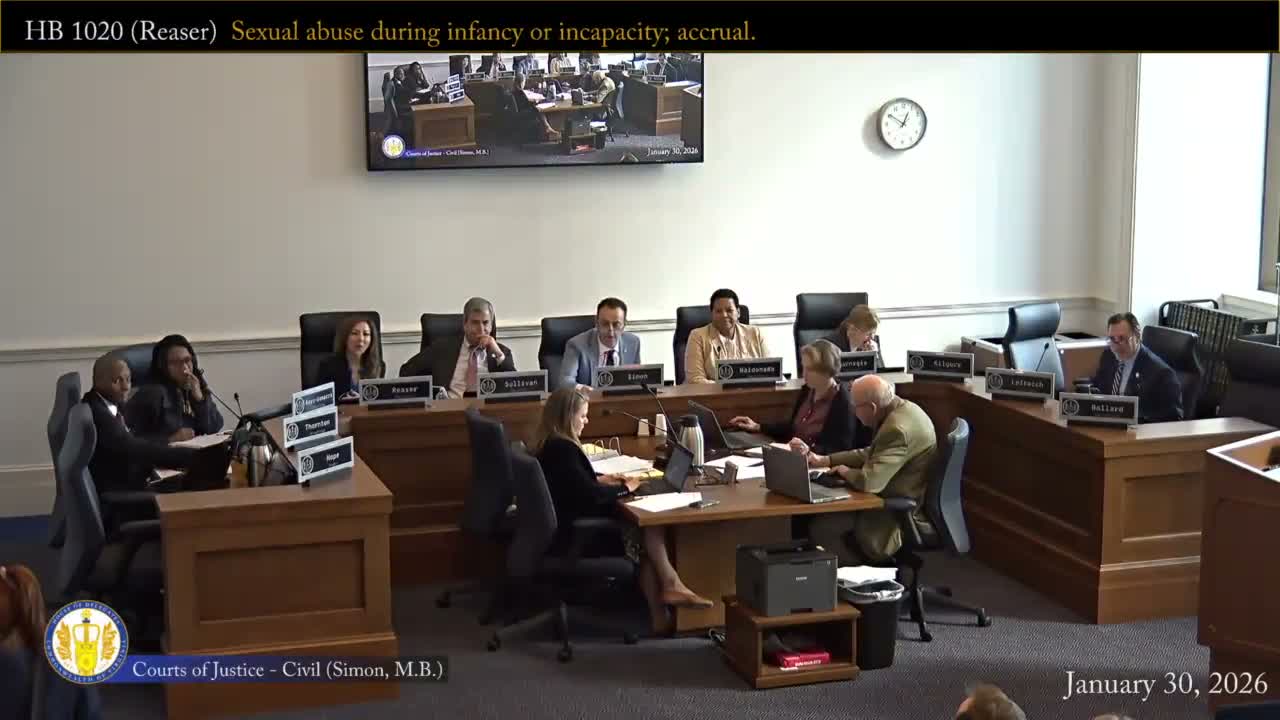
A Virginia House civil subcommittee on Friday voted to report HB 1020, a bill that would permit courts to consider newly discovered evidence — including DNA, confessions or corroborating witnesses — in civil suits alleging childhood sexual abuse.
The committee adopted line amendments and reported the bill out by a voice and recorded vote, first 7–0 and, after a motion to reconsider under Rule 22, by a final recorded vote of 8–0. Counsel and sponsors built a retroactivity carve‑out for entities, specifying that actions against entities under the clause apply only to causes of action occurring on or after July 1, 2026.
Supporters told the committee the change is narrowly tailored. "This bill would amend the code to allow for newly discovered evidence, including DNA confessions or corroborating witness testimony to be considered by a court," said Dahlia Reeser, who summarized the bill's intent to open courts to survivors without altering filing periods or evidentiary rules.
Sandy Johnson, senior legislative policy counsel for RAINN, the national sexual‑assault hotline operator, urged approval: "RAINN strongly supports HB 10 20 because it will open the doors to justice for more survivors," she said, adding that the bill "does not change the rules regarding the admissibility of evidence or the burden of proof." Testimony included survivor and advocate accounts describing delayed disclosure and the limits of current timelines.
Committee counsel read three printed amendments, including insertion of the phrase "scientifically reliable" before "test" in one subsection and a provision that any action against an entity under the clause may only be brought for causes of action occurring on or after 07/01/2026. The counsel explained the date language was "probably legally necessary" to avoid running afoul of a Virginia constitutional restriction on retroactively changing statutes of limitation for entities.
The committee discussion focused on preserving survivors' access to civil remedies when corroborative evidence emerges while maintaining constitutional and evidentiary safeguards. After the amendments and a procedural reconsideration, the committee reported the bill to the next stage of the process.
The committee chair said the report preserves options for leadership and allows further review before the bill reaches full committee consideration.
The committee adopted line amendments and reported the bill out by a voice and recorded vote, first 7–0 and, after a motion to reconsider under Rule 22, by a final recorded vote of 8–0. Counsel and sponsors built a retroactivity carve‑out for entities, specifying that actions against entities under the clause apply only to causes of action occurring on or after July 1, 2026.
Supporters told the committee the change is narrowly tailored. "This bill would amend the code to allow for newly discovered evidence, including DNA confessions or corroborating witness testimony to be considered by a court," said Dahlia Reeser, who summarized the bill's intent to open courts to survivors without altering filing periods or evidentiary rules.
Sandy Johnson, senior legislative policy counsel for RAINN, the national sexual‑assault hotline operator, urged approval: "RAINN strongly supports HB 10 20 because it will open the doors to justice for more survivors," she said, adding that the bill "does not change the rules regarding the admissibility of evidence or the burden of proof." Testimony included survivor and advocate accounts describing delayed disclosure and the limits of current timelines.
Committee counsel read three printed amendments, including insertion of the phrase "scientifically reliable" before "test" in one subsection and a provision that any action against an entity under the clause may only be brought for causes of action occurring on or after 07/01/2026. The counsel explained the date language was "probably legally necessary" to avoid running afoul of a Virginia constitutional restriction on retroactively changing statutes of limitation for entities.
The committee discussion focused on preserving survivors' access to civil remedies when corroborative evidence emerges while maintaining constitutional and evidentiary safeguards. After the amendments and a procedural reconsideration, the committee reported the bill to the next stage of the process.
The committee chair said the report preserves options for leadership and allows further review before the bill reaches full committee consideration.
Don't Miss a Word: See the Full Meeting!
Go beyond summaries. Unlock every video, transcript, and key insight with a Founder Membership.
✓
Get instant access to full meeting videos
✓
Search and clip any phrase from complete transcripts
✓
Receive AI-powered summaries & custom alerts
✓
Enjoy lifetime, unrestricted access to government data
30-day money-back guarantee
