Maryland superintendent proposes accountability overhaul, coaching pilot and leadership academy
January 31, 2026 | Howard, Delegation Committees, HOUSE OF REPRESENTATIVES, Committees, Legislative, Maryland
This article was created by AI summarizing key points discussed. AI makes mistakes, so for full details and context, please refer to the video of the full meeting. Please report any errors so we can fix them. Report an error »
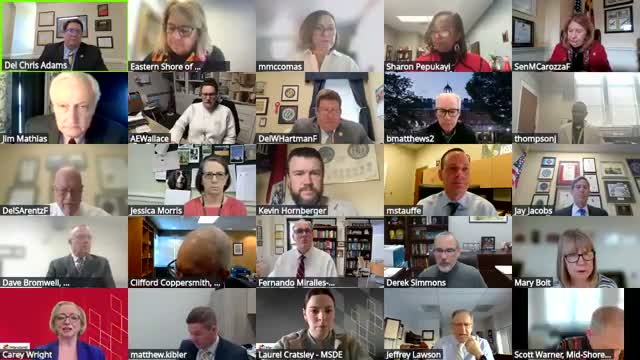
Maryland State Superintendent Doctor Wright on Friday outlined three departmental bills aimed at reshaping K-12 accountability and support for struggling schools, telling the Eastern Shore delegation that the changes are intended to credit schools for student growth and strengthen classroom instruction.
Wright, appearing with chief of staff Alex Reese, said her office has spent roughly 20 months on an accountability review and convened an assessment and accountability task force in 2024 that delivered recommendations to the State Board in December 2024. "You can't have 76% of your schools rated highly and only have a 48% proficiency in reading and a 26% proficiency in math," Wright said, describing why the system needs revision.
The departmentis proposing statutory changes to the Maryland report card to add a specific measure of growth among the bottom third of students, Wright said. She described the goal as "to give educators the ability to really be given credit" for work in schools and to use next school year as a baseline for a revised system.
Wright also described an "academic excellence" coaching program. Philanthropic funding has provided about $5,800,000 to launch a pilot in Prince George's County with seven coaches serving 14 schools immediately, and the governor's proposed budget includes $10,800,000 to expand state-led teacher coaching that Wright said would allow hiring roughly 35 additional literacy coaches statewide.
On school leadership, Wright said a Leadership Academy bill requests $1,500,000 to pay stipends to mentor principals and support a cohort-based leadership pipeline for principals, superintendents and board members. "We've got a leadership shortage just like we've got a teacher shortage," she said.
Wright signaled changes to assessment practices as well: vendors' contracts were set to expire in December 2026, she said, and the Board of Public Works recently approved a new contract. The department intends the first full administration under the new assessment in the 2026-27 cycle.
Delegates pressed Wright on cost and equity implications. Delegate Arris asked why an external ranking characterized Maryland with a failing grade and raised concerns about counties lacking the capacity to absorb blueprint costs; Wright pointed to policy work on literacy and math and a push to expand professional learning so teachers no longer must pay for training. On homeschooling access to community college benefits, Wright said she did not have statutory details and agreed to follow up.
Wright said the department will share draft materials with legislators and deliver printed copies to Annapolis offices. She also said MSDE is working with the Accountability Implementation Board (AIB) to clarify roles and responsibilities so local leaders know which agency to contact for specific issues.
The delegation did not take formal action on Wright's bills during the meeting. Wright asked legislators to support budget requests that remain under consideration in the governor's proposal.
Wright, appearing with chief of staff Alex Reese, said her office has spent roughly 20 months on an accountability review and convened an assessment and accountability task force in 2024 that delivered recommendations to the State Board in December 2024. "You can't have 76% of your schools rated highly and only have a 48% proficiency in reading and a 26% proficiency in math," Wright said, describing why the system needs revision.
The departmentis proposing statutory changes to the Maryland report card to add a specific measure of growth among the bottom third of students, Wright said. She described the goal as "to give educators the ability to really be given credit" for work in schools and to use next school year as a baseline for a revised system.
Wright also described an "academic excellence" coaching program. Philanthropic funding has provided about $5,800,000 to launch a pilot in Prince George's County with seven coaches serving 14 schools immediately, and the governor's proposed budget includes $10,800,000 to expand state-led teacher coaching that Wright said would allow hiring roughly 35 additional literacy coaches statewide.
On school leadership, Wright said a Leadership Academy bill requests $1,500,000 to pay stipends to mentor principals and support a cohort-based leadership pipeline for principals, superintendents and board members. "We've got a leadership shortage just like we've got a teacher shortage," she said.
Wright signaled changes to assessment practices as well: vendors' contracts were set to expire in December 2026, she said, and the Board of Public Works recently approved a new contract. The department intends the first full administration under the new assessment in the 2026-27 cycle.
Delegates pressed Wright on cost and equity implications. Delegate Arris asked why an external ranking characterized Maryland with a failing grade and raised concerns about counties lacking the capacity to absorb blueprint costs; Wright pointed to policy work on literacy and math and a push to expand professional learning so teachers no longer must pay for training. On homeschooling access to community college benefits, Wright said she did not have statutory details and agreed to follow up.
Wright said the department will share draft materials with legislators and deliver printed copies to Annapolis offices. She also said MSDE is working with the Accountability Implementation Board (AIB) to clarify roles and responsibilities so local leaders know which agency to contact for specific issues.
The delegation did not take formal action on Wright's bills during the meeting. Wright asked legislators to support budget requests that remain under consideration in the governor's proposal.
Don't Miss a Word: See the Full Meeting!
Go beyond summaries. Unlock every video, transcript, and key insight with a Founder Membership.
✓
Get instant access to full meeting videos
✓
Search and clip any phrase from complete transcripts
✓
Receive AI-powered summaries & custom alerts
✓
Enjoy lifetime, unrestricted access to government data
30-day money-back guarantee
