Eastern Shore superintendents seek funding and facilities for special education, safety and pre-K
January 31, 2026 | Howard, Delegation Committees, HOUSE OF REPRESENTATIVES, Committees, Legislative, Maryland
This article was created by AI summarizing key points discussed. AI makes mistakes, so for full details and context, please refer to the video of the full meeting. Please report any errors so we can fix them. Report an error »
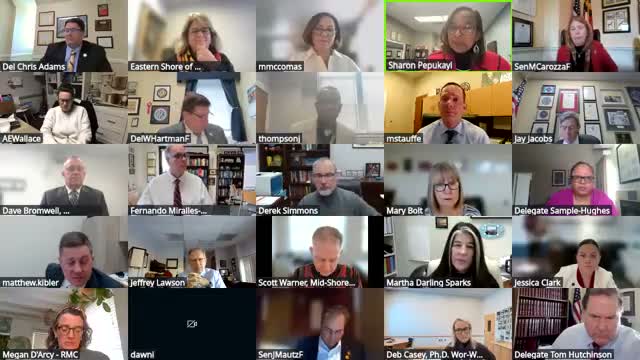
Leaders of the Eastern Shore Maryland Educational Consortium (ESMEC) on Friday asked the Eastern Shore delegation for continued and targeted support to address regional education needs, pointing to enrollment growth, rising poverty indicators and gaps in special-education services.
"We served over 64,000 students with the support of 13,000 staff members," ESMEC president Doctor Sharon Papakayi said as she opened the consortiums presentation. Papakayi said the regions data show rising need: the percentage of students eligible for free and reduced-price meals increased from 45% to 58% and special-education enrollment edged from 11% to 12% in the 2024-25 year.
Papakayi and district superintendents laid out several legislative priorities. Derek Simmons urged protection for high-need student funding tied to the community eligibility program and requested that districts not lose funding while a new poverty measure is developed. Jeff Lawson described nearly $750 million in shore capital-improvement projects on local dockets and pressed for solutions to front-funding challenges that force counties to delay other projects.
Several presenters emphasized a shortage of regional nonpublic special-education placements. Micah Stauffer said five districts are sending 32 students across the Bay Bridge for specialized placements this year at a cost of approximately $4,400,000 for tuition and transportation, including roughly $1,000,000 for transportation alone. He urged state support for capital and start-up costs and for coordination with federal funding to attract a veteran nonpublic provider such as Kennedy Krieger Institute.
On school safety, ESMEC echoed concerns raised earlier by delegates and said the consortium supports the Department of Juvenile Services commission recommendations and enhanced interagency collaboration to provide timely, actionable information to districts. Papakayi noted some districts have added practical measures such as staff safety lanyards that link to law enforcement.
Other priorities included maintaining the blueprints mixed-delivery pre-K model with clearer expectations for public and private providers; expanding dual enrollment and apprenticeship pathways (ESMEC reported dual enrollment growth and increased apprenticeships); and revising the career-ladder statute to limit certain administrative roles from the teacher career-ladder provisions.
Delegation members responded with offers to follow up in committee and requests for additional data. Several speakers committed to continuing advocacy for capital projects and special-education facilities on the Eastern Shore.
ESMEC concluded by asking legislators to remain engaged and supportive as the consortium pushes for resources and partnerships to meet regional needs.
"We served over 64,000 students with the support of 13,000 staff members," ESMEC president Doctor Sharon Papakayi said as she opened the consortiums presentation. Papakayi said the regions data show rising need: the percentage of students eligible for free and reduced-price meals increased from 45% to 58% and special-education enrollment edged from 11% to 12% in the 2024-25 year.
Papakayi and district superintendents laid out several legislative priorities. Derek Simmons urged protection for high-need student funding tied to the community eligibility program and requested that districts not lose funding while a new poverty measure is developed. Jeff Lawson described nearly $750 million in shore capital-improvement projects on local dockets and pressed for solutions to front-funding challenges that force counties to delay other projects.
Several presenters emphasized a shortage of regional nonpublic special-education placements. Micah Stauffer said five districts are sending 32 students across the Bay Bridge for specialized placements this year at a cost of approximately $4,400,000 for tuition and transportation, including roughly $1,000,000 for transportation alone. He urged state support for capital and start-up costs and for coordination with federal funding to attract a veteran nonpublic provider such as Kennedy Krieger Institute.
On school safety, ESMEC echoed concerns raised earlier by delegates and said the consortium supports the Department of Juvenile Services commission recommendations and enhanced interagency collaboration to provide timely, actionable information to districts. Papakayi noted some districts have added practical measures such as staff safety lanyards that link to law enforcement.
Other priorities included maintaining the blueprints mixed-delivery pre-K model with clearer expectations for public and private providers; expanding dual enrollment and apprenticeship pathways (ESMEC reported dual enrollment growth and increased apprenticeships); and revising the career-ladder statute to limit certain administrative roles from the teacher career-ladder provisions.
Delegation members responded with offers to follow up in committee and requests for additional data. Several speakers committed to continuing advocacy for capital projects and special-education facilities on the Eastern Shore.
ESMEC concluded by asking legislators to remain engaged and supportive as the consortium pushes for resources and partnerships to meet regional needs.
Don't Miss a Word: See the Full Meeting!
Go beyond summaries. Unlock every video, transcript, and key insight with a Founder Membership.
✓
Get instant access to full meeting videos
✓
Search and clip any phrase from complete transcripts
✓
Receive AI-powered summaries & custom alerts
✓
Enjoy lifetime, unrestricted access to government data
30-day money-back guarantee
