Vermont League warns Act 181 mapping and 'road rule' risk curbing housing in many towns
January 31, 2026 | Economic Development, Housing & General Affairs, SENATE, Committees, Legislative , Vermont
This article was created by AI summarizing key points discussed. AI makes mistakes, so for full details and context, please refer to the video of the full meeting. Please report any errors so we can fix them. Report an error »
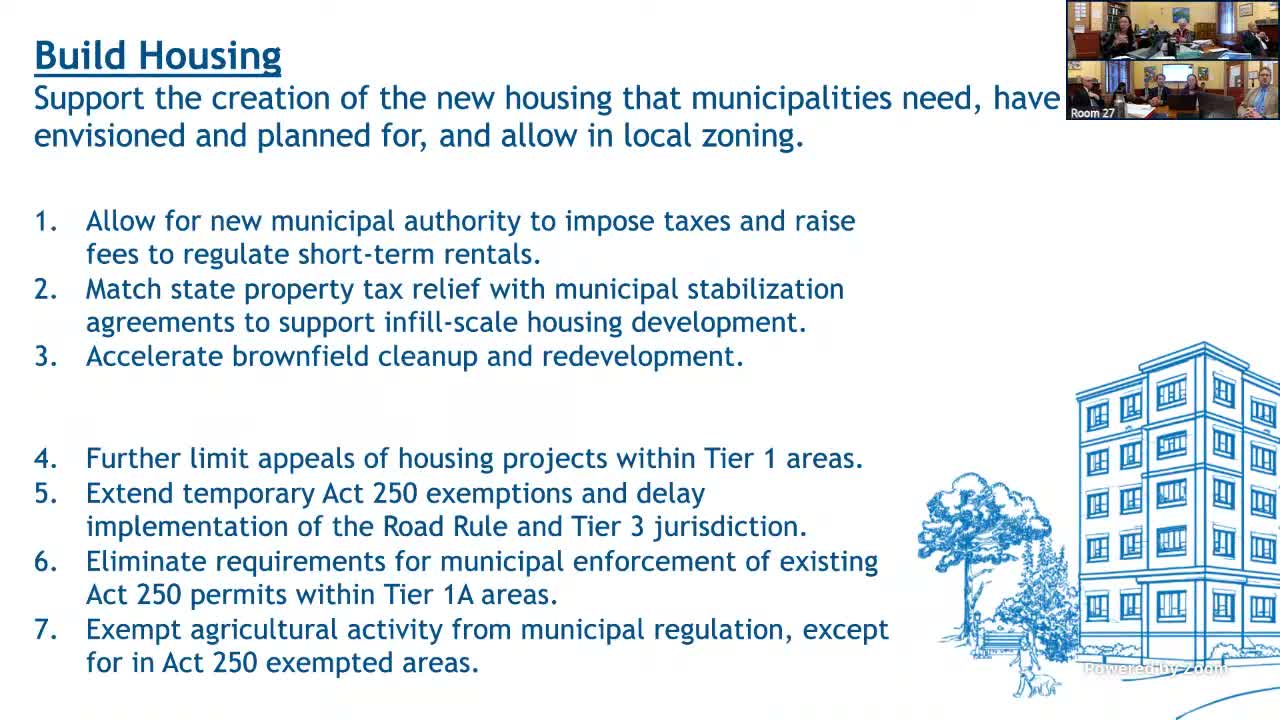
The Vermont League of Cities and Towns told the Senate committee that implementing Act 181 as currently drafted could sharply limit where towns can build and improve housing, and urged the legislature to pause parts of the rollout until maps and rules are aligned with municipal planning processes.
Presenters Josh Henford and Samantha Sheehan outlined the statute’s three-tier structure and the separately administered "road rule," which the League said will take effect in July unless the Legislature intervenes. They said regional planning commissions (RPCs) map tier 1 eligibility, the state Land Use Panel (LERB) maps tier 3, and that the road rule will apply statewide before most regional maps are finalized.
The League flagged a particular drafting concern in the LERB’s tier 3 definition of "development," which in a draft rule would cover many routine projects: structures larger than 200 square feet, decks, accessory dwelling units, new septic systems and wells, and transportation or drainage work near roads. "We are asking for a delay in the road rule," Sheehan said, arguing the current draft could require Act 250 review for home improvements and municipal road projects that have historically been handled locally.
Using maps from the Rutland RPC, presenters showed how the road rule combined with the LERB’s "habitat connector" mapping can create overlapping Act 250 jurisdiction in already developed neighborhoods and along town highways. In one example the League said the Rutland RPC’s initial tier 1 eligibility request was reduced roughly 30 percent after LERB review; presenters also cited an estimated statewide eligible area of about 2.1 percent under current draft mapping, with substantial regional variation.
League officials recommended several steps: delay the road rule’s effective date by one year, bring the tier 3 rule to the Legislature for review in the fall and delay its effect on property owners until the following summer, and provide clearer statutory guardrails so the LERB’s interpretations align with the statute’s intent to encourage growth in planned, serviced villages and centers. They emphasized tier 1b as the key place to deploy housing programs such as brownfield cleanup, downtown tax credits and other incentives.
Committee members from multiple caucuses acknowledged the tensions between protecting natural resources and encouraging local housing growth and said they would schedule follow-up and joint hearings. The League said municipalities and homeowners need time to see maps, participate in the LERB rulemaking process, and for local zoning administrators to align guidance before a rule becomes effective.
Next steps: committee members said they would hold additional hearings, and several lawmakers urged the Legislature to consider bills that would pause or modify components of implementation. The road rule remains scheduled to take effect in July unless the Legislature acts.
Presenters Josh Henford and Samantha Sheehan outlined the statute’s three-tier structure and the separately administered "road rule," which the League said will take effect in July unless the Legislature intervenes. They said regional planning commissions (RPCs) map tier 1 eligibility, the state Land Use Panel (LERB) maps tier 3, and that the road rule will apply statewide before most regional maps are finalized.
The League flagged a particular drafting concern in the LERB’s tier 3 definition of "development," which in a draft rule would cover many routine projects: structures larger than 200 square feet, decks, accessory dwelling units, new septic systems and wells, and transportation or drainage work near roads. "We are asking for a delay in the road rule," Sheehan said, arguing the current draft could require Act 250 review for home improvements and municipal road projects that have historically been handled locally.
Using maps from the Rutland RPC, presenters showed how the road rule combined with the LERB’s "habitat connector" mapping can create overlapping Act 250 jurisdiction in already developed neighborhoods and along town highways. In one example the League said the Rutland RPC’s initial tier 1 eligibility request was reduced roughly 30 percent after LERB review; presenters also cited an estimated statewide eligible area of about 2.1 percent under current draft mapping, with substantial regional variation.
League officials recommended several steps: delay the road rule’s effective date by one year, bring the tier 3 rule to the Legislature for review in the fall and delay its effect on property owners until the following summer, and provide clearer statutory guardrails so the LERB’s interpretations align with the statute’s intent to encourage growth in planned, serviced villages and centers. They emphasized tier 1b as the key place to deploy housing programs such as brownfield cleanup, downtown tax credits and other incentives.
Committee members from multiple caucuses acknowledged the tensions between protecting natural resources and encouraging local housing growth and said they would schedule follow-up and joint hearings. The League said municipalities and homeowners need time to see maps, participate in the LERB rulemaking process, and for local zoning administrators to align guidance before a rule becomes effective.
Next steps: committee members said they would hold additional hearings, and several lawmakers urged the Legislature to consider bills that would pause or modify components of implementation. The road rule remains scheduled to take effect in July unless the Legislature acts.
Don't Miss a Word: See the Full Meeting!
Go beyond summaries. Unlock every video, transcript, and key insight with a Founder Membership.
✓
Get instant access to full meeting videos
✓
Search and clip any phrase from complete transcripts
✓
Receive AI-powered summaries & custom alerts
✓
Enjoy lifetime, unrestricted access to government data
30-day money-back guarantee
