State 'Woodworms' program donates low-grade timber from state sales to local wood banks for heating assistance
January 31, 2026 | Agriculture, Food Resiliency, & Forestry, HOUSE OF REPRESENTATIVES, Committees, Legislative , Vermont
This article was created by AI summarizing key points discussed. AI makes mistakes, so for full details and context, please refer to the video of the full meeting. Please report any errors so we can fix them. Report an error »
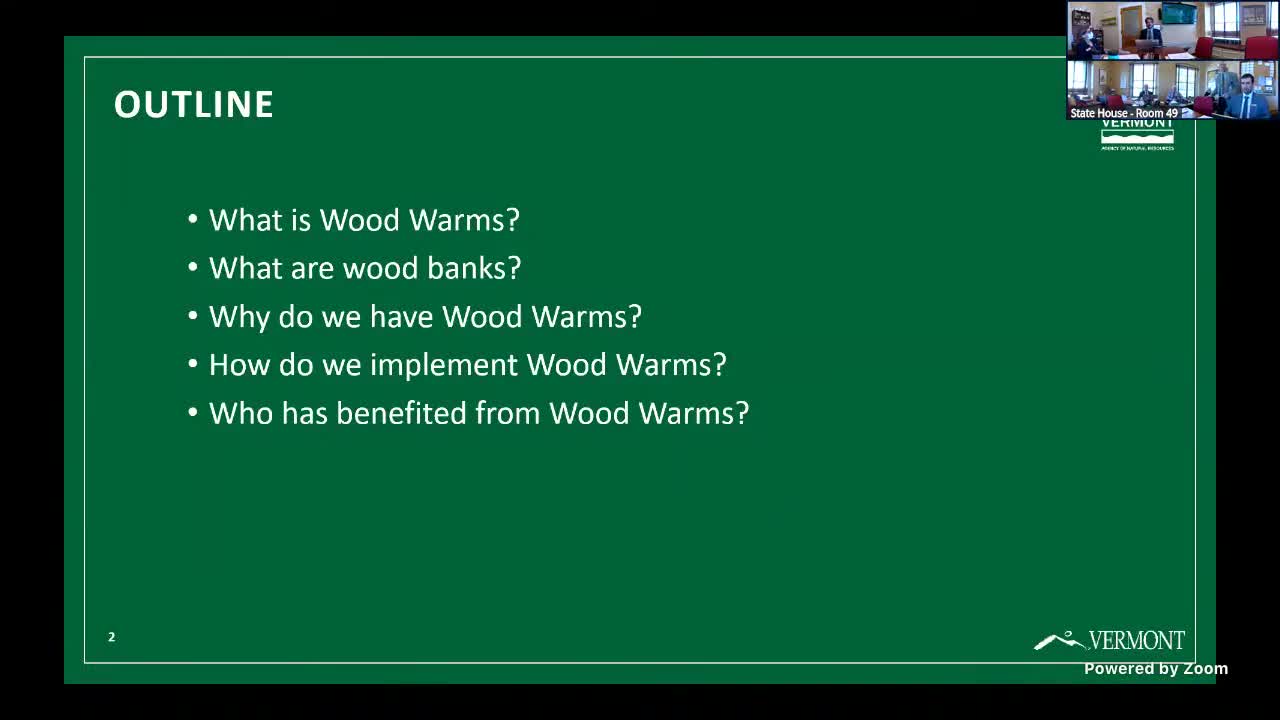
Jim Duncan, the State Lands Manager in the Division of Forests at the Department of Forests, Parks & Recreation (FPR), told a legislative committee that the agency’s Woodworms program sets aside a portion of low-grade wood from state timber sales to donate to community wood banks that supply heating fuel to Vermonters in need.
Duncan said FPR partners with local wood banks and matches harvest locations to the banks’ processing and delivery capacity. He described the program as a small but targeted component of the state lands timber-harvest program that tries to fill a “last mile” gap for households who still rely on wood during cold months.
FPR’s presentation summarized the program’s scale and mechanics. The agency estimates it offers about 2,800 cords of lower-grade wood through its timber-sale prospectuses each year and aims to commit roughly 100 cords per year for donation; on average it has solicited a commitment of about 500 cords to set aside for donation and actually delivered 232 cords over the past three winters. Duncan said timing can delay delivery — the process from planning a sale to having wood at a bank can take two to three years — so FPR now tries to provide multi-year commitments to wood banks to reduce unpredictability.
Duncan explained the procurement mechanics: prospectuses list a minimum bid price for a timber sale that factors estimated stumpage value minus any deductions (for example, donations to wood banks, landing improvements or road maintenance). Loggers bid competitively on that sale; when donated wood is part of the sale the bid floor reflects a deduction rather than a separate direct payment to the logger. In one recent example, a Little River sale resulted in 50 cords being donated to two wood banks after the logger delivered logs to a wood-bank concentration yard and took a scale slip rather than hauling the logs to a mill.
Committee members asked how wood banks organize recipients and distribute the wood. Duncan stressed that recipient selection and eligibility are handled locally by each wood bank: some use income testing, others use need-based interviews or referral processes. Capacity and processing methods vary — some banks have mechanized processors, others rely on volunteers who buck, split and stack by hand — and FPR leaves distribution rules to the banks.
Members raised finance and accounting questions. Duncan said estimated stumpage values reported over the last five years have ranged approximately from $100 to $200 (as discussed in the hearing) and that the departmental reconciliation of those values across budgets would require follow-up with finance staff. He offered to share the wood bank list on the FPR website after the meeting.
Biosecurity and pest-movement concerns surfaced during questioning. Duncan said state and federal quarantines and contract requirements apply: loggers must follow slow-the-spread guidance (including movement restrictions during active flight seasons, debarking, treatment or heat processing when required) and contracts include safeguards to avoid spreading invasive pests such as emerald ash borer.
Duncan said FPR is evaluating statewide wood-bank capacity through a Vermont Certified Public Managers program report due in April and has recently added recipients in Brattleboro and Norwich to expand delivery reach beyond northern Vermont. He listed source parcels in the harvest pipeline that have provided or could provide donated wood, including Groton, Victory State Forest, Mount Mansfield State Forest, Campbell's Home State Park and Aiken State Forest.
The committee did not take a formal vote on the program but thanked Duncan and asked for further information about accounting and the web page with participating wood banks. Duncan said he would provide that link and coordinate follow-up budget details with finance staff.
The committee recessed before taking up separate zoning and agriculture items later in the afternoon.
Duncan said FPR partners with local wood banks and matches harvest locations to the banks’ processing and delivery capacity. He described the program as a small but targeted component of the state lands timber-harvest program that tries to fill a “last mile” gap for households who still rely on wood during cold months.
FPR’s presentation summarized the program’s scale and mechanics. The agency estimates it offers about 2,800 cords of lower-grade wood through its timber-sale prospectuses each year and aims to commit roughly 100 cords per year for donation; on average it has solicited a commitment of about 500 cords to set aside for donation and actually delivered 232 cords over the past three winters. Duncan said timing can delay delivery — the process from planning a sale to having wood at a bank can take two to three years — so FPR now tries to provide multi-year commitments to wood banks to reduce unpredictability.
Duncan explained the procurement mechanics: prospectuses list a minimum bid price for a timber sale that factors estimated stumpage value minus any deductions (for example, donations to wood banks, landing improvements or road maintenance). Loggers bid competitively on that sale; when donated wood is part of the sale the bid floor reflects a deduction rather than a separate direct payment to the logger. In one recent example, a Little River sale resulted in 50 cords being donated to two wood banks after the logger delivered logs to a wood-bank concentration yard and took a scale slip rather than hauling the logs to a mill.
Committee members asked how wood banks organize recipients and distribute the wood. Duncan stressed that recipient selection and eligibility are handled locally by each wood bank: some use income testing, others use need-based interviews or referral processes. Capacity and processing methods vary — some banks have mechanized processors, others rely on volunteers who buck, split and stack by hand — and FPR leaves distribution rules to the banks.
Members raised finance and accounting questions. Duncan said estimated stumpage values reported over the last five years have ranged approximately from $100 to $200 (as discussed in the hearing) and that the departmental reconciliation of those values across budgets would require follow-up with finance staff. He offered to share the wood bank list on the FPR website after the meeting.
Biosecurity and pest-movement concerns surfaced during questioning. Duncan said state and federal quarantines and contract requirements apply: loggers must follow slow-the-spread guidance (including movement restrictions during active flight seasons, debarking, treatment or heat processing when required) and contracts include safeguards to avoid spreading invasive pests such as emerald ash borer.
Duncan said FPR is evaluating statewide wood-bank capacity through a Vermont Certified Public Managers program report due in April and has recently added recipients in Brattleboro and Norwich to expand delivery reach beyond northern Vermont. He listed source parcels in the harvest pipeline that have provided or could provide donated wood, including Groton, Victory State Forest, Mount Mansfield State Forest, Campbell's Home State Park and Aiken State Forest.
The committee did not take a formal vote on the program but thanked Duncan and asked for further information about accounting and the web page with participating wood banks. Duncan said he would provide that link and coordinate follow-up budget details with finance staff.
The committee recessed before taking up separate zoning and agriculture items later in the afternoon.
Don't Miss a Word: See the Full Meeting!
Go beyond summaries. Unlock every video, transcript, and key insight with a Founder Membership.
✓
Get instant access to full meeting videos
✓
Search and clip any phrase from complete transcripts
✓
Receive AI-powered summaries & custom alerts
✓
Enjoy lifetime, unrestricted access to government data
30-day money-back guarantee
