Lebanon utility details solar arrays and a $28M behind-the-meter generator plan
January 30, 2026 | Lebanon City council, Lebanon City, Warren County, Ohio
This article was created by AI summarizing key points discussed. AI makes mistakes, so for full details and context, please refer to the video of the full meeting. Please report any errors so we can fix them. Report an error »
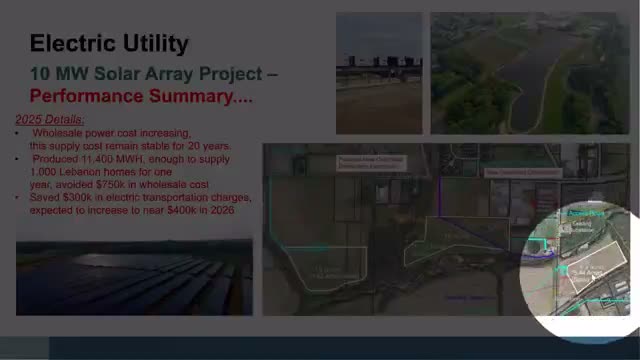
Sean Coffee, director of the city electric utility, told attendees the city has pursued local supply to blunt rising transmission (transportation) costs for purchased power. "That transportation cost over the last 5 to 7 years has dramatically gone up," Coffee said, adding it previously made up about 5–7% of costs and now represents roughly a third.
Solar arrays and savings
Coffee said the city built three utility solar arrays that total roughly 10 megawatts and reported last year's production as "11,400" (the unit was presented in the meeting and is noted as reported). He told the audience the arrays helped the city avoid about $750,000 in energy purchases and reduced transmission charges by about $300,000 in the most recent year. Coffee gave a total project figure of about $13,400,000 and said the city received approximately a $4,000,000 federal tax-credit grant; he described the city’s out-of-pocket contribution as roughly $9,400,000 (as reported in the meeting).
Behind-the-meter gas generation
To complement solar, Coffee described a behind-the-meter plan of eight natural-gas engine generators (six at a Columbia Road substation, two at Monroe) totaling about 20 megawatts. He said the project cost about $28,000,000, was financed with no initial city outlay through the municipal organization American Municipal Power (AMP), and that staff calculate a payback in the mid-teens of years as market prices change. "We're putting 20 megawatts in natural gas generation," Coffee said.
Emergency operations and resilience
Coffee explained some units will have "black start" capability to energize parts of the local grid after a system outage, and that during contingencies the utility would prioritize critical loads (hospitals, police, fire, city buildings).
Context and caveats
Numbers above are those stated by utility staff in the public meeting. Some unit labels (for example the term used alongside the reported '11,400') were presented in the session and are reported here as described; the transcript did not always standardize units (see audit). Coffee and city staff said the investments aim to reduce peak-related transmission charges and to diversify supply sources to stabilize rates for Lebanon customers.
Solar arrays and savings
Coffee said the city built three utility solar arrays that total roughly 10 megawatts and reported last year's production as "11,400" (the unit was presented in the meeting and is noted as reported). He told the audience the arrays helped the city avoid about $750,000 in energy purchases and reduced transmission charges by about $300,000 in the most recent year. Coffee gave a total project figure of about $13,400,000 and said the city received approximately a $4,000,000 federal tax-credit grant; he described the city’s out-of-pocket contribution as roughly $9,400,000 (as reported in the meeting).
Behind-the-meter gas generation
To complement solar, Coffee described a behind-the-meter plan of eight natural-gas engine generators (six at a Columbia Road substation, two at Monroe) totaling about 20 megawatts. He said the project cost about $28,000,000, was financed with no initial city outlay through the municipal organization American Municipal Power (AMP), and that staff calculate a payback in the mid-teens of years as market prices change. "We're putting 20 megawatts in natural gas generation," Coffee said.
Emergency operations and resilience
Coffee explained some units will have "black start" capability to energize parts of the local grid after a system outage, and that during contingencies the utility would prioritize critical loads (hospitals, police, fire, city buildings).
Context and caveats
Numbers above are those stated by utility staff in the public meeting. Some unit labels (for example the term used alongside the reported '11,400') were presented in the session and are reported here as described; the transcript did not always standardize units (see audit). Coffee and city staff said the investments aim to reduce peak-related transmission charges and to diversify supply sources to stabilize rates for Lebanon customers.
Don't Miss a Word: See the Full Meeting!
Go beyond summaries. Unlock every video, transcript, and key insight with a Founder Membership.
✓
Get instant access to full meeting videos
✓
Search and clip any phrase from complete transcripts
✓
Receive AI-powered summaries & custom alerts
✓
Enjoy lifetime, unrestricted access to government data
30-day money-back guarantee
