FDIC board finalizes guidelines to create Office of Supervisory Appeals, expands limited appellate rights
January 23, 2026 | National Credit Union Administration (NCUA), Executive, Federal
This article was created by AI summarizing key points discussed. AI makes mistakes, so for full details and context, please refer to the video of the full meeting. Please report any errors so we can fix them. Report an error »
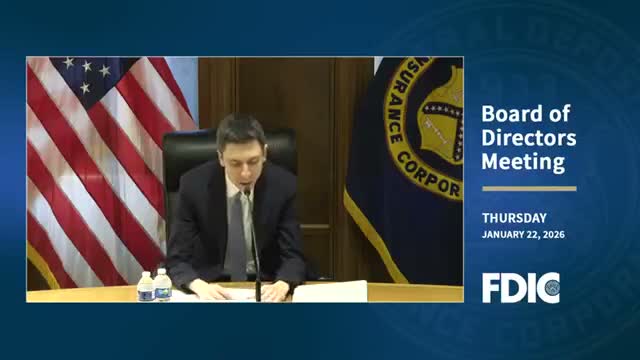
The FDIC Board of Directors voted to finalize guidelines creating an Office of Supervisory Appeals intended to provide an independent, apolitical appellate process for material supervisory determinations. The board approved the resolution during the open meeting after a presentation by legal-division staff.
The action formalizes a July 2025 proposal to replace the Supervision Appeals Review Committee (SARC) with a standalone office that would be independent of divisions that make supervisory determinations and would report to the Chairman’s office. "Today, staff is presenting a notice that would finalize changes to the FDIC's supervisory appeals process," said James Watts, an attorney in the legal division, during the presentation.
Under the finalized guidelines, appeals would generally be reviewed by panels of three reviewing officials. The rules keep the existing requirement that at least one panel member have bank supervisory or examination experience and add a requirement that each panel include at least one official with industry experience (generally defined as someone who has worked at a bank or for a bank-services company). Watts told the board the change is intended to "ensure a diversity of perspectives on panels which should benefit the appellate process." The FDIC said current FDIC employees would not be eligible to serve as reviewing officials; reviewers would be hired for fixed terms, cleared for conflicts of interest, and subject to FDIC confidentiality requirements.
The final guidelines also expand institutions' appellate rights in certain circumstances where a proposed or pending formal enforcement action forms the basis for the supervisory determinations being appealed. The guidelines specifically exclude appeals when the enforcement action is based in whole or in part on unsafe or unsound practices under section 8 of the Federal Deposit Insurance Act, or on violations of laws or regulations relating to an institution's anti-money-laundering/countering the financing of terrorism program or sanctions compliance. Watts said appeals tied to such proposed enforcement actions would be considered on an expedited basis and that, in general, initiation of the enforcement action would be delayed until after the conclusion of the appeal, though "there may be some circumstances in which a simultaneous enforcement action would be pursued."
Watts told the board the FDIC received eight comment letters on the July proposal; most commenters supported the change but suggested modifications, and the final notice adopts the proposal generally with specific changes to address that feedback. He also said the existing SARC process will remain in place to handle appeals until the new office is fully operational and that the FDIC will notify the public once the office is operational and the amended guidelines take effect.
Director Gould told the board she supported the proposal and praised leadership on the matter, noting the Office of the Comptroller of the Currency expects to pursue similar reforms. "So, applaud your efforts here and and very glad to support this," she said. Director Boat also thanked staff for their work.
The board approved the resolution regarding the notice of guidelines after a motion by James Watts and a second; the roll call as recorded in the public portion shows the presiding speaker voting "aye," Director Gould "Aye," and Director Vogt "Aye." The board also approved the meeting’s summary agenda earlier in the session, a summary agenda that the presiding speaker noted included a final rule to amend the FDIC's digital signage requirements. The open meeting then adjourned and the board convened in closed session.
Next steps: the FDIC said it will publicly announce when the Office of Supervisory Appeals is operational and the amended guidelines take effect. No implementation date was specified in the public remarks.
The action formalizes a July 2025 proposal to replace the Supervision Appeals Review Committee (SARC) with a standalone office that would be independent of divisions that make supervisory determinations and would report to the Chairman’s office. "Today, staff is presenting a notice that would finalize changes to the FDIC's supervisory appeals process," said James Watts, an attorney in the legal division, during the presentation.
Under the finalized guidelines, appeals would generally be reviewed by panels of three reviewing officials. The rules keep the existing requirement that at least one panel member have bank supervisory or examination experience and add a requirement that each panel include at least one official with industry experience (generally defined as someone who has worked at a bank or for a bank-services company). Watts told the board the change is intended to "ensure a diversity of perspectives on panels which should benefit the appellate process." The FDIC said current FDIC employees would not be eligible to serve as reviewing officials; reviewers would be hired for fixed terms, cleared for conflicts of interest, and subject to FDIC confidentiality requirements.
The final guidelines also expand institutions' appellate rights in certain circumstances where a proposed or pending formal enforcement action forms the basis for the supervisory determinations being appealed. The guidelines specifically exclude appeals when the enforcement action is based in whole or in part on unsafe or unsound practices under section 8 of the Federal Deposit Insurance Act, or on violations of laws or regulations relating to an institution's anti-money-laundering/countering the financing of terrorism program or sanctions compliance. Watts said appeals tied to such proposed enforcement actions would be considered on an expedited basis and that, in general, initiation of the enforcement action would be delayed until after the conclusion of the appeal, though "there may be some circumstances in which a simultaneous enforcement action would be pursued."
Watts told the board the FDIC received eight comment letters on the July proposal; most commenters supported the change but suggested modifications, and the final notice adopts the proposal generally with specific changes to address that feedback. He also said the existing SARC process will remain in place to handle appeals until the new office is fully operational and that the FDIC will notify the public once the office is operational and the amended guidelines take effect.
Director Gould told the board she supported the proposal and praised leadership on the matter, noting the Office of the Comptroller of the Currency expects to pursue similar reforms. "So, applaud your efforts here and and very glad to support this," she said. Director Boat also thanked staff for their work.
The board approved the resolution regarding the notice of guidelines after a motion by James Watts and a second; the roll call as recorded in the public portion shows the presiding speaker voting "aye," Director Gould "Aye," and Director Vogt "Aye." The board also approved the meeting’s summary agenda earlier in the session, a summary agenda that the presiding speaker noted included a final rule to amend the FDIC's digital signage requirements. The open meeting then adjourned and the board convened in closed session.
Next steps: the FDIC said it will publicly announce when the Office of Supervisory Appeals is operational and the amended guidelines take effect. No implementation date was specified in the public remarks.
View the Full Meeting & All Its Details
This article offers just a summary. Unlock complete video, transcripts, and insights as a Founder Member.
✓
Watch full, unedited meeting videos
✓
Search every word spoken in unlimited transcripts
✓
AI summaries & real-time alerts (all government levels)
✓
Permanent access to expanding government content
30-day money-back guarantee
