Vermont Health Department proposes cuts to tuition-assistance, AHEC grants and a pilot drug repository amid AHS shortfall
January 30, 2026 | Health Care, HOUSE OF REPRESENTATIVES, Committees, Legislative , Vermont
This article was created by AI summarizing key points discussed. AI makes mistakes, so for full details and context, please refer to the video of the full meeting. Please report any errors so we can fix them. Report an error »
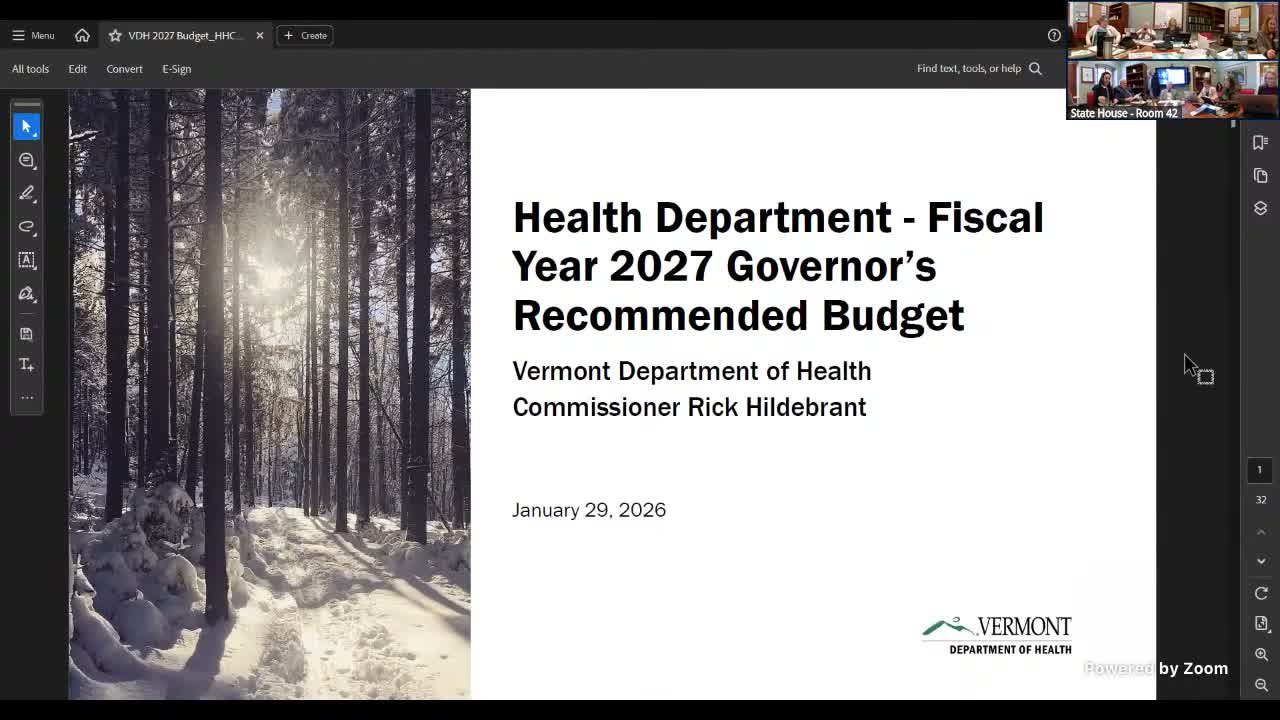
Rick Hilderbrand, the commissioner of the Department of Health, told a joint legislative hearing the Agency of Human Services faces roughly a $75,000,000 shortfall and presented a department budget that would be $221,000,000 for the coming year with a 1.2% net decrease from the prior year.
Hilderbrand said the department’s recommended package includes programmatic reductions and internal reorganizations intended to limit service impacts across AHS. The proposal would end the state-funded health professional educational assistance program administered through the University of Vermont/VSAC, discontinue a global-commitment grant that provides operating support to the State Area Health Education Centers (AHEC) (about $500,000) and eliminate a $50,000 annual AHEC recruitment grant. Officials also recommended discontinuing the state’s unused prescription drug repository pilot after the department received no viable bids to an RFP and concluded administrative costs outweighed likely benefits.
Why this matters: lawmakers and advocacy groups say the tuition-assistance and AHEC supports help recruit and retain clinicians in rural Vermont. Committee members pressed the department for outcome data and asked how many current recipients would lose funding. Hilderbrand and Megan Hope, the department’s financial director, said the department will provide detailed supplemental materials, outcome data where available and that some rural health transformation (RHT) funds might be used for workforce development but carry statutory and programmatic restrictions.
Key numbers and mechanics: Hilderbrand said federal receipts to the department are projected to be $11,110,000 lower and the department is requesting $5,000,000 less in global payment budget authority than the prior year. The department’s budget relies chiefly on federal funds; general funds account for about 11% of the Health Department total, and the general-fund share combined with the state’s global-commitment share is roughly 22% of the department’s budget.
On AHEC and loan-repayment supports, Hilderbrand and Hope said some elements remain federal or federally supported. The department will retain a $250,000 state loan repayment grant funded through federal receipts; the proposed elimination affects the global-commitment-funded pieces of the AHEC education loan repayment and the tuition-assistance elements the department currently funds. Hope said the department will invite VSAC and AHEC to brief the committee on implications for current recipients.
Drug repository pilot: department staff said the FY25 appropriation for the pilot was about $355,000. They posted an RFP but received no vendors willing to operate the program at the appropriation level; officials said the cost of sorting, repackaging and safely distributing returned prescription drugs makes the pilot expensive and may exceed the value of medication that could be repurposed.
Other program adjustments: the department described several internal, net-neutral transfers — for example, moving rural health and primary care program lines from the administration appropriation into the public health appropriation, and transferring a statewide Narcan distribution line from public health into the substance-use appropriation for accounting alignment. The immunization program requested a roughly 7.5% increase to its special fund to cover anticipated vaccine-price increases; staff said the program is funded by an insurer assessment (a per-member-per-month charge) rather than general fund dollars.
What’s next: lawmakers asked for supplemental budget documents and outcome data; the department agreed to provide additional detail and to return as needed. No formal votes or funding decisions were taken during the hearing.
Hilderbrand said the department’s recommended package includes programmatic reductions and internal reorganizations intended to limit service impacts across AHS. The proposal would end the state-funded health professional educational assistance program administered through the University of Vermont/VSAC, discontinue a global-commitment grant that provides operating support to the State Area Health Education Centers (AHEC) (about $500,000) and eliminate a $50,000 annual AHEC recruitment grant. Officials also recommended discontinuing the state’s unused prescription drug repository pilot after the department received no viable bids to an RFP and concluded administrative costs outweighed likely benefits.
Why this matters: lawmakers and advocacy groups say the tuition-assistance and AHEC supports help recruit and retain clinicians in rural Vermont. Committee members pressed the department for outcome data and asked how many current recipients would lose funding. Hilderbrand and Megan Hope, the department’s financial director, said the department will provide detailed supplemental materials, outcome data where available and that some rural health transformation (RHT) funds might be used for workforce development but carry statutory and programmatic restrictions.
Key numbers and mechanics: Hilderbrand said federal receipts to the department are projected to be $11,110,000 lower and the department is requesting $5,000,000 less in global payment budget authority than the prior year. The department’s budget relies chiefly on federal funds; general funds account for about 11% of the Health Department total, and the general-fund share combined with the state’s global-commitment share is roughly 22% of the department’s budget.
On AHEC and loan-repayment supports, Hilderbrand and Hope said some elements remain federal or federally supported. The department will retain a $250,000 state loan repayment grant funded through federal receipts; the proposed elimination affects the global-commitment-funded pieces of the AHEC education loan repayment and the tuition-assistance elements the department currently funds. Hope said the department will invite VSAC and AHEC to brief the committee on implications for current recipients.
Drug repository pilot: department staff said the FY25 appropriation for the pilot was about $355,000. They posted an RFP but received no vendors willing to operate the program at the appropriation level; officials said the cost of sorting, repackaging and safely distributing returned prescription drugs makes the pilot expensive and may exceed the value of medication that could be repurposed.
Other program adjustments: the department described several internal, net-neutral transfers — for example, moving rural health and primary care program lines from the administration appropriation into the public health appropriation, and transferring a statewide Narcan distribution line from public health into the substance-use appropriation for accounting alignment. The immunization program requested a roughly 7.5% increase to its special fund to cover anticipated vaccine-price increases; staff said the program is funded by an insurer assessment (a per-member-per-month charge) rather than general fund dollars.
What’s next: lawmakers asked for supplemental budget documents and outcome data; the department agreed to provide additional detail and to return as needed. No formal votes or funding decisions were taken during the hearing.
View the Full Meeting & All Its Details
This article offers just a summary. Unlock complete video, transcripts, and insights as a Founder Member.
✓
Watch full, unedited meeting videos
✓
Search every word spoken in unlimited transcripts
✓
AI summaries & real-time alerts (all government levels)
✓
Permanent access to expanding government content
30-day money-back guarantee
