Developer outlines five-district plan for OLF 8, says $150,000 now nonrefundable; timeline hinges on entitlements
January 30, 2026 | Escambia County, Florida
This article was created by AI summarizing key points discussed. AI makes mistakes, so for full details and context, please refer to the video of the full meeting. Please report any errors so we can fix them. Report an error »
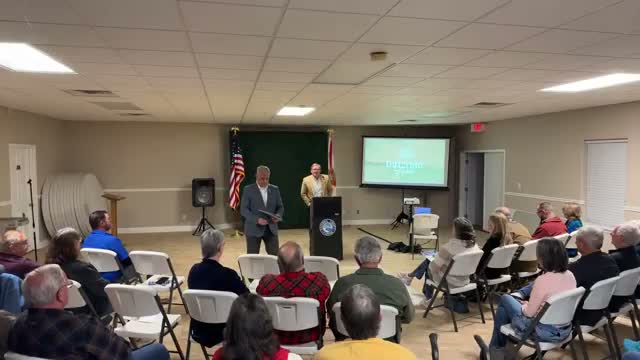
Chad Henderson, CEO of Catalyst Healthcare Real Estate, told a crowded Beulah town hall that his team wants to create a walkable, mixed-use place at the Outlying Fields (OLF 8) site that balances community space, jobs and a return for Escambia County. "We went through a branding exercise ... we want to pay homage to OLF 8," Henderson said, explaining the five-district approach (Town Centre, Community, Residential, Commerce & Services and ETI).
Henderson said the developer has completed multiple third‑party studies — traffic, wetland delineation, geotechnical borings, retail feasibility and an economic-impact study — and has pared the earlier DPZ plan to a version he said is more financeable. "We're trying to stay within that chassis and the spirit of the DPZ plan but also recognize that there were things in the DPZ plan that made it very difficult to execute and to finance," he said.
On the contract and money at risk, Henderson said the developer signed the purchase contract June 12 and placed a $100,000 earnest‑money deposit that later became nonrefundable. An additional $50,000 was also placed and is nonrefundable, leaving $150,000 currently nonrefundable toward the purchase price. He described a later $50,000 milestone on 2026‑05‑31 that would become nonrefundable and two 30‑day extension options at $20,000 each. "Today we're $150,000 nonrefundable into the contract," Henderson said.
Residents pressed Henderson on details that will affect livability: parking for townhomes, transit access, stormwater design and buildout timing. Henderson said townhouses would use rear‑loading alley parking and suggested two spaces per unit was likely. On transit he said the team would coordinate with county staff and Escambia County Transit. On stormwater, an audience member recommended using updated NOAA rainfall datasets; Henderson said the third‑party engineer was using 100‑year storm analyses and he would follow up to confirm which NOAA data set was applied.
Henderson described a range of potential residential density, noting the plan will depend on final use mixes: "I would guess 1,000 to 1,500" dwelling units in a likely scenario, he said. He also said that changing the future land‑use designation would require an appeal to Tallahassee and that rezoning and entitlement processes could take several months, but the team hopes to start infrastructure work "as early as the end of this year" if approvals and timelines align.
Henderson framed the project as a three‑way balancing act among county stewardship, community character and job creation: "We want everybody to win as much as possible with those 3 stakeholder goals in mind." He also said an overlay district and architectural pattern books will be used to maintain design standards across districts.
The next procedural steps Henderson described are the developer’s continuing due diligence, county staff reviews, rezoning/future land‑use applications and the public input opportunities built into those processes. He said the developer’s milestones and some entitlements will proceed in parallel to avoid unnecessary delays. "There will have opportunities for input and for further discussion," he said.
What happens next: Henderson and county staff will continue entitlement work and schedule public hearings; residents were invited to follow up with county staff for detailed technical answers and to get updates as studies and applications progress.
Henderson said the developer has completed multiple third‑party studies — traffic, wetland delineation, geotechnical borings, retail feasibility and an economic-impact study — and has pared the earlier DPZ plan to a version he said is more financeable. "We're trying to stay within that chassis and the spirit of the DPZ plan but also recognize that there were things in the DPZ plan that made it very difficult to execute and to finance," he said.
On the contract and money at risk, Henderson said the developer signed the purchase contract June 12 and placed a $100,000 earnest‑money deposit that later became nonrefundable. An additional $50,000 was also placed and is nonrefundable, leaving $150,000 currently nonrefundable toward the purchase price. He described a later $50,000 milestone on 2026‑05‑31 that would become nonrefundable and two 30‑day extension options at $20,000 each. "Today we're $150,000 nonrefundable into the contract," Henderson said.
Residents pressed Henderson on details that will affect livability: parking for townhomes, transit access, stormwater design and buildout timing. Henderson said townhouses would use rear‑loading alley parking and suggested two spaces per unit was likely. On transit he said the team would coordinate with county staff and Escambia County Transit. On stormwater, an audience member recommended using updated NOAA rainfall datasets; Henderson said the third‑party engineer was using 100‑year storm analyses and he would follow up to confirm which NOAA data set was applied.
Henderson described a range of potential residential density, noting the plan will depend on final use mixes: "I would guess 1,000 to 1,500" dwelling units in a likely scenario, he said. He also said that changing the future land‑use designation would require an appeal to Tallahassee and that rezoning and entitlement processes could take several months, but the team hopes to start infrastructure work "as early as the end of this year" if approvals and timelines align.
Henderson framed the project as a three‑way balancing act among county stewardship, community character and job creation: "We want everybody to win as much as possible with those 3 stakeholder goals in mind." He also said an overlay district and architectural pattern books will be used to maintain design standards across districts.
The next procedural steps Henderson described are the developer’s continuing due diligence, county staff reviews, rezoning/future land‑use applications and the public input opportunities built into those processes. He said the developer’s milestones and some entitlements will proceed in parallel to avoid unnecessary delays. "There will have opportunities for input and for further discussion," he said.
What happens next: Henderson and county staff will continue entitlement work and schedule public hearings; residents were invited to follow up with county staff for detailed technical answers and to get updates as studies and applications progress.
View the Full Meeting & All Its Details
This article offers just a summary. Unlock complete video, transcripts, and insights as a Founder Member.
✓
Watch full, unedited meeting videos
✓
Search every word spoken in unlimited transcripts
✓
AI summaries & real-time alerts (all government levels)
✓
Permanent access to expanding government content
30-day money-back guarantee
