Senate committee hears competing views on adding PTs and OTs as workers’ comp attending providers
January 19, 2026 | Legislative Sessions, Washington
This article was created by AI summarizing key points discussed. AI makes mistakes, so for full details and context, please refer to the video of the full meeting. Please report any errors so we can fix them. Report an error »
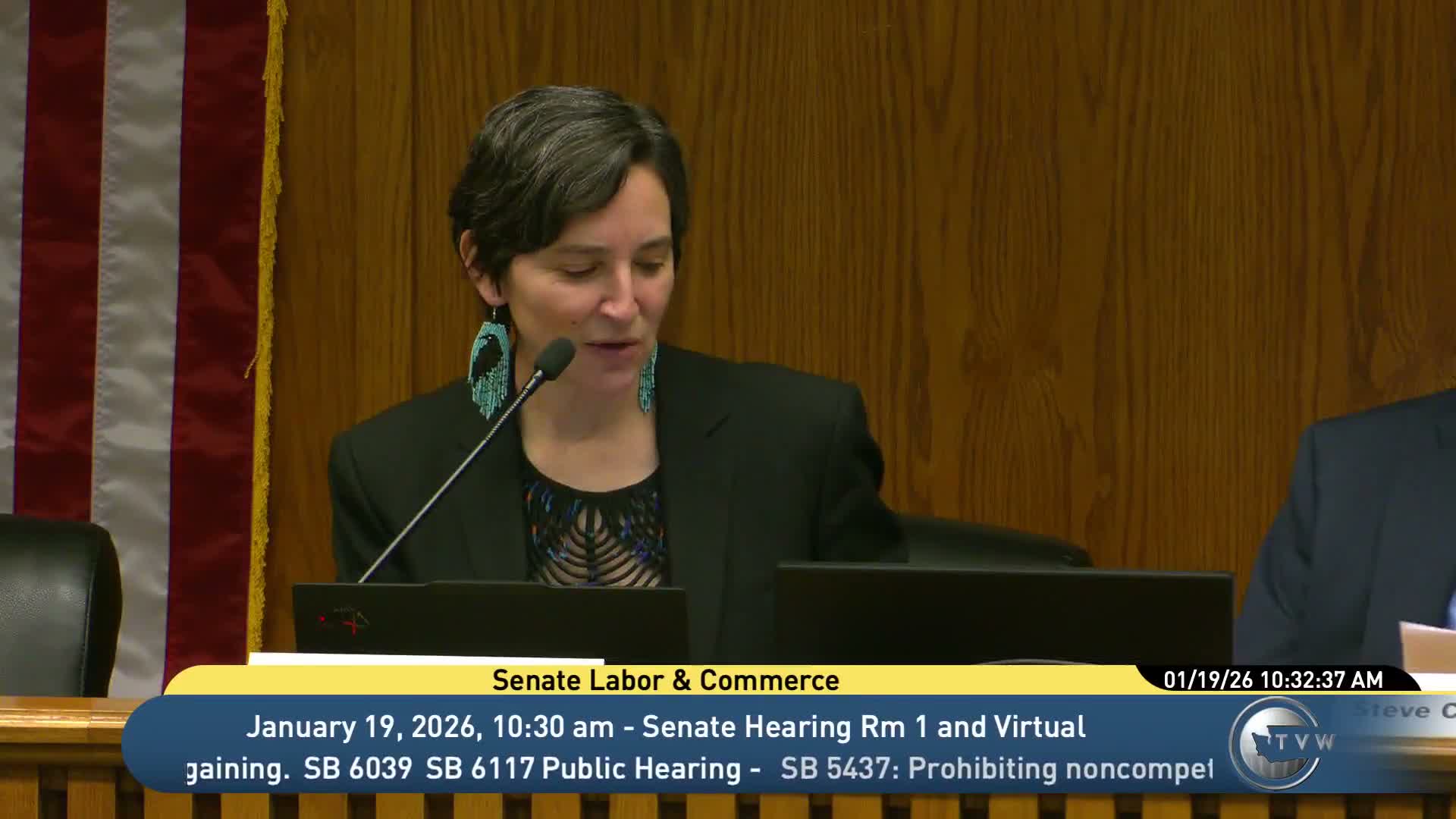
Senate Bill 6,152, which would add licensed physical and occupational therapists to the list of "attending providers" in the state workers' compensation system, drew robust testimony Tuesday in the Senate Labor and Commerce Committee.
Committee staff told lawmakers the bill would remove an administrative barrier that now limits PTs and OTs from being the attending provider, and that the change would require credentialing, outreach and IT work with an estimated fiscal note of about $1,900,000 for the 2025–29 period. "Senate Bill 6,152 is an act relating to including physical and occupational therapists as attending providers for workers' compensation," committee staff member Susan Jones said during the bill report.
Sponsor Sen. Paul Harris said the measure is straightforward: "This will add occupational therapist and PTs to that list," he told the committee, noting about 20 other states already allow similar access. Proponents — including clinic owners and leaders of the state chapters of the American Physical Therapy Association and the Washington Occupational Therapy Association — said early access to therapy speeds return to work, reduces reliance on opioids and lowers use of imaging and surgery. "Physical therapists are doctoral trained providers with extensive education in differential diagnosis," Suzanne Michaud, a doctor of physical therapy, said.
Opponents raised diagnostic‑scope and system‑capacity concerns. The Washington Medical Association and small‑business groups said PTs and OTs cannot prescribe medications or perform some procedures and worried the change could slow care in cases that require a broader medical evaluation. Rose Gunderson of a statewide retail association suggested guardrails similar to those added for psychologists when they were enrolled as attending providers. Department of Labor & Industries staff also cautioned that adding a provider class requires enrolling thousands of clinicians in the medical network and recommended a later effective date to allow the department time for outreach and IT changes.
Committee members pressed staff on the fiscal and operational details; staff said enrollment and outreach explain the bulk of the initial costs and that the funds would come from the accident and medical aid accounts, not the general fund. The committee did not take action on the bill during the hearing; testimony closed after panels from both pro and con sides spoke.
Committee staff told lawmakers the bill would remove an administrative barrier that now limits PTs and OTs from being the attending provider, and that the change would require credentialing, outreach and IT work with an estimated fiscal note of about $1,900,000 for the 2025–29 period. "Senate Bill 6,152 is an act relating to including physical and occupational therapists as attending providers for workers' compensation," committee staff member Susan Jones said during the bill report.
Sponsor Sen. Paul Harris said the measure is straightforward: "This will add occupational therapist and PTs to that list," he told the committee, noting about 20 other states already allow similar access. Proponents — including clinic owners and leaders of the state chapters of the American Physical Therapy Association and the Washington Occupational Therapy Association — said early access to therapy speeds return to work, reduces reliance on opioids and lowers use of imaging and surgery. "Physical therapists are doctoral trained providers with extensive education in differential diagnosis," Suzanne Michaud, a doctor of physical therapy, said.
Opponents raised diagnostic‑scope and system‑capacity concerns. The Washington Medical Association and small‑business groups said PTs and OTs cannot prescribe medications or perform some procedures and worried the change could slow care in cases that require a broader medical evaluation. Rose Gunderson of a statewide retail association suggested guardrails similar to those added for psychologists when they were enrolled as attending providers. Department of Labor & Industries staff also cautioned that adding a provider class requires enrolling thousands of clinicians in the medical network and recommended a later effective date to allow the department time for outreach and IT changes.
Committee members pressed staff on the fiscal and operational details; staff said enrollment and outreach explain the bulk of the initial costs and that the funds would come from the accident and medical aid accounts, not the general fund. The committee did not take action on the bill during the hearing; testimony closed after panels from both pro and con sides spoke.
View the Full Meeting & All Its Details
This article offers just a summary. Unlock complete video, transcripts, and insights as a Founder Member.
✓
Watch full, unedited meeting videos
✓
Search every word spoken in unlimited transcripts
✓
AI summaries & real-time alerts (all government levels)
✓
Permanent access to expanding government content
30-day money-back guarantee
